All species › Pigeons and doves › Pigeons and doves › Eurasian Collared-Dove
Eurasian Collared-Dove | Streptopelia decaocto
Turkse tortel | Tórtola turca
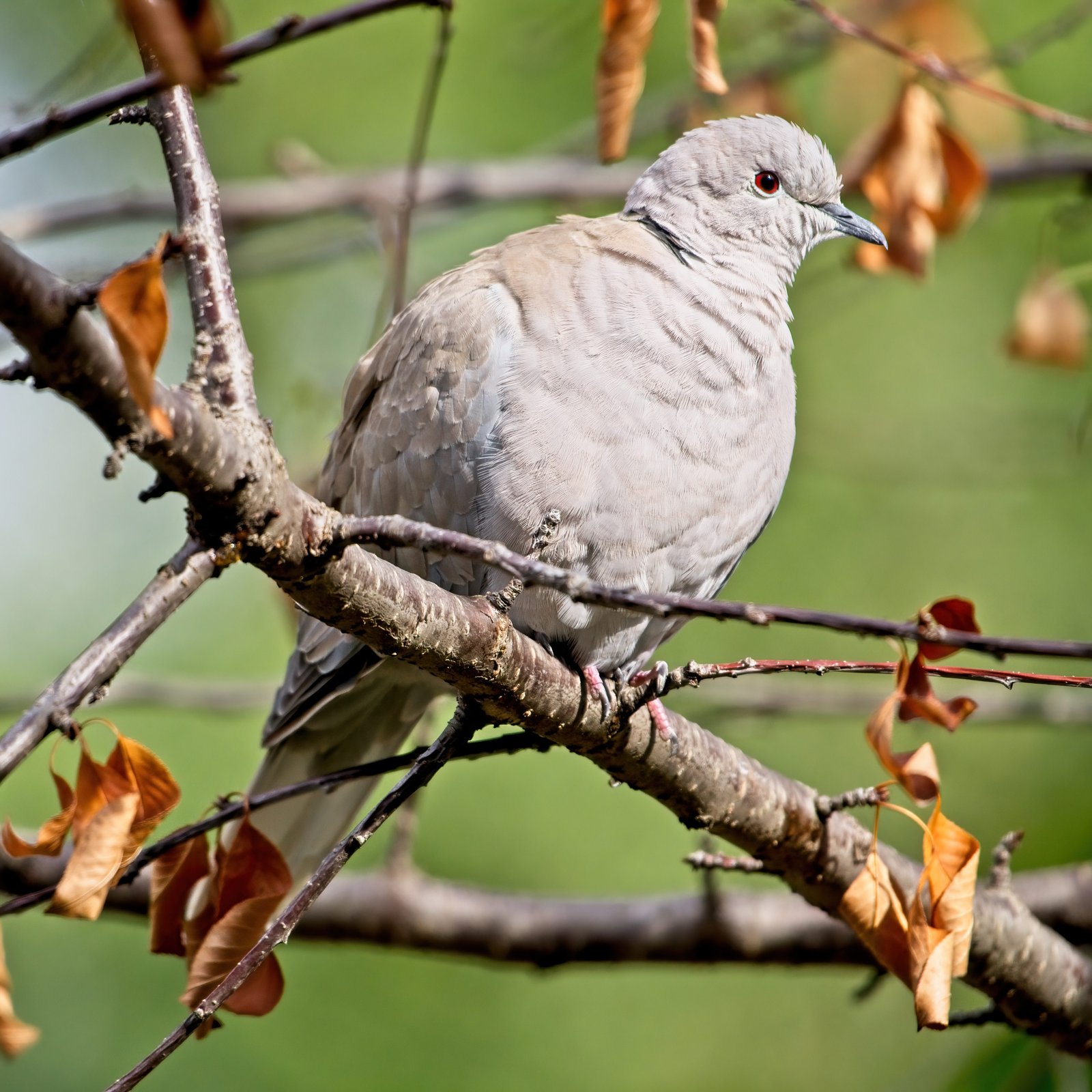
A pale, long-tailed dove with a narrow black neck band that spread from Turkey and the Levant across half of Europe in the twentieth century and has been colonising North Africa and the Arabian Peninsula since the 1980s. Now a fixture of towns, farmyards and palm groves.
Voice
A three-note, hollow coo stressed on the middle syllable, doo-DOOO-doo, repeated endlessly from roofs and aerials. In flight and on landing a nasal, plaintive krruu.
Recording: Mats Olsson — CC BY-NC-SA 4.0 · shortened to the first 60 s, mono · xeno-canto
Identification
Medium-sized, slender dove, uniform greyish-sandy with a slightly pinker head and breast and a narrow black, white-edged band on the nape. The primaries are dark and contrast with the pale wing coverts and a greyer panel. The long tail is black at the base below with a broad white outer half; the undertail coverts are grey. Red eye with a narrow white ring. Juveniles lack the neck band.
Confusion species
African Collared Dove (Streptopelia roseogrisea) is smaller and paler, with white undertail coverts, a stronger contrast between pale wing and dark primaries and a rolling, purring coo. Feral Barbary Doves, the domesticated form of African Collared Dove, are paler and creamier still. Laughing Dove (Spilopelia senegalensis) is smaller, more warmly coloured and has a spotted breast shield instead of a neck band.
Habitat
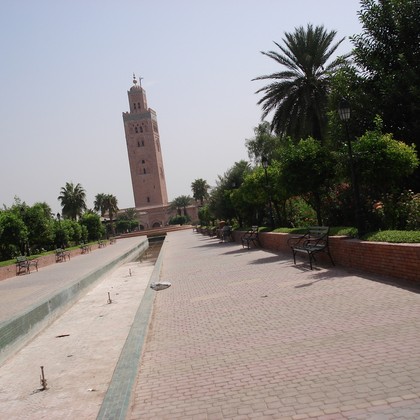
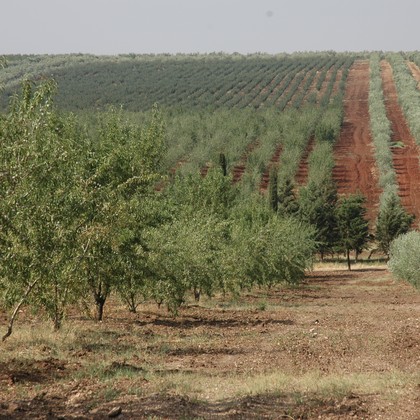
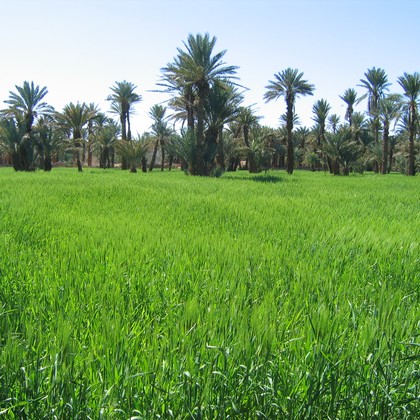
Towns, villages, parks, farmyards, grain stores, palm groves and orchards, often close to people. Avoids open desert, but follows irrigation schemes, roads and new settlements deep into arid areas.
Where the bird is most at home, classified by the habitats of North Africa and the Middle East.
Range and movements
Long-established resident in Iraq, Syria, Lebanon, Israel, Samaria and Judea and Jordan. Since the 1980s and 1990s it has spread across the Arabian Peninsula: now common in Kuwait, Bahrain, Qatar, the Emirates, Oman and much of Saudi Arabia, and local in Yemen; in the Gulf states partly derived from escaped birds. In Egypt established in Sinai and the Nile Delta. In the Maghreb a recent colonist: Morocco since 1986, then Algeria, Tunisia and western Libya, now in most northern towns and also in oases on the edge of the Sahara. Beyond the region from Europe through Turkey and Central Asia to India and China; introduced in North America and Japan.
- Resident
- Summer visitor (c. Apr–Sep)
- Winter visitor (c. Oct–Mar)
- Passage (Mar–Apr, Oct–Nov)
- dark = core range, pale = thinly spread
How and when to look
Eurasian Collared-Doves are easiest to find early in the morning, calling from a roof, lamp post or palm top. Where they occur alongside African Collared Doves, as in south-west Arabia, check the colour of the undertail and listen to the call.
Conservation status
Not globally threatened and one of the most striking range expansions among birds in the last century; still advancing in the region. It may locally displace Laughing Dove and African Collared Dove, but this is poorly studied.
Scientific name
Streptopelia decaocto | (Frivaldszky, 1838)
Frivaldszky described the species in 1838 as Columba decaocto; because it was later moved to another genus, the author and year stand in brackets. The genus Streptopelia was introduced in 1855 by Bonaparte. Streptopelia is Greek, from streptos 'collar, twisted chain' and peleia 'dove', after the dark neck collar of these doves. decaocto is Greek for 'eighteen', from deka 'ten' and oktō 'eight', a traditional rendering of the call; in a Greek tale a maid who earned only eighteen coins a year was turned into this dove. The specimen the first description was based on came from Turkey.