All species › Pigeons and doves › Pigeons and doves › Dusky Turtle Dove
Dusky Turtle Dove | Streptopelia lugens
Rouwtortel | Tórtola oscura
A dark, sturdy mountain dove of the juniper forests and terraced fields of south-west Arabia, the Arabian outpost of a species of the Ethiopian and East African highlands. One of the birds that make a visit to the Asir or the Yemeni highlands worthwhile.
Voice
A deep, slow and hoarse coo, krroo-oo… krroo-oo, often with a rolling start, lower and slower than other doves. Mostly heard in the morning from dense trees.
Recording: David Darrell-Lambert — CC BY-NC-SA 4.0 · converted to mono · xeno-canto
Identification
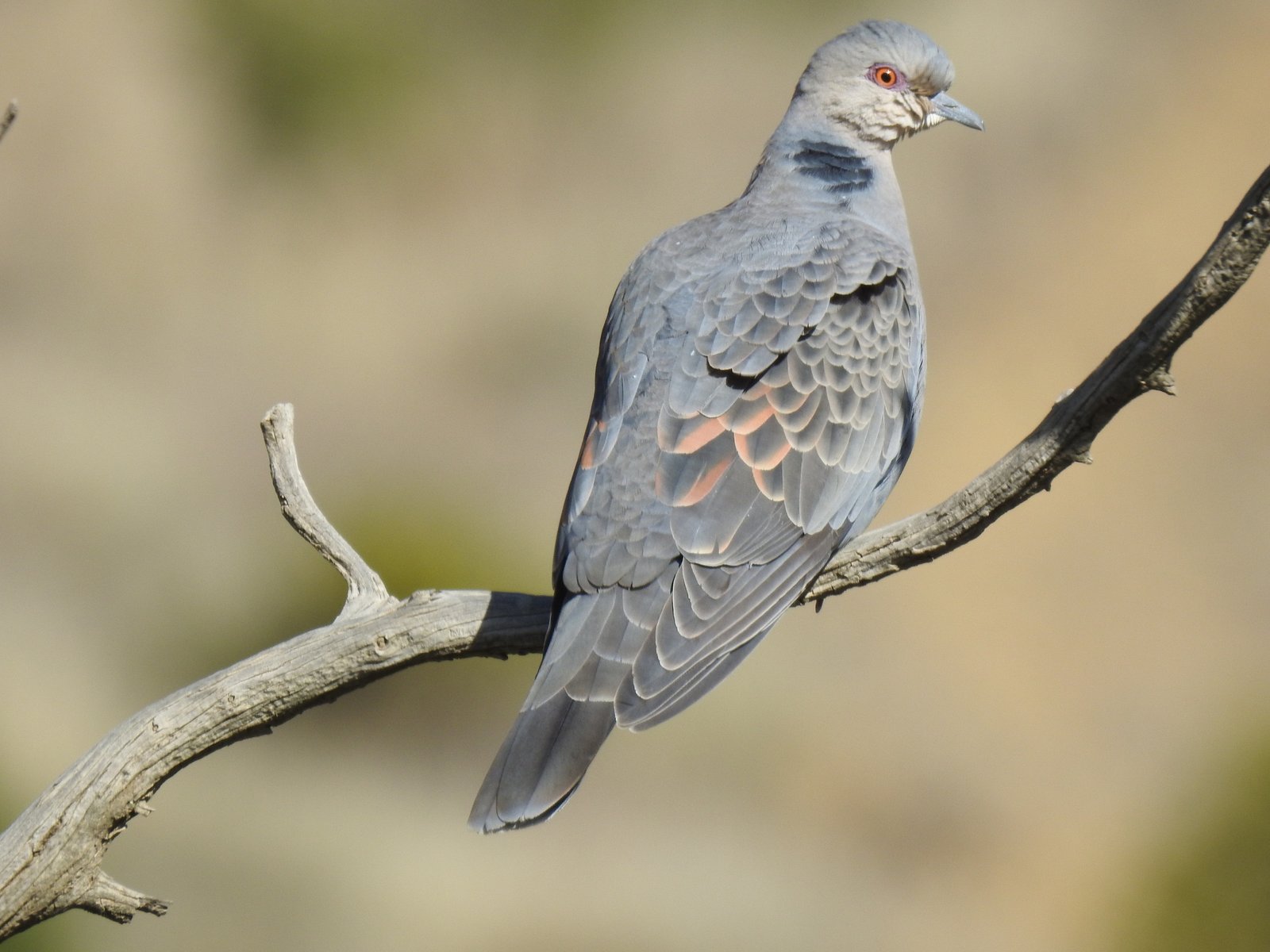
Large, dark dove with a grey head, a dark vinous-grey breast and a large black patch on the side of the neck, without white stripes. The upperwing coverts have blackish centres and broad rufous fringes, giving the wing a warm, coarsely scaled pattern. The tail is dark slate-grey with grey, not white, corners. Orange eye with a reddish eye-ring. Juveniles are browner and largely lack the neck patch.
Confusion species
European Turtle Dove (Streptopelia turtur) is smaller and slimmer, with black-and-white striped neck patches, a paler belly and a white tail tip; it may turn up in the same area on passage. Red-eyed Dove (Streptopelia semitorquata) has a narrow black neck band and a plain brown, unscaled wing. Oriental Turtle-Dove (Streptopelia orientalis) does not occur in south-west Arabia.
Habitat
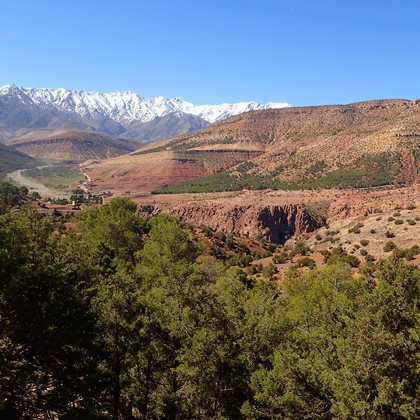
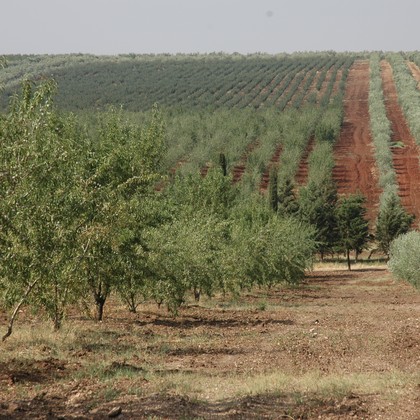
Juniper forest, acacia and olive woodland on mountain slopes, terraced fields with scattered trees and gardens around mountain villages, in Arabia mostly between about 1,500 and 3,000 metres. Feeds on the ground in fields and on tracks and seeks cover in dense trees.
Where the bird is most at home, classified by the habitats of North Africa and the Middle East.
Range and movements
In the region only in south-west Arabia: resident in the Asir mountains of Saudi Arabia, from around Taif and Al Baha southwards, and in the highlands of Yemen. Beyond the region in the highlands of Eritrea and Ethiopia and through East Africa south to Malawi; also isolated in Sudan.
- Resident
- Summer visitor (c. Apr–Sep)
- Winter visitor (c. Oct–Mar)
- Passage (Mar–Apr, Oct–Nov)
- dark = core range, pale = thinly spread
How and when to look
Drive a mountain road in the Asir early in the morning past juniper woods and terraced fields: the birds then sit on the road or on walls. Check a dove flying off for the tail: grey rather than white corners point to Dusky Turtle Dove.
Conservation status
Not globally threatened. In Arabia it depends on the highland woodlands, which are under pressure from felling, overgrazing and building; there it is still locally common.
Scientific name
Streptopelia lugens | (Rüppell, 1837)
Rüppell described the species in 1837 as Columba lugens; because it was later moved to another genus, the author and year stand in brackets. The genus Streptopelia was introduced in 1855 by Bonaparte. Streptopelia is Greek, from streptos 'collar, twisted chain' and peleia 'dove', after the dark neck collar of these doves. lugens is Latin for 'mourning' — for the dark, sombre plumage. The specimen the first description was based on came from Taranta Mountains and Simien, Ethiopia.