All species › Passerines › Larks › Dupont's Lark
Dupont's Lark | Chersophilus duponti
Duponts leeuwerik | Alondra ricotí
Dupont's Lark is one of the most sought-after species of North Africa: a shy, long-billed lark of flat dwarf-shrub steppe that prefers running to flying. By day it is hardly ever seen; before dawn and at night it betrays itself by its melancholy, whistling song. Most of the world population lives in the Maghreb.
Voice
The song is a slow, nasal, melancholy whistled phrase that first rises and then falls, something like hoo-hee-hooee, often repeated; it is given from a small shrub or high in the air, mainly at dusk and at night, and is hard to locate. The call is a nasal hoo-ee.
Recording: Pere Josa — CC BY-NC-SA 4.0 · converted to mono · xeno-canto
Identification
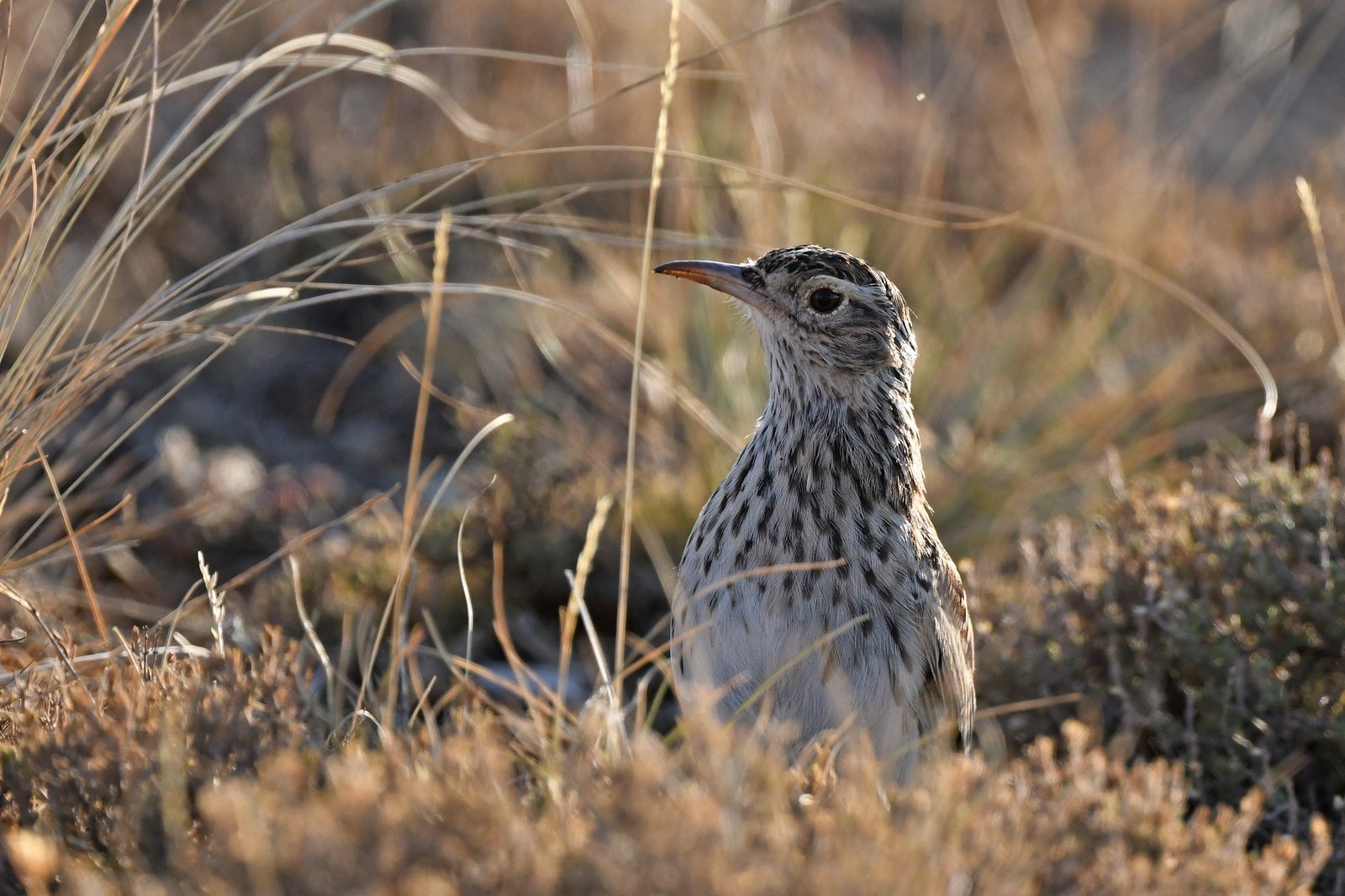
17–18 cm, a slim lark with a long, thin, slightly decurved bill, a fairly long neck and an upright stance on long legs. No crest. Upperparts scaly with pale feather fringes, breast densely streaked dark, belly white; narrow pale supercilium and pale central crown-stripe. The tail has white outer edges, the wing no white trailing edge. The nominate form in the northern Maghreb is grey-brown; the form margaritae of the northern Saharan fringe, from central Algeria to western Egypt, is paler and rufous above. Sexes alike.
Confusion species
Greater Hoopoe-Lark (Alaemon alaudipes) is much larger, with longer legs and tail, an unstreaked back and a striking black-and-white wing pattern in flight. Crested Lark (Galerida cristata) and Thekla's Lark (Galerida theklae) have a pointed crest and a shorter, thicker bill. Greater Short-toed Lark (Calandrella brachydactyla) is smaller, with a short conical bill and an unstreaked breast.
Habitat
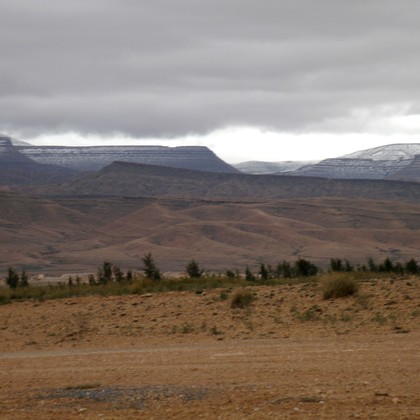
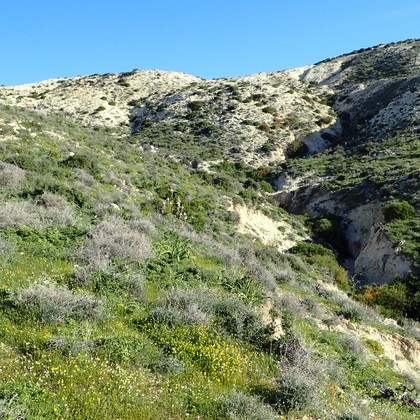
Flat to gently rolling steppe with low, open dwarf shrubs and tussock grasses, such as alfa steppe and Artemisia steppe on plateaux, and on the Saharan fringe semi-desert with scattered shrubs on sandy or gravelly soil. Avoids trees, tall shrubs and cultivation.
Where the bird is most at home, classified by the habitats of North Africa and the Middle East.
Range and movements
In Morocco it breeds on the plateaux of the east (around Missour, Tendrara and Bouarfa) and on the plains at the foot of the Middle and High Atlas, such as at Zeida and Midelt. In Algeria on the High Plateaux and the steppes on the northern edge of the Sahara, in Tunisia in the steppes of the centre and south. The form margaritae lives in the northern Sahara from central Algeria through southern Tunisia and northern Libya to the coastal desert of western Egypt, where it is rare and poorly known. Beyond the region it breeds only in Spain.
- Resident
- Summer visitor (c. Apr–Sep)
- Winter visitor (c. Oct–Mar)
- Passage (Mar–Apr, Oct–Nov)
- dark = core range, pale = thinly spread
How and when to look
In April–May go to the steppe around Tendrara or the Zeida plain in Morocco in the last hours of the night and listen for the whistling song. After sunrise it sings less and less; then scan with a telescope for a running, long-billed bird between the shrubs. Stay on the tracks: disturbance and trampling of the breeding grounds harm the species.
Conservation status
Vulnerable. The species is declining throughout its range through overgrazing, conversion of steppe to cropland, planting of shrubs and trees, and fragmentation; in Spain the population fell by a third between 2008 and 2018. The North African populations are much larger but poorly studied.
Scientific name
Chersophilus duponti | (Vieillot, 1824)
Vieillot described the species in 1824 as Alauda Duponti; because it was later moved to another genus, the author and year stand in brackets. The genus Chersophilus was introduced in 1890 by Sharpe. Chersophilus is Greek, from khersos 'dry, barren ground' and philos 'loving': a bird of arid plains. duponti honours the French naturalist and dealer in natural history specimens Léonard Puech Dupont (1796–1828). The specimen the first description was based on came from Provence.