All species › Waders, gulls and terns › Sandpipers and snipes › Dunlin
Dunlin | Calidris alpina
Bonte strandloper | Correlimos común
The yardstick for all small sandpipers and in winter the most numerous sandpiper of the North African mudflats. In dense, wheeling flocks it moves over the flats of the Gulf of Gabès, the Nile Delta and the Persian Gulf.
Voice
A rasping, somewhat nasal treeep, which from a flock taking off sounds like a rushing chorus. That grating tone separates it from the clear twick of Sanderling and the full chirrup of Curlew Sandpiper.
Recording: Christian Kerihuel — CC BY-NC-SA 4.0 · converted to mono · xeno-canto
Identification
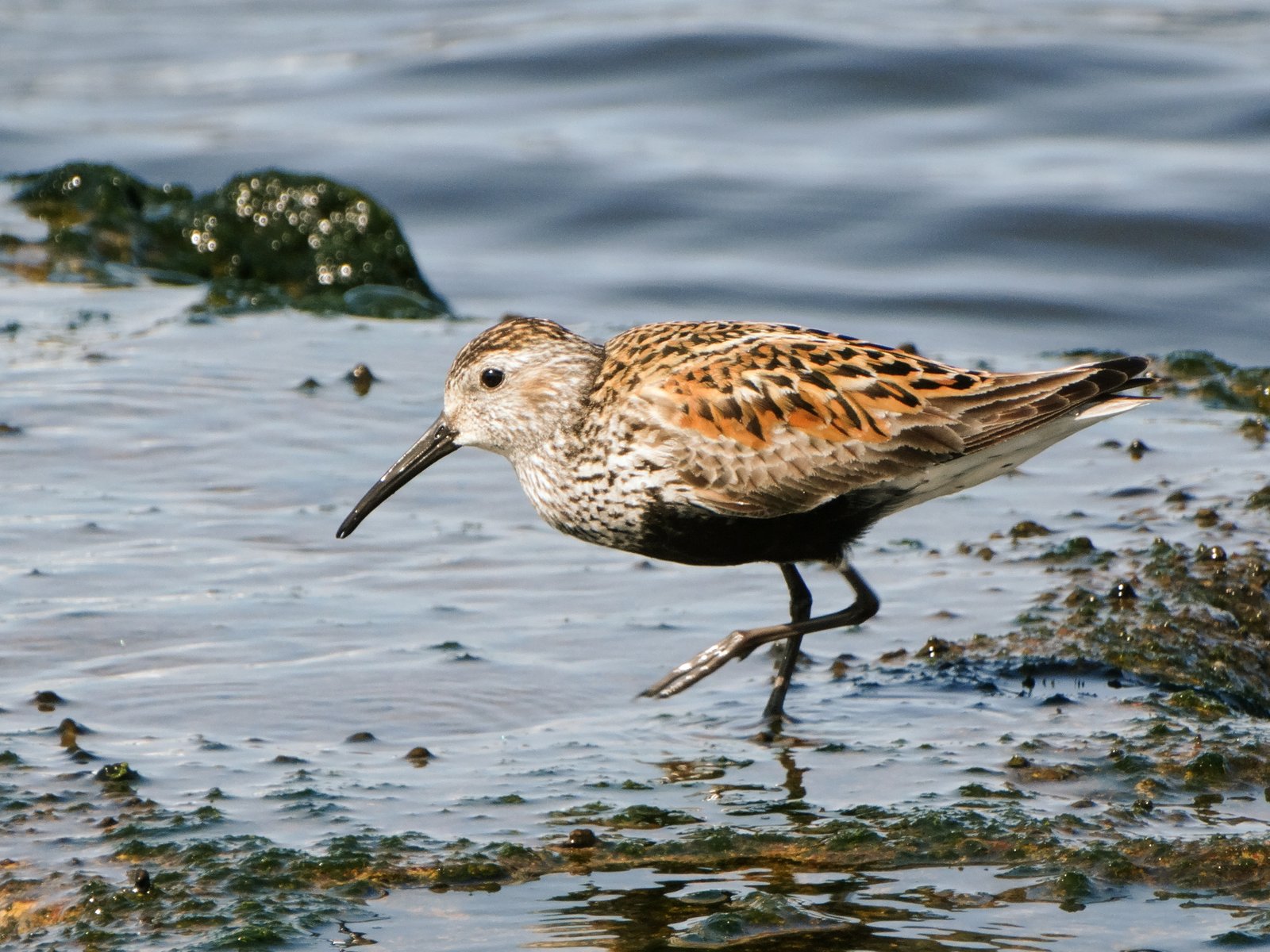
Compact, with black legs and a black bill that droops slightly towards the tip. In winter plumage plain grey-brown above with a finely streaked grey breast and white belly. In breeding plumage (from March–April, seen on spring passage) rufous-scaled upperparts and a large black belly patch, shown by no other sandpiper in the region. Juveniles are warm-brown scaled with black spots on the flanks. In flight a narrow white wing bar and a dark central stripe on rump and tail with white sides.
Confusion species
Curlew Sandpiper (Calidris ferruginea) is longer-legged and longer-billed, with an evenly decurved bill and an all-white rump. Broad-billed Sandpiper (Calidris falcinellus) is smaller, with a darker back, a double supercilium and a bill kinked at the tip. Sanderling (Calidris alba) in winter plumage is much whiter, shorter-billed and has a black carpal patch. Little Stint (Calidris minuta) and Temminck's Stint (Calidris temminckii) are clearly smaller, with a short, straight bill.
Habitat
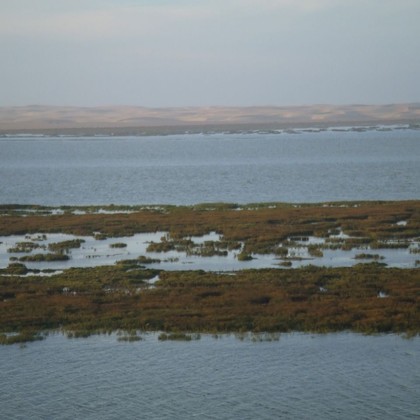
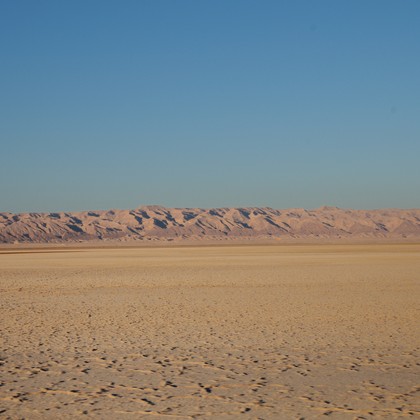
Mudflats and tidal flats, coastal lagoons, salt pans and sebkhas, where it feeds in fast-moving flocks, probing the soft mud like a sewing machine. On passage also at freshwater lakes, reservoirs, sewage ponds and oasis pools inland. At high tide it roosts in compact flocks.
Where the bird is most at home, classified by the habitats of North Africa and the Middle East.
Range and movements
Widespread on coasts and inland waters. In Morocco common on the Atlantic coast (Merja Zerga, Sidi Moussa, Oualidia, the Oued Massa estuary, Khnifiss and Dakhla Bay). The Gulf of Gabès in Tunisia, with the Kneiss islands and Bou Grara, is one of the most important wintering areas on the East Atlantic Flyway and holds tens of thousands. Also on the Algerian and Libyan lagoons, the Egyptian delta lakes (Manzala, Burullus, Bardawil) and along the coast of Israel. In Arabia common in the Gulf from Kuwait to the Emirates and in Oman (Barr al Hikman, Masirah, Khor Dhahariz), scarcer along the Red Sea and in Yemen. On passage at inland waters deep into the Sahara and the Arabian desert. Beyond the region it breeds on the tundra from Greenland and Iceland to Alaska and winters from western Europe and Africa to South Asia.
- Resident
- Winter visitor (c. Oct–Mar)
- Passage (Mar–Apr, Oct–Nov)
- dark = core range, pale = thinly spread
How and when to look
Visit the Gulf of Gabès or the Egyptian delta lakes on a rising tide in winter: the flocks then wheel over the flats, flashing white underparts and dark backs in turn. Scan a resting flock carefully: among the Dunlins there are often Curlew Sandpipers, Little Stints or a Broad-billed Sandpiper. In April–May black-bellied birds are easy to see at Eilat and in the Gulf.
Conservation status
Near Threatened. The world population is declining, mainly through loss and degradation of intertidal areas along the flyways. In the region the main threats are land reclamation and coastal development (especially in the Gulf), pollution and disturbance; the Gulf of Gabès and Barr al Hikman are of international importance.
Scientific name
Calidris alpina | (Linnaeus, 1758)
Linnaeus described the species in 1758 as Tringa alpina; because it was later moved to another genus, the author and year stand in brackets. The genus Calidris was introduced in 1804 by Merrem. Calidris goes back to Ancient Greek kalidris or skalidris, a name Aristotle used for an unidentified grey waterside bird. alpina is Latin for 'of high mountains'; here it refers to alpine tundra in general rather than to the Alps. The specimen the first description was based on came from Lapland.