All species › Passerines › Cisticolas › Delicate Prinia
Delicate Prinia | Prinia lepida
Oostelijke gestreepte prinia | Prinia delicada
The Delicate Prinia is the eastern sibling species of the Graceful Prinia, only recently recognised as a separate species on the basis of DNA and song. In the region it lives in Mesopotamia and around the Persian Gulf, where it has spread strongly in a few decades and is now common in the gardens and parks of Kuwait, Qatar and the Emirates.

Voice
The song is a fast, grating series, zrit-zrit-zrit-zrit, at four to five phrases per second with buzzy filler notes, like a continuous rattling reel. The calls, a dry chit and a purring trrrt, are the same as those of Graceful Prinia.
Recording: Gregory Askew — CC BY-NC-SA 4.0 · shortened to the first 60 s, mono · xeno-canto
Identification
10–11 cm. Pale grey-brown to sandy above with fine dark streaks on the crown and mantle, off-white below with warm buff flanks; Gulf birds are often paler and warmer than Iraqi ones. Long, graduated tail, usually distinctly finely barred above, from below with narrow, faint dark bands before the white tips. Head rather plain with pale lores and an orange-yellow eye. Sexes alike.
Confusion species
Graceful Prinia (Prinia gracilis) is barely separable in the field: from below it has larger, darker, round tail spots, an often less barred uppertail and a slower, more rhythmic song; the two meet in eastern Saudi Arabia and Qatar. Zitting Cisticola (Cisticola juncidis) is more heavily streaked with a short tail.
Habitat
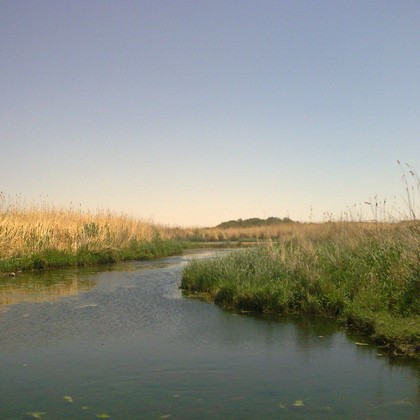
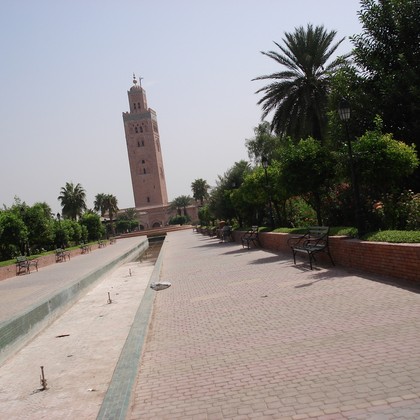
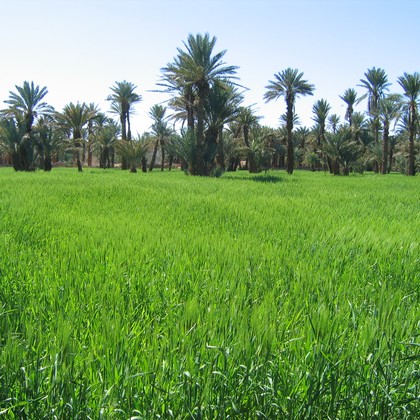
Reeds and tamarisk along rivers, canals and marshes, fields and date-palm gardens, and in the Gulf states above all irrigated gardens, parks, golf courses and roadside verges in cities; also mangroves and coastal scrub. Eats small insects. The domed nest is placed low in a bush or grass tussock.
Where the bird is most at home, classified by the habitats of North Africa and the Middle East.
Range and movements
Common in Iraq in Mesopotamia and the marshes, along the Euphrates also in eastern Syria. Colonised Kuwait in the 1990s and spread along the Gulf coast into north-eastern Saudi Arabia (Khafji, Jubail, Qatif to Dhahran). Common in the United Arab Emirates and northern Oman (its own subspecies), and in eastern and central Qatar. Beyond the region in south-eastern Turkey, Iran, Turkmenistan, Afghanistan, Pakistan and north-western India.
- Resident
- Summer visitor (c. Apr–Sep)
- Winter visitor (c. Oct–Mar)
- Passage (Mar–Apr, Oct–Nov)
- dark = core range, pale = thinly spread
How and when to look
Found in almost any city park or irrigated green space in Dubai, Abu Dhabi, Doha or Kuwait City. Record the song: the fast, grating rhythm is the best feature against Graceful Prinia.
Conservation status
Not (yet) assessed by the IUCN as a separate species; BirdLife taxonomy includes it in Graceful Prinia, which is not threatened. In the region common and increasing thanks to greening and irrigation.
Scientific name
Prinia lepida | Blyth, 1844
Blyth described the species in 1844 and placed it straight away in the genus where it still stands. The genus Prinia was introduced in 1821 by Horsfield. Prinia comes from prinya, the Javanese name for Prinia familiaris, the prinia of that island. lepida is Latin for 'elegant, charming'. The specimen the first description was based on came from Sindh, Pakistan.