All species › Pelicans, herons and ibises › Pelicans › Dalmatian Pelican
Dalmatian Pelican | Pelecanus crispus
Kroeskoppelikaan | Pelícano ceñudo
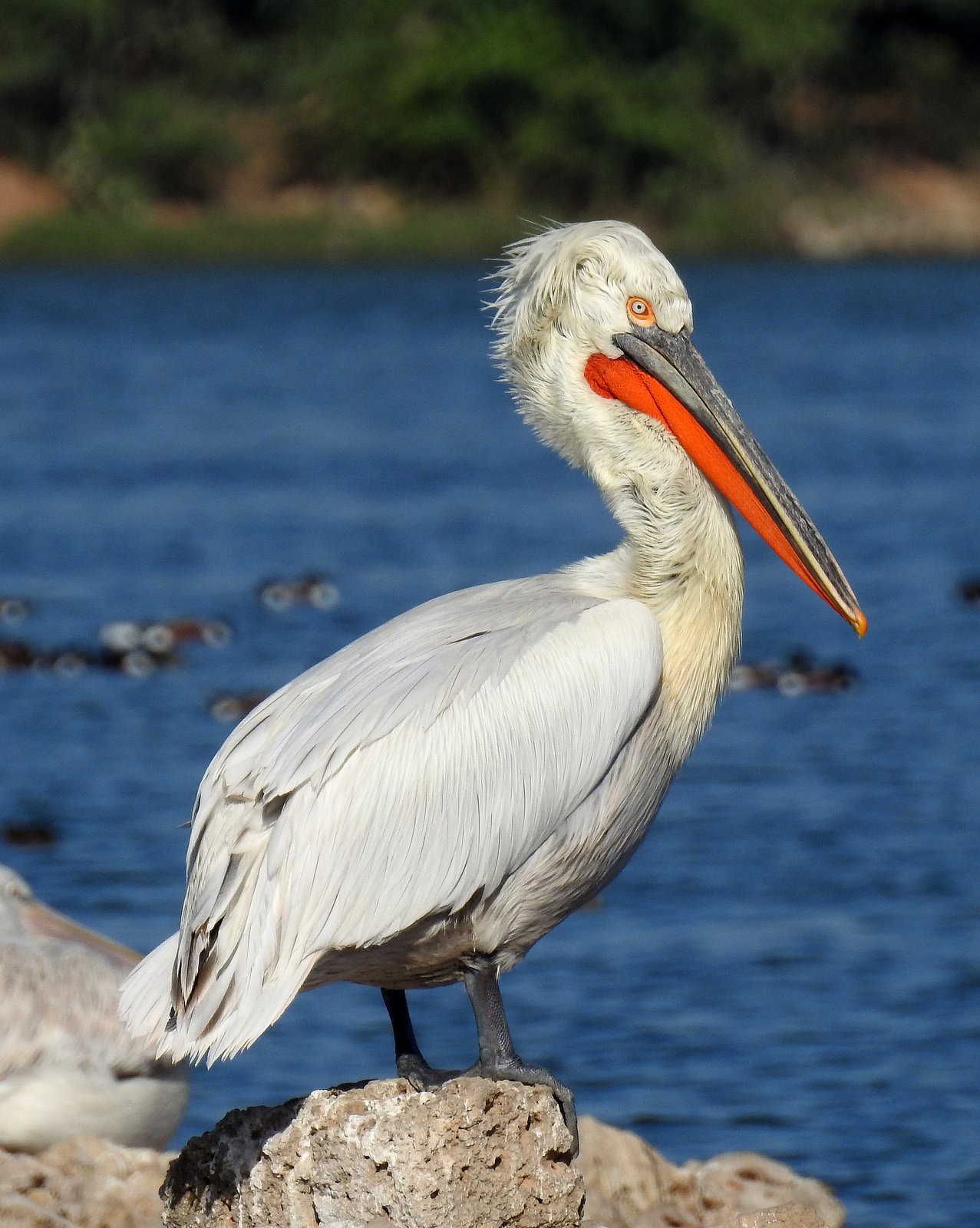
The largest pelican and one of the heaviest flying birds in the world, silvery grey with a curly crest. It breeds from the Balkans to Mongolia and reaches the region in winter: regularly in small numbers in the marshes of Iraq, and beyond that as a rare vagrant as far as Israel, the Gulf states and Oman.
Voice
Silent away from the breeding colony; at the colony a low, hoarse barking and hissing growl.
No recording with a suitable Creative Commons licence is available for this species yet.
Identification
Enormous and heavily built, with silvery grey-white plumage and a curly, untidy crest on the head and nape. The pouch is orange-red in the breeding season, yellowish otherwise; the eye is pale with a small area of bare yellowish skin around it, and the legs are grey. In flight the underwing is dirty white to pale grey, with only the primaries and a narrow trailing edge dark. Juveniles are greyish white with a brown-grey upper wing and a pale pouch.
Confusion species
Great White Pelican (Pelecanus onocrotalus) is whiter with a pink tinge, pink to orange legs, a bare face around the eye and an underwing on which the all-black primaries and secondaries contrast sharply with the white coverts; juveniles of that species also show dark secondaries below. Pink-backed Pelican (Pelecanus rufescens) is much smaller and greyer with a dark spot in front of the eye.
Habitat
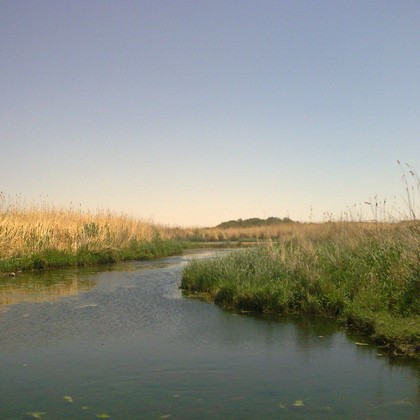
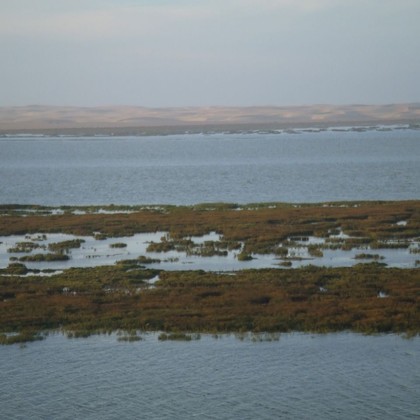
Large marshes, lakes, river deltas, fishponds and shallow coastal lagoons. Usually fishes alone or in small groups, not in large coordinated groups like Great White Pelican. Migrates less far than Great White Pelican and winters on the nearest ice-free waters.
Where the bird is most at home, classified by the habitats of North Africa and the Middle East.
Range and movements
In the region mainly a scarce winter visitor to the marshes of Iraq; a chick from the Shatt al-Arab area in the early twentieth century suggests former breeding. In Egypt it was a winter visitor to the Nile Delta in the nineteenth century; now very rare there. Elsewhere a rare vagrant, mainly November – April: in Israel some twenty records, mostly in the 1980s and in the Hula Valley; in Kuwait about ten records, including Sulaibikhat Bay, Bubiyan and Al Jahra; in the United Arab Emirates a few records since 1970, including Ras al Khor and Kalba Dam (2021); in Oman a few birds at Shinas and Al Ansab (2005 – 2006), in Dhofar (2021 – 2022) and at Qurayyat (2024); further a few old records from Lebanon and one from Bahrain (1999). Practically unknown in the Maghreb. Beyond the region it breeds from Greece, Albania and Montenegro via the Danube Delta, Turkey and the Caspian to Mongolia, and winters in Greece, Turkey, Iran, Pakistan and India.
- Resident
- Summer visitor (c. Apr–Sep)
- Winter visitor (c. Oct–Mar)
- Passage (Mar–Apr, Oct–Nov)
- dark = core range, pale = thinly spread
How and when to look
In winter search the marshes of southern Iraq (Hammar, Hawizeh) or, as a vagrant, the Hula Valley among the Great White Pelicans; look there for a greyer bird with an untidy crest and grey legs. In the Gulf states vagrants sometimes stay for weeks or months on the same lagoon or reservoir.
Conservation status
Near Threatened. After a steep decline in the twentieth century through drainage, persecution by fishermen and collisions with power lines, the species has increased thanks to protection of the colonies in Greece and the Danube Delta; in 2017 its status was lowered from Vulnerable to Near Threatened. Avian influenza caused heavy mortality in the Greek colonies in 2022. In the region it depends on the marshes of Iraq, which are under pressure from drought and water abstraction.
Scientific name
Pelecanus crispus | Bruch, 1832
Bruch described the species in 1832 and placed it straight away in the genus where it still stands. The genus Pelecanus was introduced in 1758 by Linnaeus. Pelecanus is the Latin form of the Greek pelekan 'pelican', which itself derives from pelekys 'axe'. crispus is Latin for 'curly', for the ruffled feathers on the nape. The specimen the first description was based on came from Dalmatia.