All species › Passerines › Leaf warblers › Brown Woodland Warbler
Brown Woodland Warbler | Phylloscopus umbrovirens
Rüppells boszanger | Mosquitero oscuro
The Brown Woodland Warbler is an African leaf warbler that in the region occurs only in the highlands of south-western Arabia, as the endemic form yemenensis. There it is a common resident of juniper woodland and vegetated mountain slopes, and the only leaf warbler singing there all year round.

Voice
The song is a short, sweet, somewhat descending phrase of clear whistles and trills, roughly tsee-tsee-choo-choo-choo, often repeated and heard all year. The call is a hard chik or a soft tweet.
Recording: Zsombor Károlyi — CC BY-NC-SA 4.0 · converted to mono · xeno-canto
Identification
11–12 cm. A leaf warbler with a warm brown instead of green tone: upperparts olive-brown to earth-brown, underparts off-white with a warm buff to ochre wash on breast and flanks. The wing and tail feathers have conspicuous bright olive-green edges, giving a greenish wing that contrasts with the brown back. Pale buff supercilium and a dark eye-stripe; no wing-bar. Bill dark with a paler base to the lower mandible, legs brown. Sexes alike.
Confusion species
Common Chiffchaff (Phylloscopus collybita), also in the Arabian mountains in winter, is greener olive above, whiter below, with dark legs and a short supercilium, and dips its tail more. Willow Warbler (Phylloscopus trochilus), a passage migrant, is greener and yellower and has a longer wing. Mountain Chiffchaff (Phylloscopus sindianus) does not occur here.
Habitat
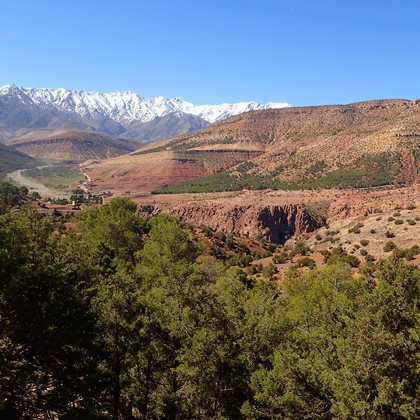
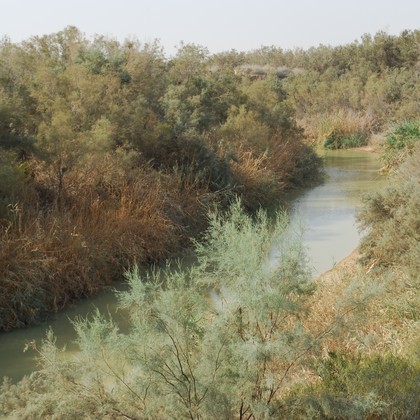
Juniper woodland, acacia woodland and dense scrub on mountain slopes and in vegetated wadis, mostly between 1500 and 3000 m, also in gardens and terraces with trees. Gleans insects among leaves and shrubs, often low down.
Where the bird is most at home, classified by the habitats of North Africa and the Middle East.
Range and movements
Resident in the mountains of south-western Saudi Arabia (Asir and Hejaz, from Taif south via Al Baha and Abha to the Yemeni border) and in the western highlands of Yemen. Not known from Oman. Beyond the region the species occurs in the mountains of East Africa, from Eritrea and Ethiopia through Somalia, South Sudan, Uganda and Kenya to eastern Congo and Tanzania.
- Resident
- Summer visitor (c. Apr–Sep)
- Passage (Mar–Apr, Oct–Nov)
- dark = core range, pale = thinly spread
How and when to look
In the juniper woodland around Abha, Al Soudah or Taif its sweet song can be heard almost all year; look for a brown leaf warbler with green wing edges, low in the bushes.
Conservation status
Not globally threatened. In Arabia locally vulnerable to juniper dieback caused by drought, felling and overgrazing.
Scientific name
Phylloscopus umbrovirens | (Rüppell, 1840)
Rüppell described the species in 1840 as Sylvia (Ficedula) umbrovirens; because it was later moved to another genus, the author and year stand in brackets. The genus Phylloscopus was introduced in 1826 by Boie. Phylloscopus is Greek, from phullon 'leaf' and skopos 'seeker', from skopeō 'to watch': the bird that searches the foliage. umbrovirens is Latin for 'dusky green', from umbra 'shade' and virens 'green'. The specimen the first description was based on came from Simien, Ethiopia.