All species › Passerines › Chats and flycatchers › Blackstart
Blackstart | Oenanthe melanura
Zwartstaart | Colinegro común
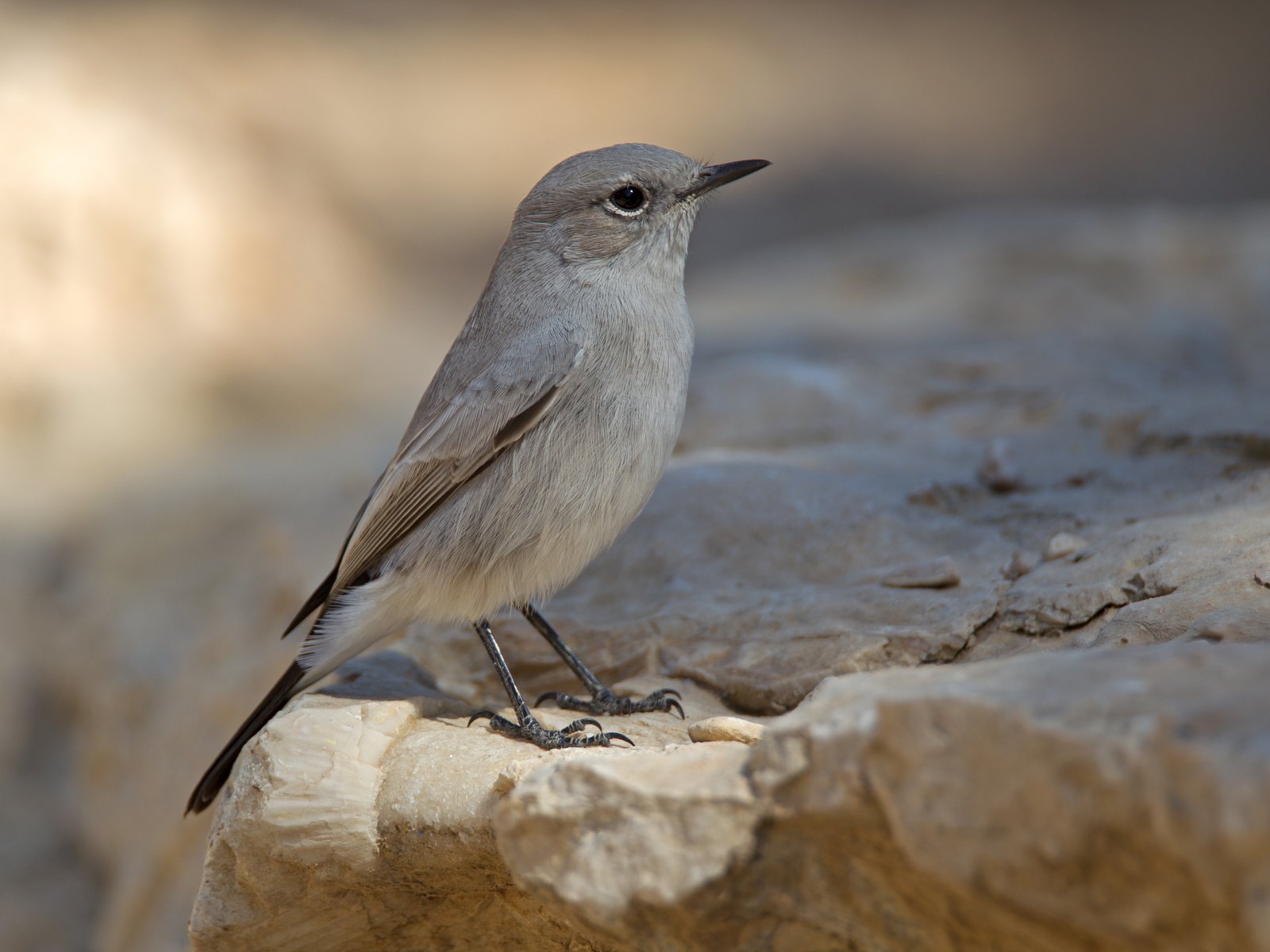
The Blackstart is a small, unobtrusively grey bird of rocky desert gorges, which gives itself away by constantly fanning its all-black tail. It is a resident of the desert mountains of Egypt, the Levant and Arabia.
Voice
The song is a clear, somewhat melancholy whistled phrase of a few short, repeated notes with pauses, for instance chee-choo, chee-choo, often from a boulder or acacia top. Snatches of song also serve as calls; also a soft chak.
Recording: Sven Normant — CC BY-NC-SA 4.0 · converted to mono · xeno-canto
Identification
14–15 cm. Slim and upright, with a fine black bill and black legs. The whole body is plain grey: ash-grey above, paler grey to off-white on the belly below. Wings dark grey-brown. Rump and tail entirely black, without any white. The behaviour is typical: after landing it fans the tail and droops the wings, again and again. Sexes alike. The form neumanni of south-western Arabia and Oman is warmer, browner grey.
Confusion species
The female Black Redstart (Phoenicurus ochruros) has a rufous tail and rump. Little Rock Thrush (Monticola rufocinereus) of the Asir and Yemen highlands is larger, with an orange-red belly and rufous tail sides. Young White-crowned Wheatears (Oenanthe leucopyga) and Mourning Wheatears (Oenanthe lugens) have a white rump.
Habitat
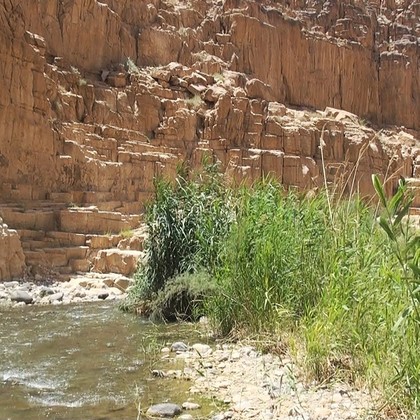
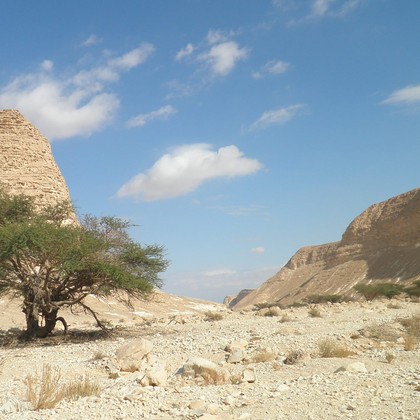
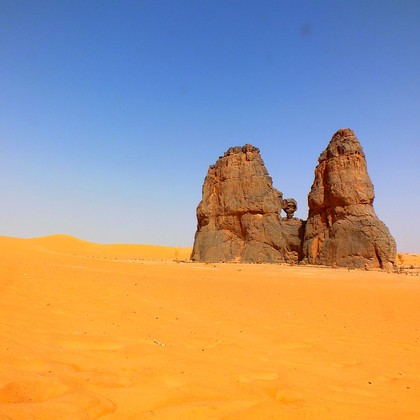
Rocky wadis, gorges and mountain slopes in the desert with scattered acacias and shrubs, up into the high mountains of Asir and Yemen; also at springs and oases in rocky terrain. Not shy.
Where the bird is most at home, classified by the habitats of North Africa and the Middle East.
Range and movements
Common in the Eastern Desert of Egypt, the Red Sea mountains to Gebel Elba and in Sinai; in Israel in the Negev, the Arava and around the Dead Sea, scarcer north in the Jordan Valley; in Jordan in the west, from the Jordan Valley and the Dead Sea to the Arava and the mountains near Aqaba. In Saudi Arabia in the Hejaz and Asir and in rocky parts of the central plateau; further in Yemen and Oman (mainly Dhofar). Poorly known in south-eastern Algeria and southern Libya, at most very local on the edge of the Sahelian mountains. Beyond the region in the Sahel and the Horn of Africa, from Mali to Somalia.
- Resident
- Winter visitor (c. Oct–Mar)
- Passage (Mar–Apr, Oct–Nov)
- dark = core range, pale = thinly spread
How and when to look
In the gorges of Ein Gedi, Petra or Wadi Rum and at Sharm el-Sheikh: it lets people come close. Look for a small grey bird that fans its black tail each time it lands.
Conservation status
Not globally threatened and common in most rocky deserts of the region; sometimes benefits from irrigation and gardens in tourist resorts.
Scientific name
Oenanthe melanura | (Temminck, 1824)
Temminck described the species in 1824 as Saxicola melanura; because it was later moved to another genus, the author and year stand in brackets. The genus Oenanthe was introduced in 1816 by Vieillot. Oenanthe was used by Aristotle for a bird that can no longer be identified; the word comes from the Greek oinos, oinoē 'wine, vine' and anthos 'flower, bloom'. melanura comes from Classical Greek melanouros 'with a black tail', from melas 'black' and oura 'tail'. The specimen the first description was based on came from the Sinai Peninsula.