All species › Waders, gulls and terns › Avocets and stilts › Black-Winged Stilt
Black-Winged Stilt | Himantopus himantopus
Steltkluut | Cigüeñuela común
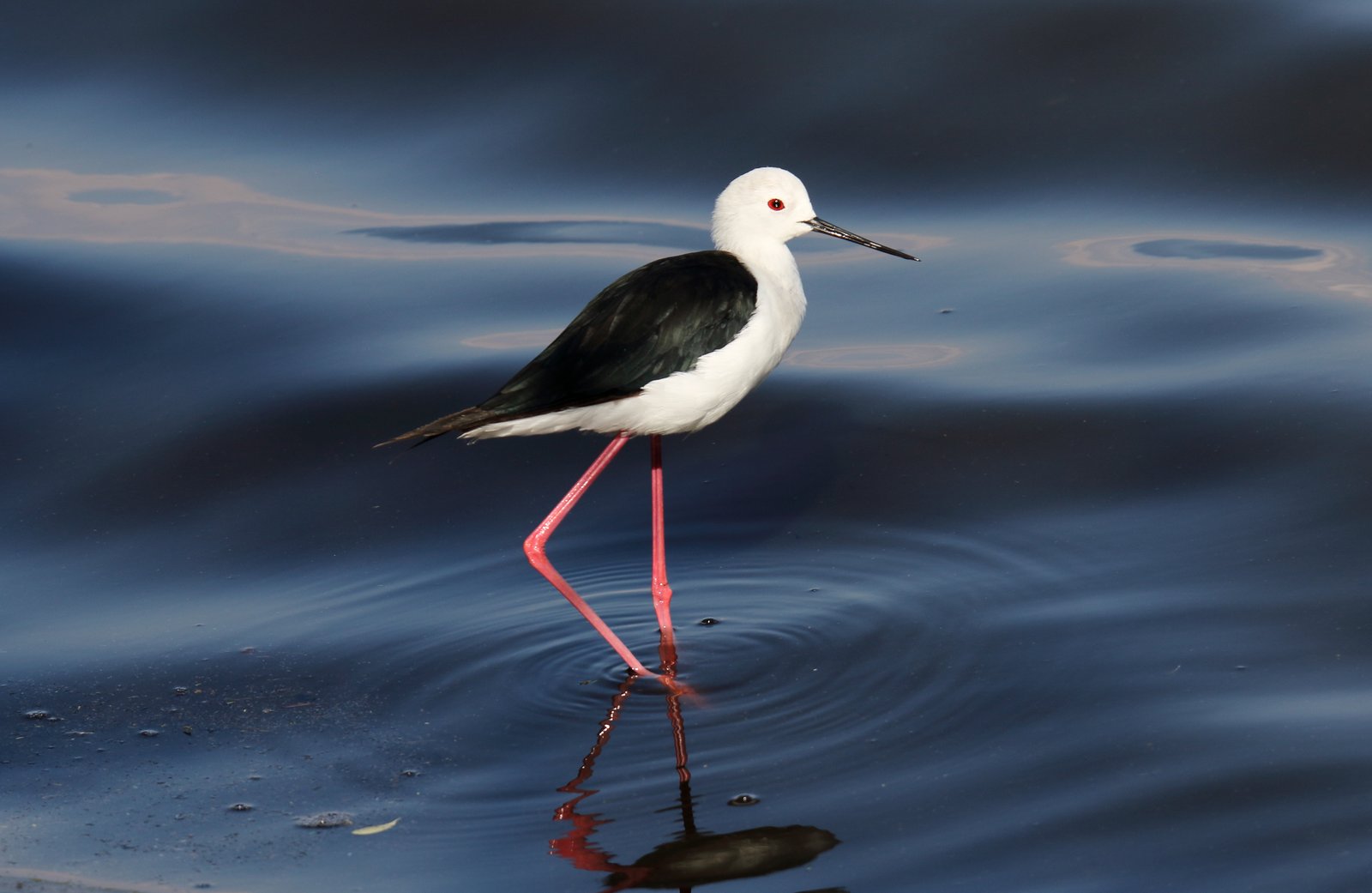
The wader with proportionately the longest legs of any bird, and one of the most widespread waterbirds of the region. From the Moroccan merjas to the sewage ponds of Riyadh and the lagoons of Oman it breeds wherever there is shallow water, including artificial water in the middle of the desert.
Voice
A sharp, yapping kek or kyek, often in quick series; at the nest a shrill, persistent kik-kik-kik and a high, nasal kreeh, as the birds hover loudly alarming over an intruder.
Recording: Swann Terrier — CC BY-NC-SA 4.0 · converted to mono · xeno-canto
Identification
Slim and finely built with extremely long, thin pink to red legs, a straight, needle-fine black bill and a small round head. Upperwing and back are black (glossed green in the male, browner black in the female), the underparts white. The head pattern varies: from all white to a grey or black cap and hindneck, especially in males in summer. Juveniles have grey-brown upperparts with pale fringes, a white trailing edge to the wing and duller, orange-pink legs. In flight: all-black, pointed wings, a white V on the back and legs projecting far beyond the tail.
Confusion species
With its long pink legs and pied plumage it is hard to mistake. Pied Avocet (Recurvirostra avosetta) is larger, with an upturned bill, blue-grey legs and much white in the wing. Marsh Sandpiper (Tringa stagnatilis) and Common Redshank (Tringa totanus) are also long-legged, but are grey-brown and lack the contrast between black wings and white underparts.
Habitat
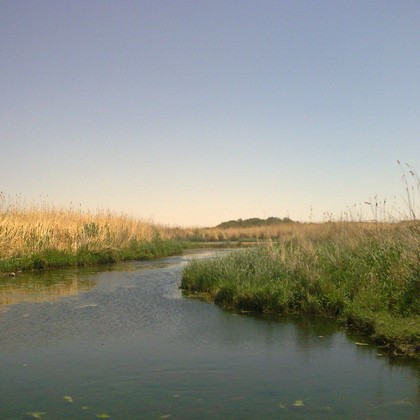
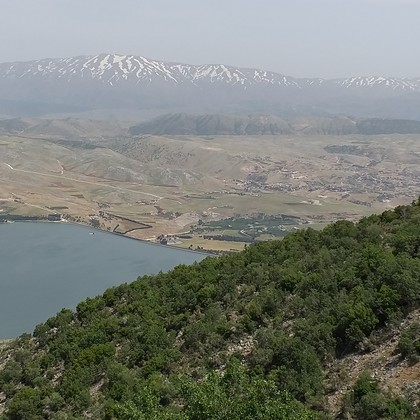
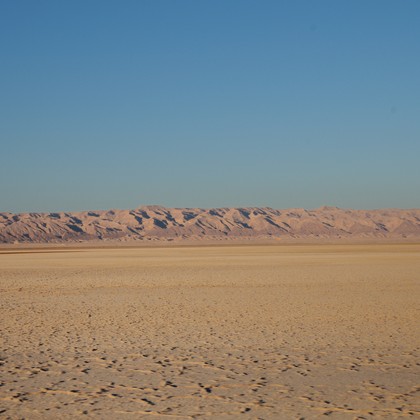
Shallow fresh, brackish and salt water with bare or sparsely vegetated margins: marshes, flooded meadows, rice fields, fish ponds, salt pans, chotts, coastal lagoons and sewage ponds. It benefits greatly from artificial water in the desert, such as irrigation reservoirs and settling ponds. Breeds in loose colonies on islets, bunds and dried-out mud.
Where the bird is most at home, classified by the habitats of North Africa and the Middle East.
Range and movements
Breeds in almost the whole region wherever suitable water exists. Morocco, Algeria and Tunisia: common in coastal wetlands, chotts and reservoirs, mainly as a summer visitor. Libya and Egypt: scattered along the coast, numerous in the Nile Delta, along the Nile and in the Faiyum; in Egypt also in winter. In the east it breeds in Israel, Jordan, Syria, Lebanon and the marshes of Iraq, and in Arabia patchily in Kuwait, Bahrain, Qatar, the Emirates, Oman, Saudi Arabia (mainly at sewage ponds and irrigation schemes) and Yemen; present year-round in the south. A common passage migrant across the Sahara, along the Nile and through the Jordan Valley. Beyond the region it breeds in southern Europe, sub-Saharan Africa and from Central Asia to India; European birds winter in West Africa.
- Resident
- Summer visitor (c. Apr–Sep)
- Winter visitor (c. Oct–Mar)
- Passage (Mar–Apr, Oct–Nov)
- dark = core range, pale = thinly spread
How and when to look
In Egypt it can be seen all year on the rice fields and fish ponds of the Nile Delta and in the Faiyum. In the Gulf states and Saudi Arabia, sewage ponds and irrigation reservoirs are the best sites; it sometimes breeds in the middle of cities. In April and August the fish ponds of the Hula Valley and Beit She'an in Israel are good for flocks of migrants.
Conservation status
Not globally threatened and common. In Arabia it has expanded strongly thanks to sewage treatment, irrigation and artificial lakes. Elsewhere in the region it suffers from drainage of marshes, disturbance and fluctuating water levels, which can cause whole colonies to fail; it is hunted locally.
Scientific name
Himantopus himantopus | (Linnaeus, 1758)
Linnaeus described the species in 1758 as Charadrius Himantopus; because it was later moved to another genus, the author and year stand in brackets. The genus Himantopus was introduced in 1760 by Brisson. Himantopus is Greek, from himas 'strap, thong' and pous 'foot': 'strap-foot', after the long thin legs. The specific name repeats the genus name. The specimen the first description was based on came from southern Europe.