All species › Passerines › Bearded reedlings › Bearded Reedling
Bearded Reedling | Panurus biarmicus
Baardmannetje | Bigotudo
An orange-brown, long-tailed reedbed bird, the only member of its own family. In the region it is a rare vagrant that in some years turns up in large reedbeds after an irruption from Europe and Turkey; no breeding population is known.
Voice
The call is the key: a clear, metallic, slightly nasal ping or tching, often in short series and from several birds at once. Also a dry, rattling tchrrr. There is hardly any song.
Recording: Paul Kelly — CC BY-NC-SA 4.0 · shortened to the first 60 s, mono · xeno-canto
Identification
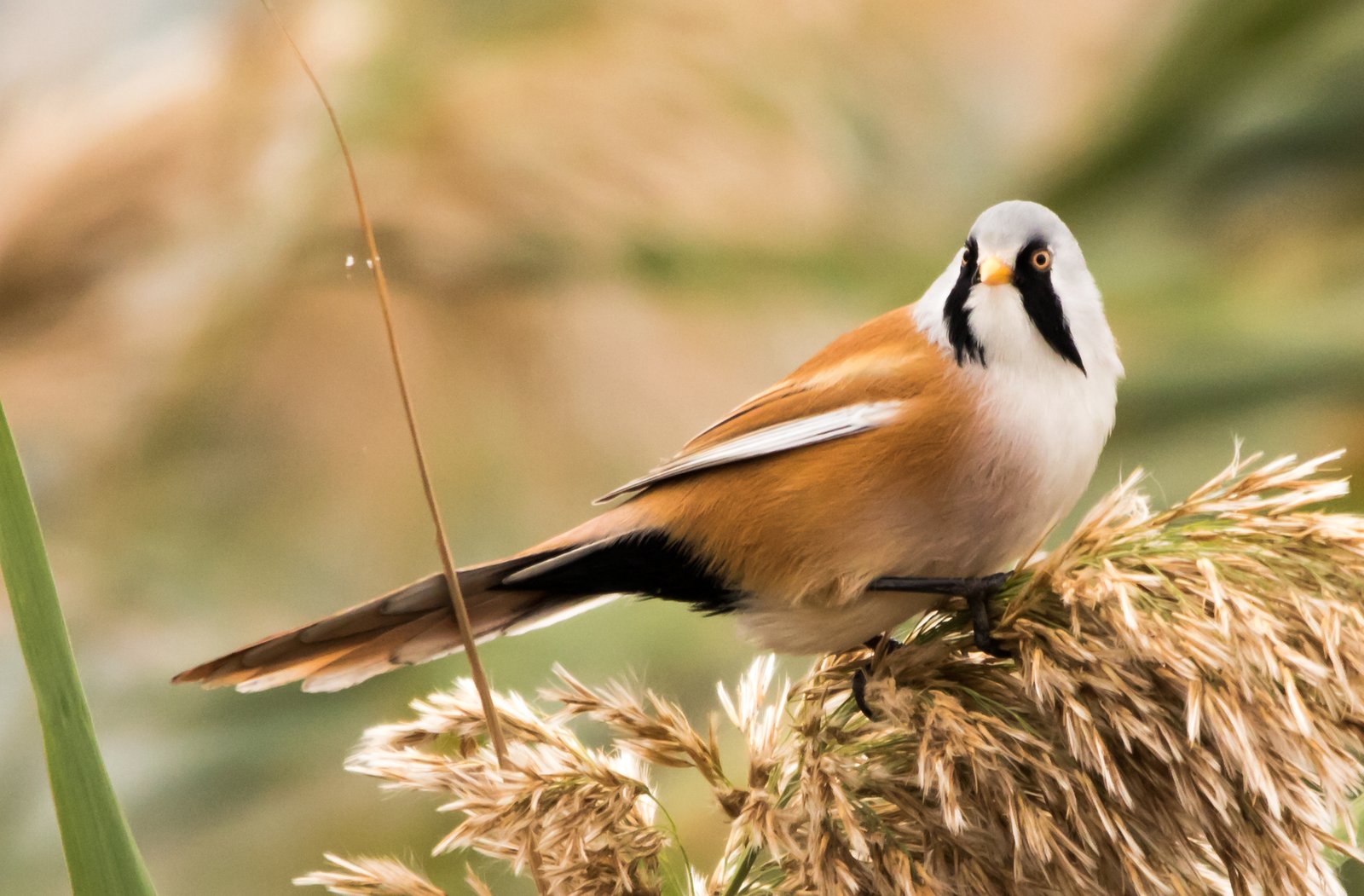
14–15.5 cm, almost half of it tail. Small body with a very long, graduated tail and warm ochre-brown to cinnamon upperparts. The male has a blue-grey head, a yellow bill, a yellow eye and a broad, drooping black moustache, and black undertail coverts. The female lacks the grey head and moustache and is plain ochre-brown with pale undertail coverts. Juveniles have a black back and black tail sides. Flight weak and whirring, low over the reeds, with the tail trailing behind.
Confusion species
Hard to confuse in reeds. Reed Bunting (Emberiza schoeniclus) shares the habitat but is streaked, with a shorter tail and a conical bill. Iraq Babbler (Argya altirostris) of the Mesopotamian marshes is also brown and long-tailed, but larger, grey-brown and without a moustache. Eurasian Penduline-Tit (Remiz pendulinus) has a black mask, a short tail and a chestnut back.
Habitat
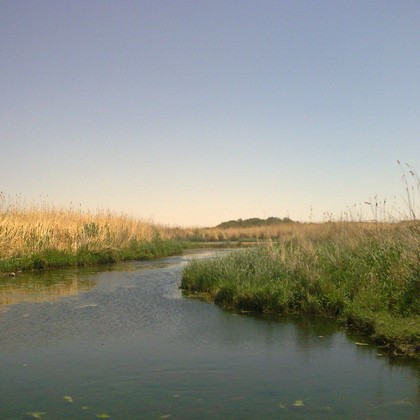
Extensive old reedbeds with a layer of dead stems along fresh and brackish water: marshes, lake shores, reed fringes of salt lakes and sewage ponds. Eats insects in summer and mainly reed seeds in winter.
Where the bird is most at home, classified by the habitats of North Africa and the Middle East.
Range and movements
Very rare in the region. In Israel a few irruptions: a flock that stayed in the Hula Valley Nature Reserve in the winter of 1995–1996, and in November 2024 a flock in the Be'er Sheva park and the old sewage ponds of Be'er Sheva. In Syria seen repeatedly since 2006 at the Jabbul salt lake near Aleppo, also in spring and May, so breeding there cannot be ruled out. In Morocco a few old records, including near Fès (1929) and at the mouth of the Oued Massa (1987 and 1991). Also reported from Kuwait. The nearest breeding area is in Turkey; the dark subspecies kosswigi of Lake Amik in Hatay, close to the Syrian border, has not been seen since 1962 and disappeared after the lake was drained. Beyond the region it breeds from western Europe to Central Asia and north-east China.
How and when to look
The best chance is in October–January in large reedbeds in the northern Levant. Listen for the metallic ping: that is usually all that gives a party away before it shoots off low over the reeds. Report any sighting to the national rarities committee.
Conservation status
Not globally threatened, but in the region a rare vagrant without a regular population. The loss of large reed marshes, such as the drainage of Lake Amik and the Hula, has reduced the chance of colonisation; the size of irruptions depends on breeding success and hard winters in Europe and Turkey.
Scientific name
Panurus biarmicus | (Linnaeus, 1758)
Linnaeus described the species in 1758 as [Parus] biarmicus; because it was later moved to another genus, the author and year stand in brackets. The genus Panurus was introduced in 1816 by Koch. Panurus is Greek, from panu 'exceedingly' and oura 'tail', for the long tail. biarmicus refers to Biarmia, the Latinised name of Bjarmaland by the White Sea; the bird does not in fact breed there, and the name rests on a mistake in the original description. The specimen the first description was based on came from Holstein, Germany.