All species › Tubenoses › Petrels and shearwaters › Barolo Shearwater
Barolo Shearwater | Puffinus baroli
Kleine pijlstormvogel | Pardela chica macaronésica
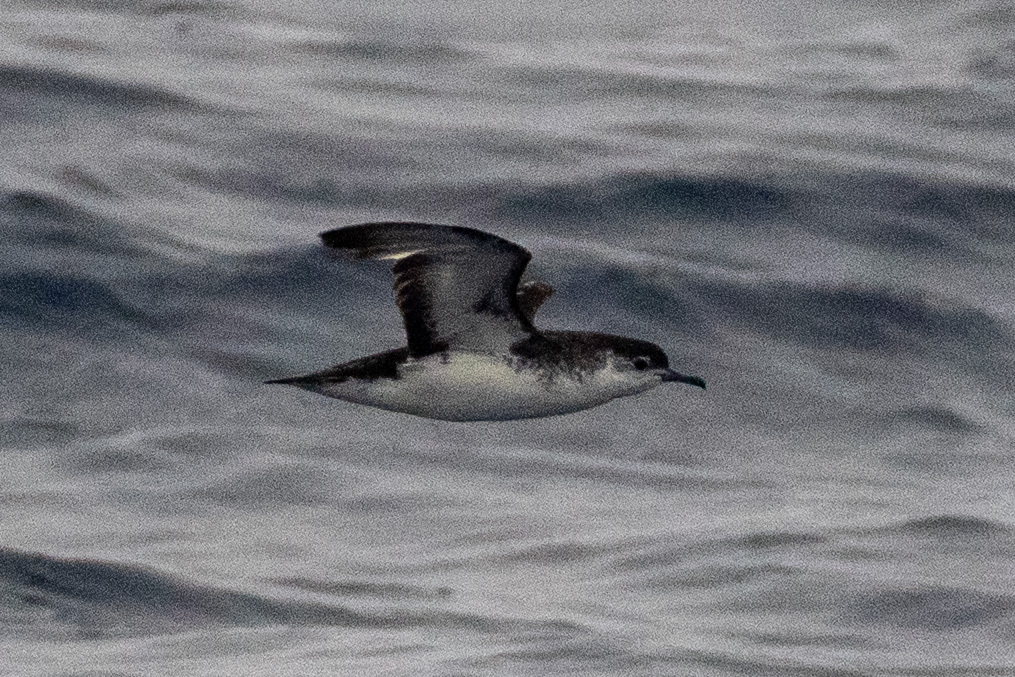
A small black-and-white shearwater of the Macaronesian islands, flying low over the waves with whirring wingbeats. It breeds in the Canaries, less than a hundred kilometres from the Moroccan coast, but stays largely on the open sea near its islands; in the region it is a rare and easily missed visitor.
Voice
Silent at sea. At the colony at night a high, fast, panting ka-kee-ka-kerr, repeated in short series; not heard in the region.
Recording: Rinse van der Vliet — CC BY-NC-SA 4.0 · converted to mono · xeno-canto
Identification
Small, compact and short-winged, with rounded wingtips. Black above and pure white below down to the undertail, with only a narrow dark trailing edge and tip to the underwing. The decisive feature is the white face: the border between black cap and white throat runs above the eye, so that the dark eye sits in a white field. The bill is short and thin, blue-grey with a dark tip; the legs are bluish. The flight consists of long series of quick, whirring beats just above the water, interspersed with short glides, with much less tilting than in larger shearwaters.
Confusion species
Manx Shearwater (Puffinus puffinus) is clearly larger and longer-winged, with the dark cap reaching below the eye and long, tilting glides. Yelkouan Shearwater (Puffinus yelkouan) is larger and browner, with dark axillaries and, in the western form, grubby underparts and brown undertail. Bulwer's Petrel (Bulweria bulwerii) is about the same size, but all dark with a long, pointed tail. At a distance the fast, whirring flight can recall Razorbill (Alca torda), which has a white trailing edge to the wing and never glides.
Habitat
Warm, deep oceanic waters around the islands and over the edge of the continental shelf, often at upwellings and seamounts; rarely comes close inshore. Feeds by swimming and diving for small fish and squid. Breeds in crevices and burrows on rocky islands and cliffs outside the region.
Where the bird is most at home, classified by the habitats of North Africa and the Middle East.
Range and movements
Morocco and Western Sahara: vagrant, with only few documented records, mainly from seawatching at headlands on the Atlantic coast and from boats over the upwelling zone between the Canaries and the African coast; at sea there it is probably more regular than records suggest. No confirmed records are known from the Mediterranean or the rest of the region. Beyond the region it breeds on the Azores, Madeira, Porto Santo, the Desertas, the Selvagens and the Canaries; outside the breeding season it stays largely in the surrounding ocean, with small numbers wandering north in late summer to the Bay of Biscay and the waters south-west of Britain and Ireland.
How and when to look
The best chance is a pelagic trip off Agadir or Dakhla, or seawatching from an Atlantic headland after a stiff westerly. With every small black-and-white shearwater, wait for the white face and the whirring flight, and document the sighting with photographs.
Conservation status
Not evaluated separately on the Red List, but vulnerable given a small world population estimated at a few thousand pairs. Threats are rats and cats on the breeding islands, artificial light that grounds fledglings and disturbance of colonies; the species has declined in the Canaries and Madeira.
Scientific name
Puffinus baroli | (Bonaparte, 1856)
Bonaparte described the species in 1856 as Procellaria baroli; because it was later moved to another genus, the author and year stand in brackets. The genus Puffinus was introduced in 1760 by Brisson. Puffinus comes from English puffin and its variants, the name for the cured nestling of the shearwater, once a delicacy. baroli honours Carlo Tancredi Falletti, marquis of Barolo, an Italian nobleman of the nineteenth century. The specimen the first description was based on came from the Desertas Islands, Madeira.