All species › Passerines › Swallows and martins › Asian House Martin
Asian House Martin | Delichon dasypus
Aziatische huiszwaluw | Avión asiático
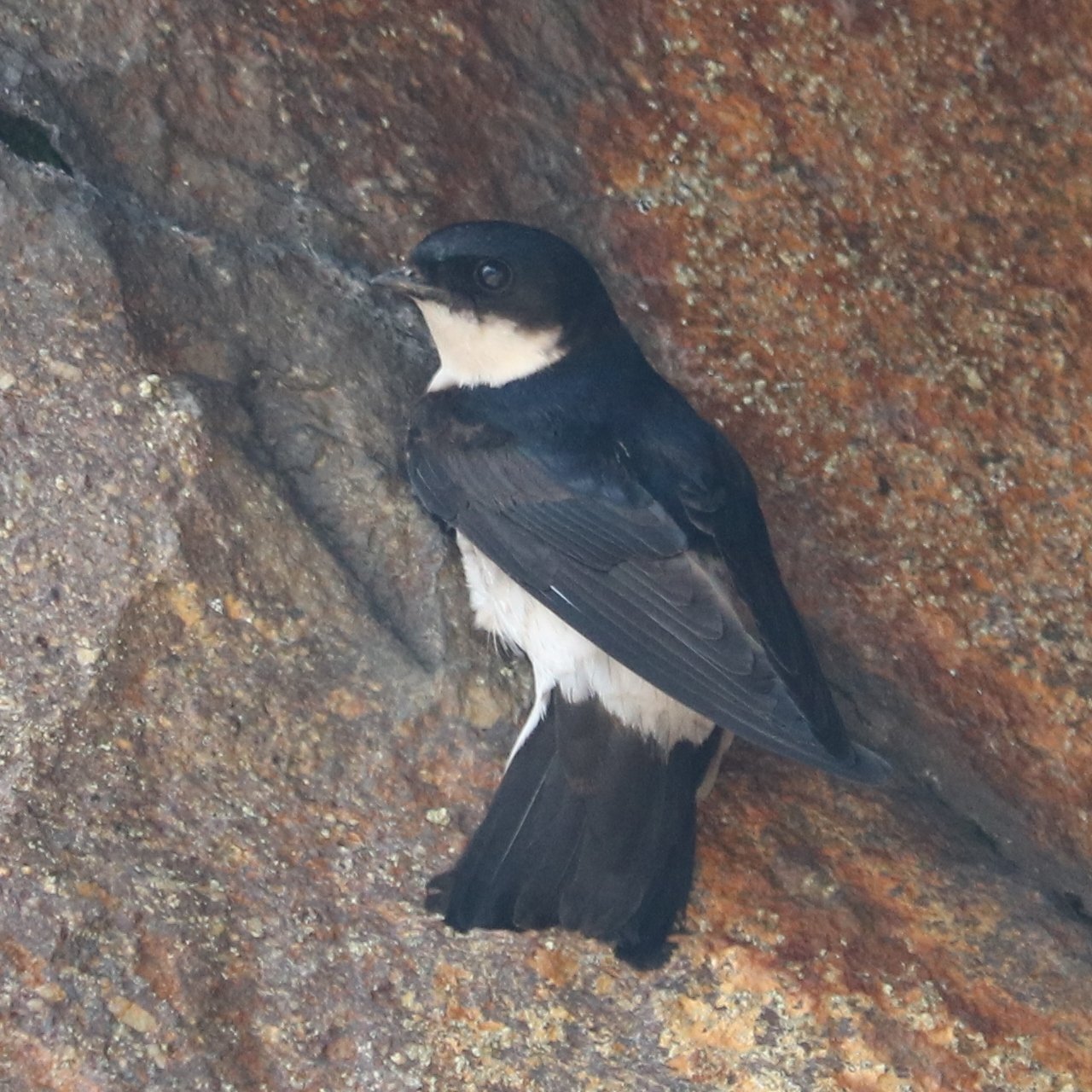
The Asian House Martin is the East Asian and Himalayan sister of the Common House-Martin. In the region it is an exceptional vagrant recorded only in the United Arab Emirates, and one that is easily overlooked among flocks of house martins.
Voice
Calls like those of Common House-Martin but thinner and harsher, a short djit or prrt; of little use in the region.
Recording: Bo Shunqi 薄顺奇 — CC BY-NC-SA 4.0 · shortened to the first 60 s, mono · xeno-canto
Identification
12–13 cm. A small, stocky house martin with a short, barely notched tail. Upperparts blue-black, with a white rump that is narrower than in Common House-Martin and often has fine dark shaft streaks. Underparts not pure white but dingy to greyish white, darker on the flanks and undertail coverts; the throat can be almost white. Underwing coverts blackish, darker than the grey-brown ones of Common House-Martin. Legs feathered white. Juveniles are even dingier below.
Confusion species
Common House-Martin (Delichon urbicum) is larger, with a deeper tail fork, a large pure white rump, bright white underparts and paler underwing coverts; note that juvenile Common House-Martins also have a dusky breast. Other hirundines in the region lack a white rump.
Habitat
Breeds on rock faces and cliffs in high mountains, locally on buildings. In winter over lower slopes, river valleys and open country. Vagrants in Arabia appear at water, such as sewage works and ponds, among other hirundines.
Where the bird is most at home, classified by the habitats of North Africa and the Middle East.

Range and movements
In the region only a few accepted records in the United Arab Emirates, as far as known in the winter half of the year. Breeds in the Himalayas from Afghanistan to Sikkim and in Tibet and western and central China (cashmeriensis), further in eastern China, Korea, Japan and the Russian Far East, and winters in the Himalayan foothills, north-east India and South-East Asia.
How and when to look
In winter check every house martin in the Emirates and Oman: a small bird with dingy underparts, a short tail and a narrow, dirty rump deserves photographs of rump, tail and underwing.
Conservation status
Not globally threatened. A very rare vagrant to the region; records need photographic documentation because of confusion with juvenile Common House-Martins.
Scientific name
Delichon dasypus | (Bonaparte, 1850)
Bonaparte described the species in 1850 as Chelidon dasypus; because it was later moved to another genus, the author and year stand in brackets. The genus Delichon was introduced in 1854 by Moore. Delichon is an anagram of Greek chelidon 'swallow'. dasypus is Greek for 'hairy-footed', from dasus 'shaggy, hairy' and pous 'foot', for the feathered legs. The specimen the first description was based on came from Borneo.