All species › Waders, gulls and terns › Sandpipers and snipes › Asian Dowitcher
Asian Dowitcher | Limnodromus semipalmatus
Aziatische grijze snip | Agujeta asiática
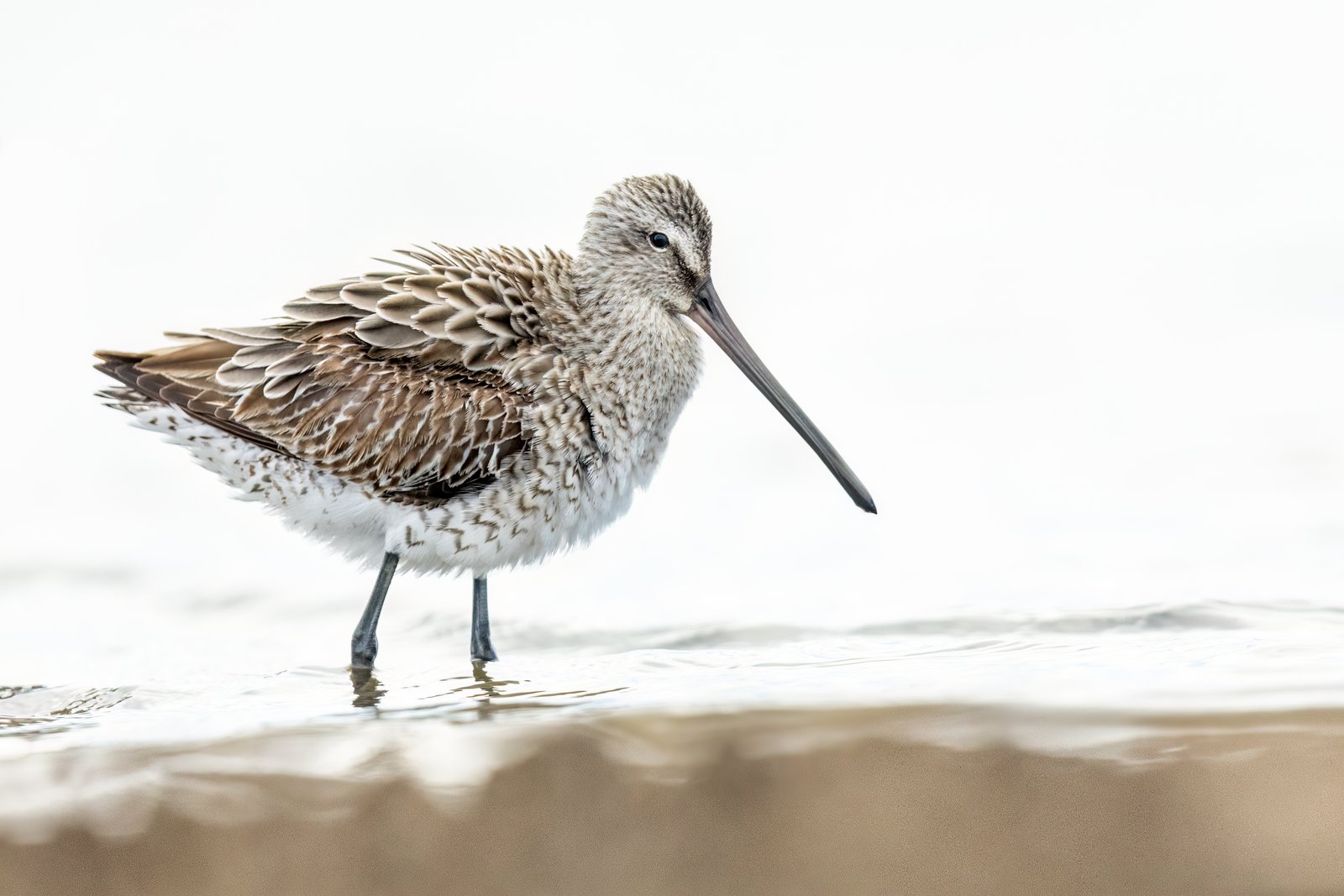
A large, godwit-like dowitcher from the steppes of Central and East Asia that winters from India to Australia. In the region it is an extremely rare vagrant to the mudflats of the eastern Arabian Peninsula, usually among Bar-Tailed Godwits.
Voice
Mostly silent; in flight a soft, plaintive chowp or kiaow, sometimes a short mewing sound.
Recording: Sébastien Provost - Birding Mont-Saint-Michel — CC BY-NC-SA 4.0 · converted to mono · xeno-canto
Identification
About as large as a small Bar-tailed Godwit but stockier, with shorter legs and an all-black, straight bill with a slightly swollen tip. In winter plumage grey-brown with pale fringes above and pale grey below, with a white supercilium; in breeding plumage rufous on head, neck and breast. Legs dark grey to black. In flight a fairly pale, finely barred rump and tail without a white wedge, and a pale trailing edge to the wing. Feeds with rapid, sewing-machine probing.
Confusion species
Bar-tailed Godwit (Limosa lapponica) is larger, with a longer, slightly upturned, bicoloured bill, and has a white wedge on the back. Long-billed Dowitcher (Limnodromus scolopaceus), also a vagrant, is smaller, with greenish legs and a white wedge on the back. Black-tailed Godwit (Limosa limosa) has a broad white wingbar and a black tail band.
Habitat
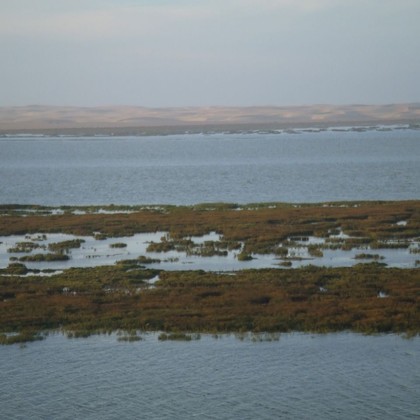
Tidal flats with soft mud, coastal lagoons, salt pans and coastal fish ponds; in winter often with godwits.
Where the bird is most at home, classified by the habitats of North Africa and the Middle East.

Range and movements
In the region an extremely rare vagrant: a few records are known from the coasts of Oman and the United Arab Emirates, mainly in winter; not reliably recorded elsewhere in the region. The first record for Africa was a bird in Kenya. Beyond the region it breeds very patchily in southern Siberia, Mongolia and north-eastern China and winters from eastern India and South-East Asia to northern Australia, with Sumatra as its main area.
How and when to look
Anyone scanning the large flocks of Bar-Tailed Godwits at Barr al Hikman or on the Abu Dhabi coast should look for a slightly smaller bird with a straight black bill and the typical sewing-machine probing; most records were found that way.
Conservation status
Near Threatened. The small world population suffers from the loss of wetlands in the breeding areas and of mudflats along the Yellow Sea and in South-East Asia. In the region a vagrant without specific protection.
Scientific name
Limnodromus semipalmatus | (Blyth, 1848)
Blyth described the species in 1848 as Macrorhamphus semipalmatus; because it was later moved to another genus, the author and year stand in brackets. The genus Limnodromus was introduced in 1833 by Wied-Neuwied. Limnodromus is Ancient Greek, from limnē 'marsh' and -dromos '-runner'. semipalmatus is Latin for 'half-webbed', from semi, 'half', and palmatus, 'webbed' — for the small webs between the toes. The specimen the first description was based on came from Calcutta (Kolkata), India.