All species › Passerines › Sylvia warblers › Asian Desert Warbler
Asian Desert Warbler | Curruca nana
Woestijngrasmus | Curruca del desierto
The Asian Desert Warbler is a tiny, pale warbler of the steppes and deserts of Central Asia that winters in the deserts of Arabia and the Middle East. It lives almost entirely on the ground, running from shrub to shrub, and is often first noticed by the rufous tail it constantly flicks and fans. Until 2025 it was treated as one species with the African Desert Warbler.
Voice
In winter mainly the call: a dry, rattling trrrt, often in short series, and a nasal chair. In late spring a snatch of song may be heard: a short phrase mixing clear and scratchy notes, thinner and more silvery than the chatter of the Greater Whitethroat.
Recording: Stanislas Wroza — CC BY-NC-SA 4.0 · shortened to the first 60 s, mono · xeno-canto
Identification
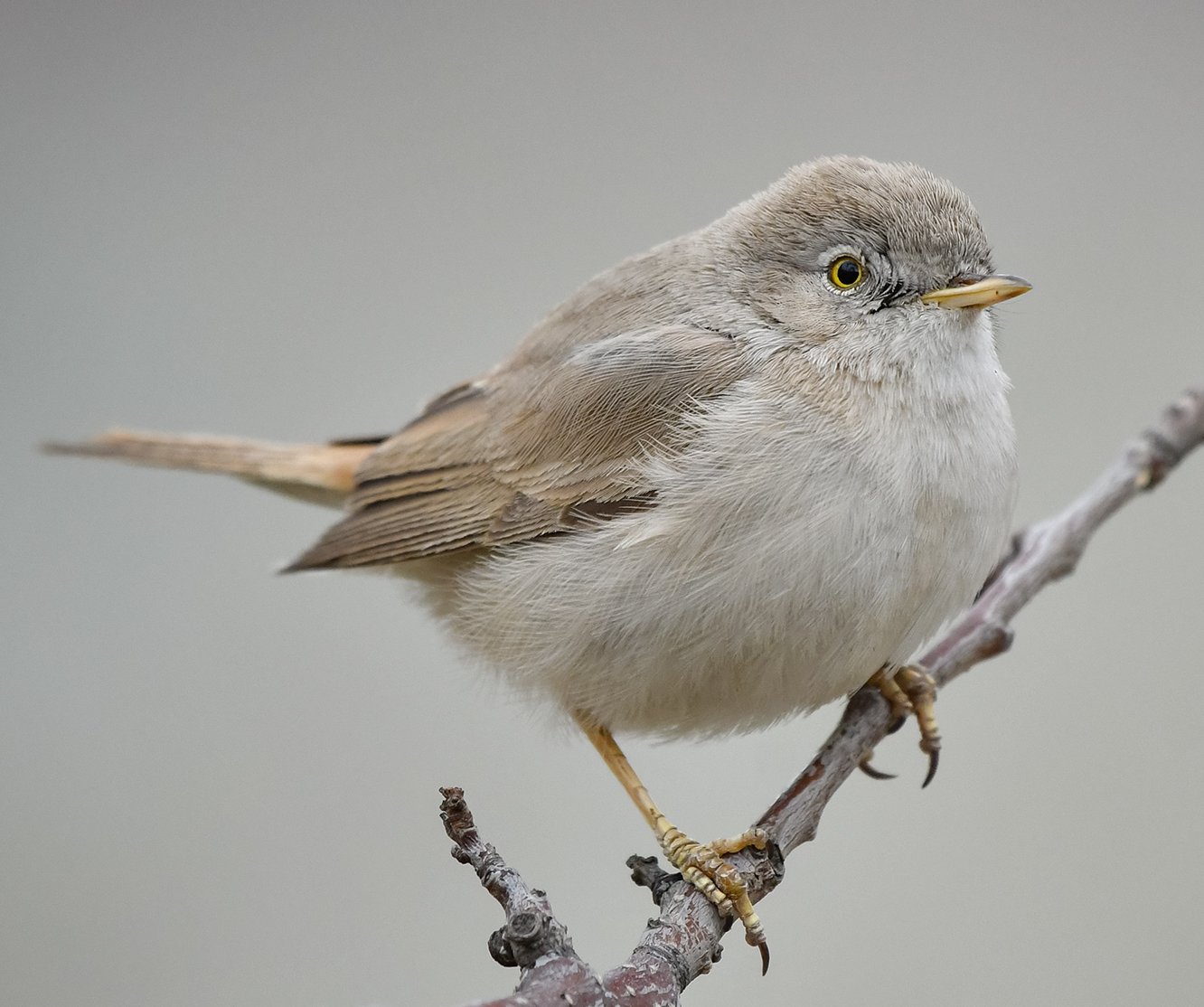
11.5–12.5 cm. Very small and pale: sandy grey-brown above, off-white below, with a warm rufous rump and tail and white outer tail feathers. That rufous tail against the cooler, greyer mantle is what catches the eye. The iris is bright yellow, the tiny bill straw-yellow with a dark tip, the legs pale yellow. The greater coverts and tertials have darker centres within pale fringes, so the folded wing looks lightly patterned. Sexes alike. Walks and runs on the ground rather than hopping.
Confusion species
African Desert Warbler (Curruca deserti) is warmer and more uniformly golden-sandy, without dark centres in the wing, so the tail contrasts less; it lives only in the Sahara west of the Nile, where Asian Desert Warbler does not occur, so location almost always decides. Ménétriés's Warbler (Curruca mystacea), wintering in the same scrub, is larger, with a blackish tail lacking rufous and a red or pale eye-ring. Streaked Scrub Warbler (Scotocerca inquieta) has a streaked crown and breast, a dark eye and a long, dark tail often held cocked.
Habitat
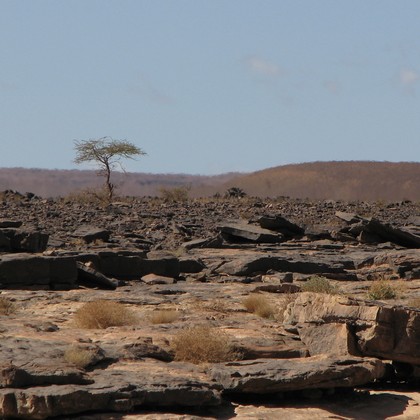
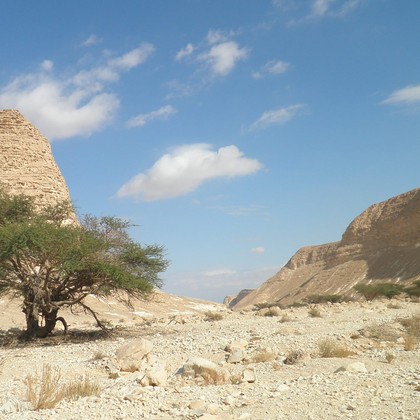
Flat sand and gravel desert with scattered low shrubs, saltbush scrub (Haloxylon, Zygophyllum), wadi edges and sandy plains with dune vegetation. Avoids dense scrub and trees. In winter it often follows a Desert Wheatear or feeds close to one, and runs mouse-like beneath the shrubs.
Where the bird is most at home, classified by the habitats of North Africa and the Middle East.

Range and movements
Winter visitor to almost the whole Arabian Peninsula: Saudi Arabia (mainly the east and centre), Kuwait, Bahrain, Qatar, the United Arab Emirates, Oman and inland Yemen; also southern and eastern Iraq, Jordan, southern Israel (especially the Arava and Negev) and Sinai, and in smaller numbers in Egypt's Eastern Desert along the Red Sea. Absent west of the Nile. Breeds from the Caspian lowlands across Central Asia to Mongolia and north-west China; also winters in southern Iran, Pakistan and north-west India. Vagrant to Europe.
- Winter visitor (c. Oct–Mar)
- Passage (Mar–Apr, Oct–Nov)
- dark = core range, pale = thinly spread
How and when to look
In winter search the Arava (Israel and Jordan) and the deserts of the Emirates and Oman on plains with scattered low shrubs, and follow a Desert Wheatear: the warbler often keeps close to it. The rattling call usually gives it away first.
Conservation status
Not globally threatened, with a large breeding range in Central Asia. In the wintering areas scattered and usually at low density, but fairly common in suitable desert; possibly locally sensitive to overgrazing of the shrub layer.
Scientific name
Curruca nana | Hemprich & Ehrenberg, 1833 (GBIF: Sylvia nana)
Hemprich & Ehrenberg described the species in 1833 and placed it straight away in the genus where it still stands. The genus Curruca was introduced in 1802 by Bechstein. Curruca is Latin, the name of an unidentified small bird mentioned by the Roman poet Juvenal. nana is Latin for 'dwarf', taken from Ancient Greek nanos. The specimen the first description was based on came from El Tor, Sinai.