All species › Waders, gulls and terns › Gulls and terns › White-winged Tern
White-winged Tern | Chlidonias leucopterus
Witvleugelstern | Fumarel aliblanco
The White-winged Tern is a marsh tern of Europe and Asia that winters in Africa, southern Asia and Australia. In the Caribbean it is a rare vagrant, presumably arriving across the Atlantic, like other Old World species that turn up in the Lesser Antilles. Almost all birds here are in winter or juvenile plumage, without the black-and-white breeding dress.
Voice
Rather silent away from the breeding grounds. The call is a short, harsh kesh or kek, lower and harder than in Black Tern.
Recording: Paul Kelly — CC BY-NC-SA 4.0 · converted to mono · xeno-canto
Identification
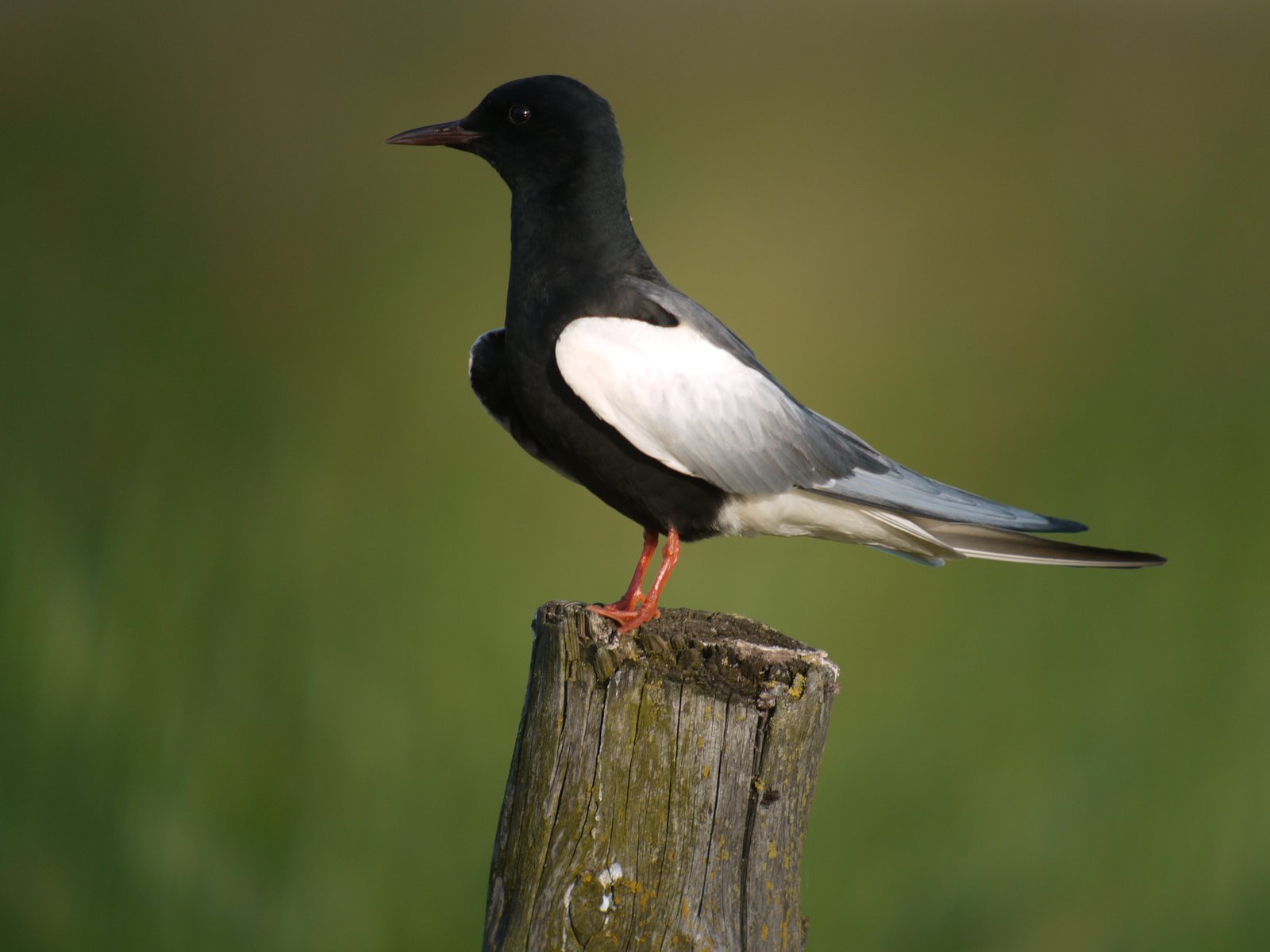
23–27 cm, small and compact, with a short, slightly notched tail and a short, stubby black bill. In breeding plumage the head, neck, body and underwing coverts are black, while the upperwing, rump and tail are white to pale grey. In winter the underparts are white and the head is white with a small black spot behind the eye and a dark, loosely mottled hindcrown, without a solid cap. Juveniles have a dark brown 'saddle' on the back, sharply contrasting with the pale grey wings and white rump. The legs are red, shorter and brighter than in Black Tern.
Confusion species
Black Tern Chlidonias niger is the main pitfall. In breeding plumage it has grey, not white, wings and a pale grey underwing. In winter and juvenile plumage Black Tern shows a dark patch on the breast sides, a grey rather than white rump, a fuller black cap reaching below the eye and, in juveniles, a back that barely contrasts with the wing. Other small terns, such as Least Tern Sternula antillarum, plunge-dive and have a yellow or longer bill.
Habitat
Freshwater lakes, ponds, flooded fields, rice fields, marshes and the edges of salt pans. Like other marsh terns it hunts in light, buoyant flight low over the water, picking insects and small prey from the surface without diving. It rests on posts, wires or the shore.
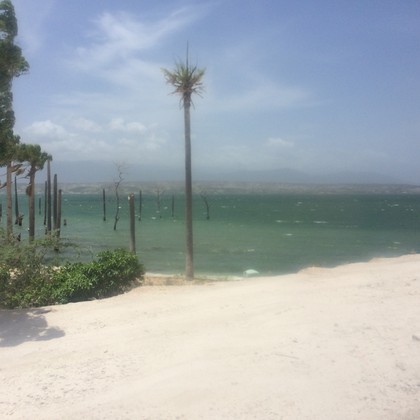
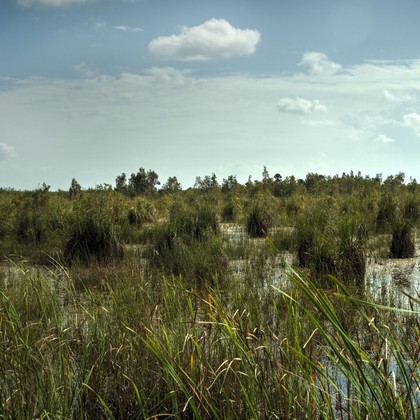
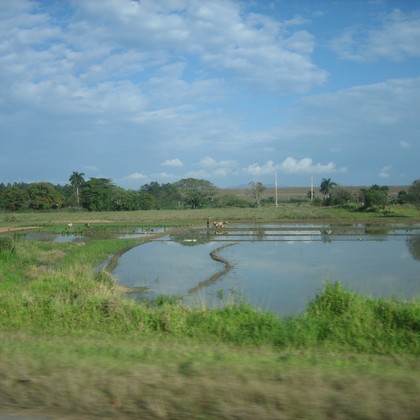
Where the bird is most at home, classified by the vegetation types of the Caribbean.

Range and movements
Most records come from Puerto Rico, Barbados and Guadeloupe; there are also sightings from Bonaire, the Bahamas and the US Virgin Islands. Most islands have no records. On Barbados a bird stayed for more than a month in autumn 2022, and elsewhere birds have sometimes remained at one site for long periods. Outside the region it breeds from Eastern Europe to East Asia; in North and South America it is a scarce vagrant, mainly along the Atlantic coast.
How and when to look
Any marsh tern on a freshwater pond or salt pan in the eastern islands deserves a second look, especially in autumn. The white rump, the lack of a breast-side patch and, in juveniles, the dark back saddle separate it from Black Tern. Photographs from above and from the side are often needed for a firm identification.
Conservation status
Not threatened. A numerous and widespread species; in parts of Eastern Europe numbers are falling as flooded grasslands and marshes disappear. In the Caribbean an accidental visitor.
Scientific name
Chlidonias leucopterus | (Temminck, 1815)
Temminck described the species in 1815 as Sterna leucoptera; because it was later moved to another genus, the author and year stand in brackets. The genus Chlidonias was introduced in 1822 by Rafinesque. Chlidonias is from Ancient Greek khelidonios 'swallow-like', from khelidon 'swallow'. leucopterus is Greek, from leukos 'white' and -pteros '-winged'. The specimen the first description was based on came from the Mediterranean coast.