All species › Parrots › Parrots › White-winged Parakeet
White-winged Parakeet | Brotogeris versicolurus
Witvleugelparkiet | Catita Versicolor
The White-winged Parakeet is a medium-sized green parakeet from the Amazon basin. It is not native to the Caribbean: the birds on Puerto Rico descend from escaped and released cage birds. Since the 1990s the population there has grown strongly and spread over much of the island.
Voice
Flocks keep up a continuous, high chatter of grating notes such as tchree and kree-kree, loud when taking off and at the roost. Birds separated from the flock call loudly and repeatedly.
Recording: GABRIEL LEITE — CC BY-NC-SA 4.0 · converted to mono · xeno-canto
Identification
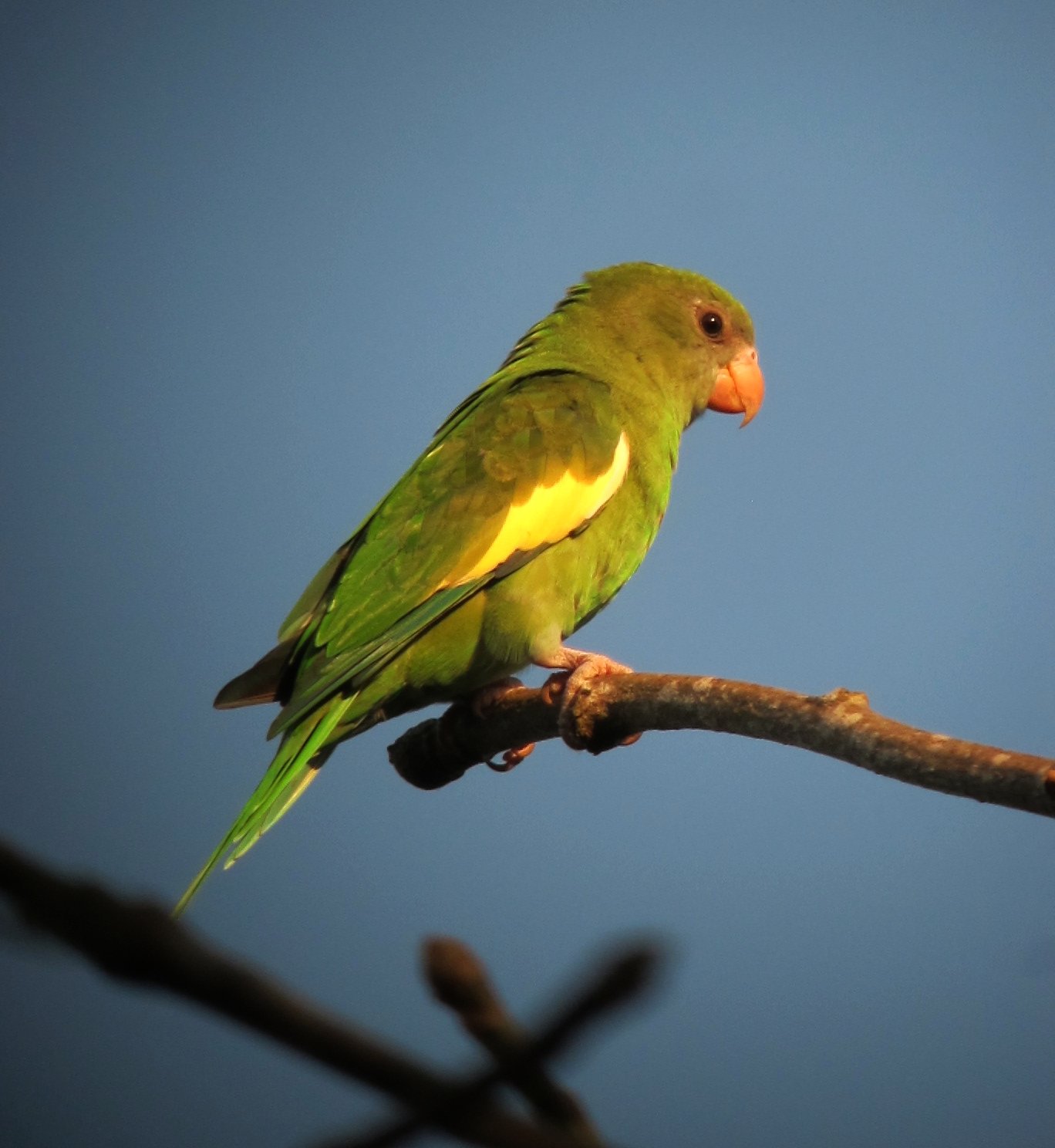
21–23 cm, slim, with a long pointed tail. Mostly green, slightly greyer on the face. A yellow line runs along the trailing edge of the folded wing. In flight the white inner primaries and secondaries stand out, bordered by yellow greater coverts, a feature no other parakeet in the region has. The bill is pale horn. The sexes are alike.
Confusion species
Monk Parakeet Myiopsitta monachus, often seen together with this species on Puerto Rico, is larger, with a grey face and breast and blue flight feathers. Red-masked Parakeet Psittacara erythrogenys is larger, with a red face. The closely related Brotogeris chiriri, long treated as the same species, shares the yellow wing line but has no white in the wing.
Habitat
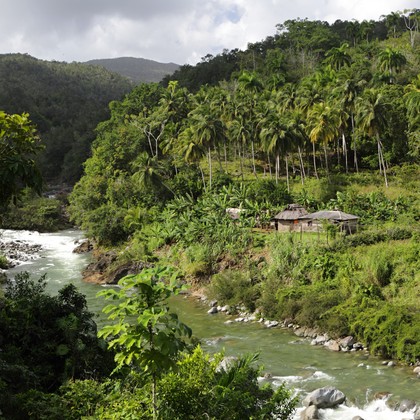
Residential districts and towns with large trees, parks, university campuses, gardens, farms, coastal woodland and the low hills and foothills of the mountains, mainly in the moist lowland zone. It eats mostly fruit, flowers and seeds, largely of non-native trees. On Puerto Rico it nests almost exclusively in arboreal termite nests, in which the pair digs out a cavity.
Where the bird is most at home, classified by the vegetation types of the Caribbean.




Range and movements
Established only on Puerto Rico. The first record dates from 1969, at Luquillo; in the 1980s and 1990s breeding groups appeared at Naguabo, Guaynabo and San Germán, among other places. It now occurs in most municipalities, especially on the northern coastal plain around San Juan, Bayamón and Trujillo Alto and in the west and south around Mayagüez, Cabo Rojo and Ponce. Only single records are known from other islands. Native to the Amazon basin, from south-eastern Colombia to the mouth of the Amazon; feral populations also in Florida, California and Lima.
- Resident
- dark = core range, pale = thinly spread
How and when to look
In San Juan and other towns on the north coast, in parks and on campuses with large trees, often together with Monk Parakeets. Flocks fly noisily between roost and feeding sites in the morning and towards evening, when the white wing patch is best seen.
Conservation status
Not threatened globally. On Puerto Rico an introduced species with a growing population and an expanding range. Fears of damage to crops there have so far not materialised.
Scientific name
Brotogeris versicolurus | (Müller, 1776)
Müller described the species in 1776 as Psittacus versicolurus; because it was later moved to another genus, the author and year stand in brackets. The genus Brotogeris was introduced in 1825 by Vigors. Brotogeris is Greek, from brotos 'human' and gērus 'voice': 'human-voiced', after the ability to mimic speech. versicolurus is formed from Latin versicolor 'variegated' and Greek -ouros '-tailed': 'variegated-tailed'. The specimen the first description was based on came from Cayenne, French Guiana.