All species › Passerines › Thrushes › Veery
Veery | Catharus fuscescens
Veery | Zorzalito rojizo
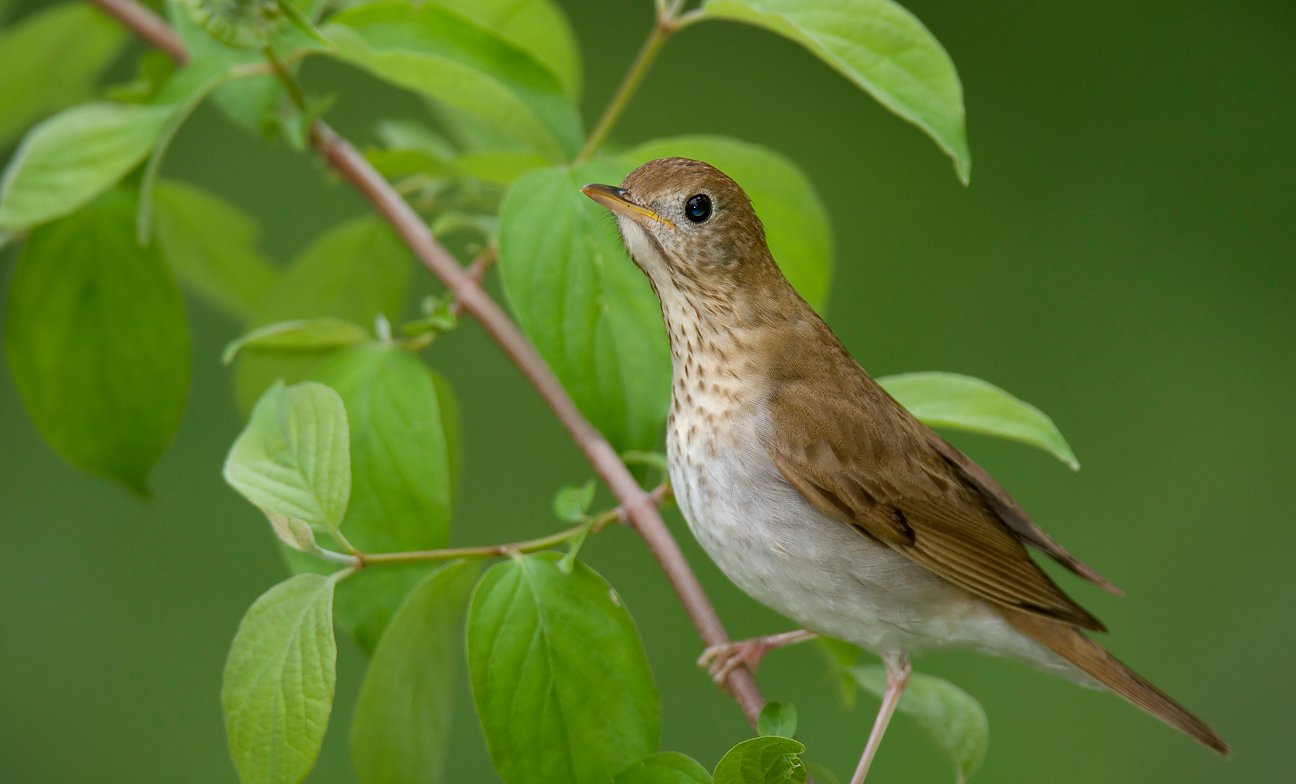
The Veery is the most rufous and least spotted of the Catharus thrushes. It breeds in moist deciduous forest in Canada and the northern United States and winters in the Amazon basin and south-eastern Brazil. On southward migration birds pass through the western Caribbean, mainly Cuba; in spring it is seen there far less often.
Voice
Usually silent in the region. The call is a low, falling vee-ur, which gives the species its name; also a soft wuck. The nocturnal flight call is a hoarse, falling veer. The song on the breeding grounds is a series of descending, fluted spirals.
Recording: Stanislas Wroza — CC BY-NC-SA 4.0 · shortened to the first 60 s, mono · xeno-canto
Identification
16–19 cm, slim, with a short bill. Upperparts uniform warm rufous to cinnamon-brown, including head and tail; birds from the western breeding range are duller. The eye-ring is faint greyish white. Throat and breast are washed buff with small, indistinct rufous spots; the rest of the underparts is white, with grey flanks. The sexes are alike.
Confusion species
Swainson's Thrush Catharus ustulatus is olive-brown, with clear buff spectacles and sharper, dark spots. Grey-cheeked Thrush Catharus minimus and Bicknell's Thrush Catharus bicknelli are grey-brown with grey cheeks and blackish spots. Hermit Thrush Catharus guttatus has only a rufous tail, contrasting with a browner back, and sharp black spots.
Habitat
On migration in moist and dry broadleaf forest, coastal woodland and limestone forest with dense undergrowth, sometimes in gardens and parks. It forages on or near the ground for insects and eats fruit and berries. It migrates at night, often in long stages without stopping.
Where the bird is most at home, classified by the vegetation types of the Caribbean.




Range and movements
A scarce passage migrant in Cuba, the Bahamas and the Cayman Islands, mainly in September and October. Rare on Jamaica, Hispaniola, Puerto Rico and the ABC Islands. It breeds in southern Canada and the northern United States, south along the Rocky Mountains and the Appalachians, and winters in the southern Amazon basin and central and south-eastern Brazil.
- Summer visitor (c. Oct–Mar)
- Passage (Mar–Apr, Oct–Nov)
- dark = core range, pale = thinly spread
How and when to look
The best chance is in September and early October in western Cuba and on Grand Cayman, after a cold front. A thrush with warm brown upperparts and a barely spotted breast is a Veery; Swainson's Thrushes are more olive and more clearly spotted.
Conservation status
Not threatened. The population is large but has declined in parts of the breeding range since the 1960s. Forest loss on the Brazilian wintering grounds may play a part. In the Caribbean scarce to rare.
Scientific name
Catharus fuscescens | (Stephens, 1817)
Stephens described the species in 1817 as Turdus Fuscescens; because it was later moved to another genus, the author and year stand in brackets. The genus Catharus was introduced in 1850 by Bonaparte. Catharus is from Ancient Greek katharos 'pure, clean', a name given for the clean plumage of the orange-billed nightingale-thrush. fuscescens is Latin for 'darkish, dusky', from fuscus 'dark', after the tawny-brown upperparts. The specimen the first description was based on came from Pennsylvania, USA.