All species › Parrots › Parrots › Turquoise-fronted Amazon
Turquoise-fronted Amazon | Amazona aestiva
Blauwvoorhoofdamazone | Amazona frentiazul
The Turquoise-fronted Amazon, also known as Blue-fronted Amazon, is native to interior South America and one of the most commonly kept amazons. In the Caribbean it is an alien: free-flying birds are regularly seen in Puerto Rico, presumably escaped pets. Breeding in the wild has not been recorded there.
Voice
Loud, grating and whistled calls, often in series in flight. Cage birds are known for a tendency to sing and mimic.
Recording: JAYRSON ARAUJO DE OLIVEIRA — CC BY-NC-SA 4.0 · converted to mono · xeno-canto
Identification
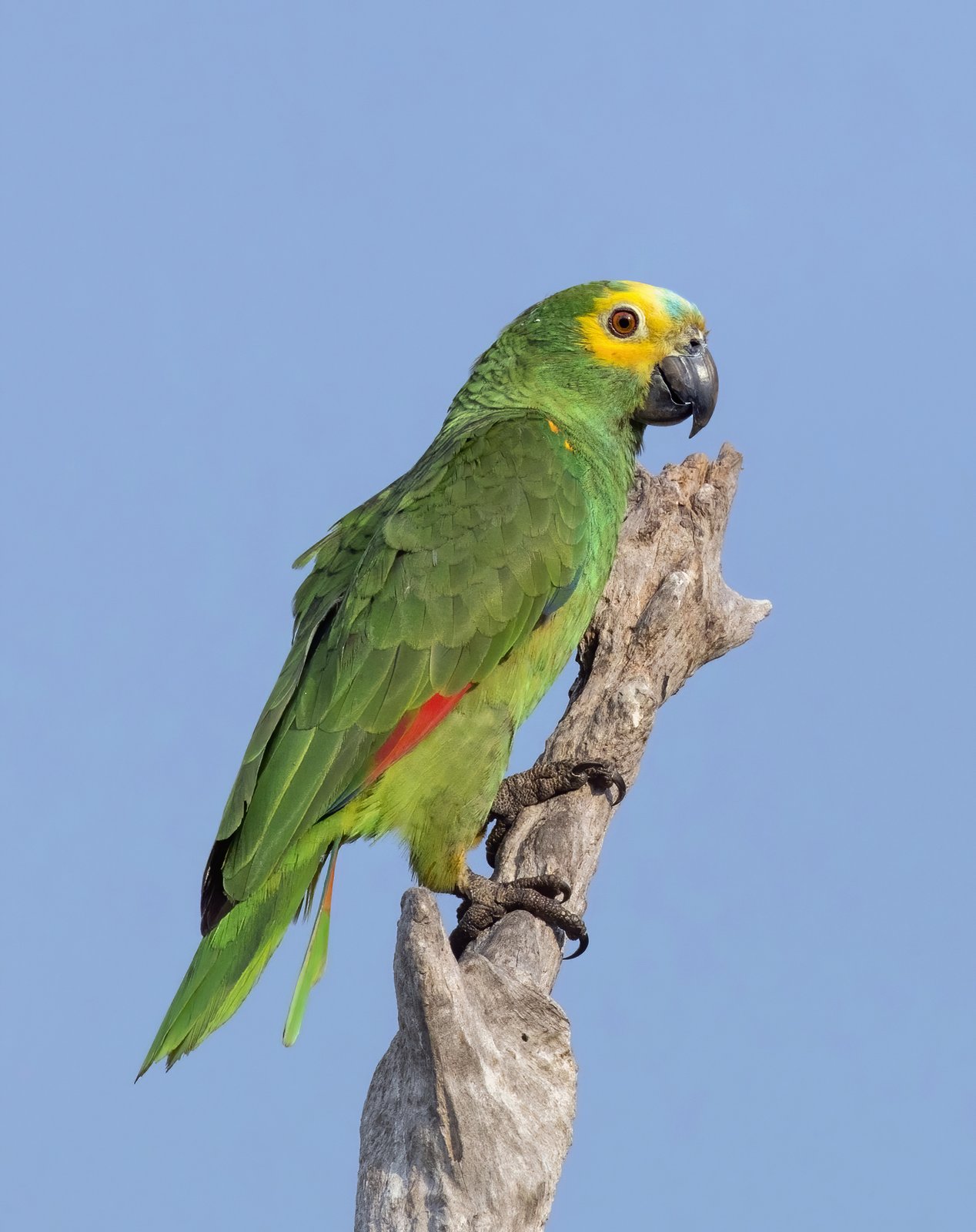
35–38 cm, heavy-bodied, with a short broad tail. Green, with blue on the forehead above the bill and yellow on the face and crown; the extent of blue and yellow varies greatly between individuals. The bend of the wing is red, yellow in some birds, and the wing shows a red speculum; the primaries are tipped dark blue. The bill is mainly black, a feature shared by few amazons. Juveniles are duller, with less yellow and blue and a dark iris.
Confusion species
Orange-winged Amazon Amazona amazonica, also present in Puerto Rico from the cage-bird trade, has blue above the eye and yellow cheeks, an orange speculum and a pale horn bill with a dark tip. Yellow-crowned Amazon A. ochrocephala lacks the blue forehead and has a pale patch on the upper mandible. The native Puerto Rican Amazon A. vittata has a red forehead band, no yellow on the head and a pale bill; Hispaniolan Amazon A. ventralis, also introduced to Puerto Rico, has a white forehead and a red belly patch.
Habitat
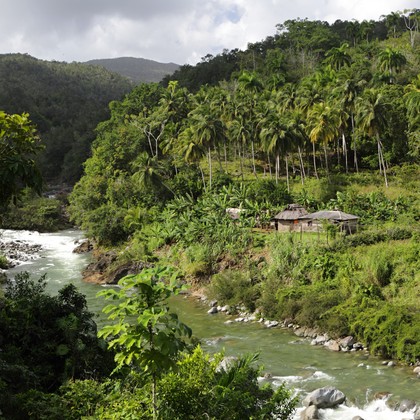
Naturally forest, woodland, savanna and palm groves, but not extensive humid rainforest. In Puerto Rico mainly in urban areas, gardens, parks and around plantings of fruit trees.
Where the bird is most at home, classified by the vegetation types of the Caribbean.


Range and movements
Reported widely in Puerto Rico, mainly in and around the urban areas of the north coast; the birds are probably escaped cage birds and breeding has not been confirmed. No populations are known from other islands in the region. Native to eastern and northern Bolivia, eastern Brazil, Paraguay and northern Argentina; outside its native range small feral groups live in Stuttgart, Genoa and Rio de Janeiro, among other places.
- Resident
- dark = core range, pale = thinly spread
How and when to look
An amazon with a blue forehead and black bill in Puerto Rico is almost always an escape. Pair behaviour and nest cavities are worth noting, since establishment has not been confirmed.
Conservation status
Near Threatened globally, mainly through large-scale trapping for the cage-bird trade. In the Caribbean an alien without a proven breeding population.
Scientific name
Amazona aestiva | (Linnaeus, 1758)
Linnaeus described the species in 1758 as Psittacus aestivus; because it was later moved to another genus, the author and year stand in brackets. The genus Amazona was introduced in 1830 by Lesson. Amazona comes from 'Amazone', the French name Buffon gave to various tropical American parrots because they came from the Amazon region. aestiva is Latin for 'summery'; why Linnaeus chose it is unclear, possibly after the bright, summery colours. The specimen the first description was based on came from southern Brazil (substituted for 'America').