All species › Passerines › Waxbills › Tricolored Munia
Tricolored Munia | Lonchura malacca
Driekleurennon | Capuchino tricolor
The Tricolored Munia is a munia from India and Sri Lanka, named after the three colours of its plumage: black, white and chestnut. Escaped cage birds have established themselves in the Caribbean in wet grassland and rice fields, especially on Cuba, Hispaniola, Puerto Rico, Jamaica and Trinidad. Older Caribbean literature often treated these birds together with Chestnut Munia Lonchura atricapilla as a single species.
Voice
A thin, nasal peet or tee contact call, mainly in flight. The song is very quiet and audible only at close range.
Recording: David Ricardo Rodríguez-Villamil — CC BY-NC-SA 4.0 · converted to mono · xeno-canto
Identification
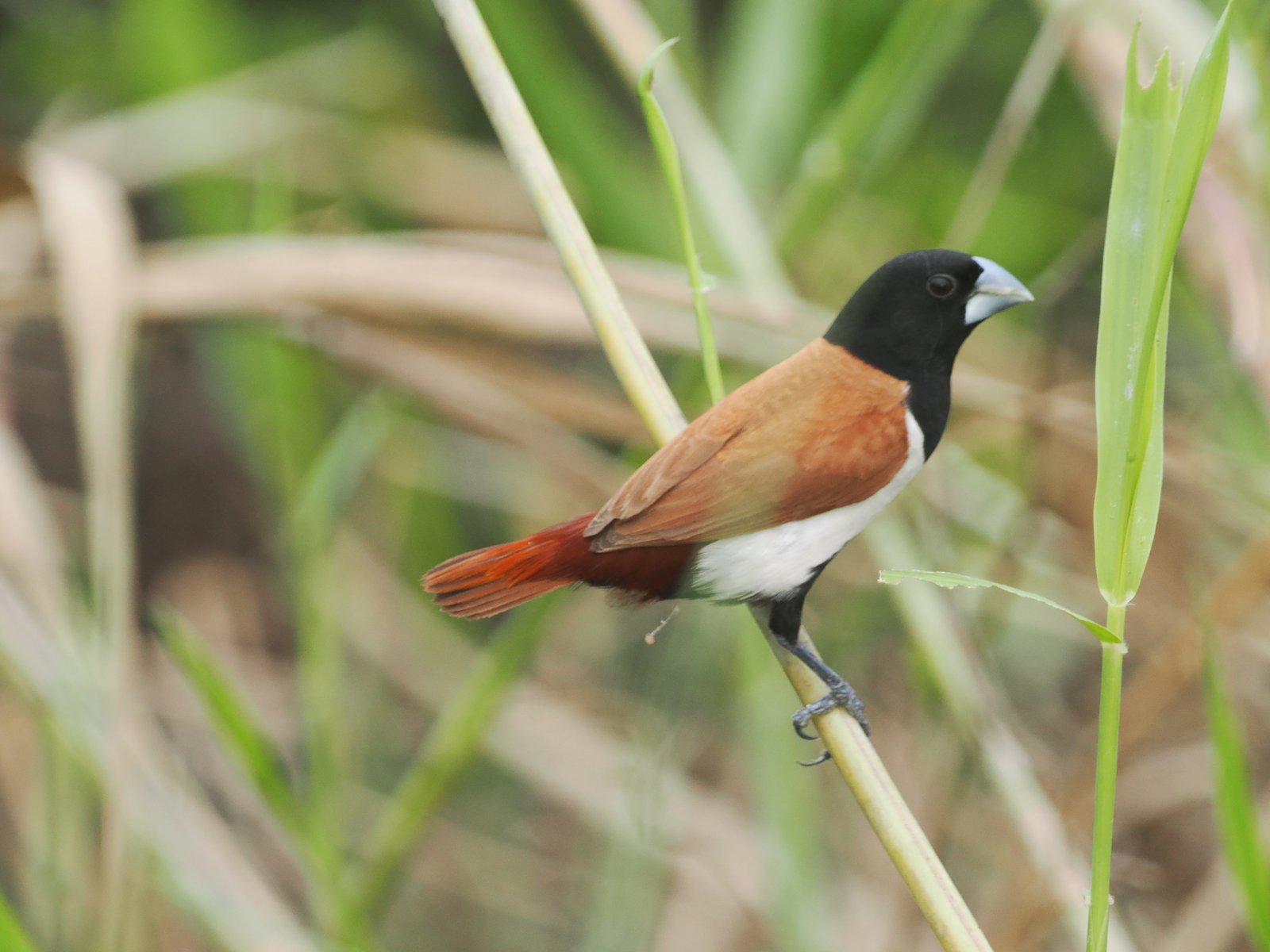
11–12 cm, compact, with a heavy, pale blue-grey bill. Head, neck and upper breast are black, as are a broad band down the centre of the belly and the undertail coverts. Lower breast and flanks are white. Back and wings are warm chestnut, rump and tail rufous. The sexes are similar. Juveniles are plain warm brown above and buff below, without a black head and with a darker bill.
Confusion species
Chestnut Munia Lonchura atricapilla also has a black head, but chestnut underparts without white; intermediates also occur in the region. Scaly-breasted Munia Lonchura punctulata has a brown head and scaly underparts. Bronze Mannikin Spermestes cucullata is smaller, with a brown back, white belly and barred flanks. Young Tricolored Munias are barely distinguishable from young Scaly-breasted Munias and are best identified by the adults in the flock.
Habitat
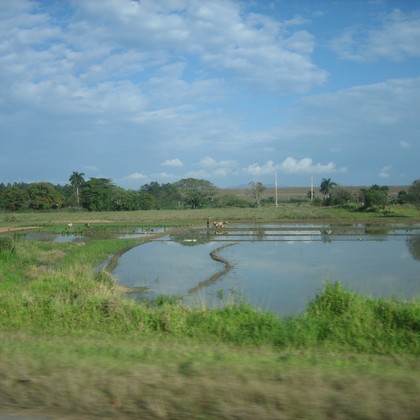
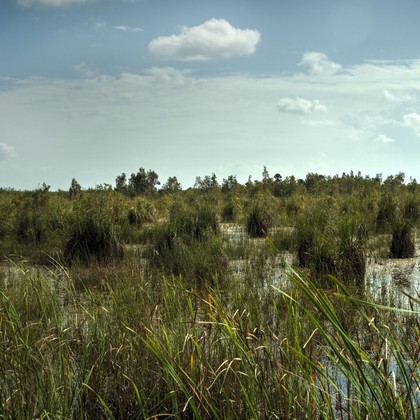
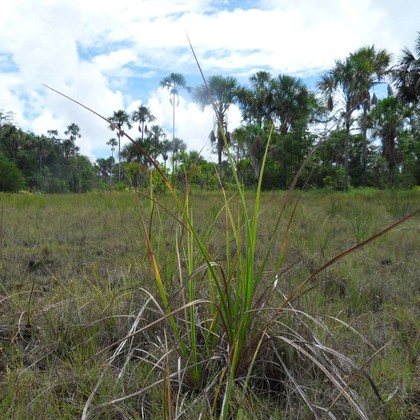
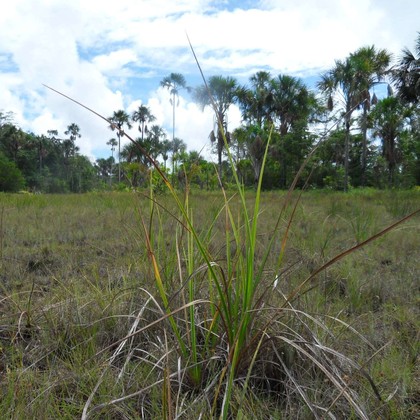
Wet, open areas with tall grasses and reeds: rice fields, freshwater marshes, flooded grassland, the banks of ditches and canals, and the edges of cane fields. It forages in flocks on rice and grass seeds and is regarded as a pest in rice-growing areas. The nest is a loose oval ball of grass with a side entrance, often in tall vegetation over water.
Where the bird is most at home, classified by the vegetation types of the Caribbean.

Range and movements
Introduced and established on Cuba (mainly in the rice-growing lowlands), Hispaniola (Haiti and the Dominican Republic), Puerto Rico, Jamaica and Trinidad. Isolated records from the Cayman Islands, the Bahamas, Martinique, Aruba and the Turks and Caicos Islands. Native to India and Sri Lanka. Also introduced in Venezuela and elsewhere in South America, and on Hawaii.
- Resident
- dark = core range, pale = thinly spread
How and when to look
Most likely in rice fields and wet grassland in the lowlands of Cuba and the Dominican Republic, and in rice-growing areas on Trinidad. Flocks fly low over the fields and give themselves away with the thin contact call; the black head with white flanks is visible even at a distance.
Conservation status
Not threatened globally. In the Caribbean an established alien that locally damages rice crops.
Scientific name
Lonchura malacca | (Linnaeus, 1766)
Linnaeus described the species in 1766 as Loxia malacca; because it was later moved to another genus, the author and year stand in brackets. The genus Lonchura was introduced in 1832 by Sykes. Lonchura is Greek, from lonkhē 'spear-head' and oura 'tail', after the pointed tail. malacca refers to Malacca on the Malay Peninsula, one of the places originally given as its origin. The specimen the first description was based on came from Belgaum, India.