All species › Passerines › Cardinals › Summer Tanager
Summer Tanager | Piranga rubra
Zomertangare | Piranga roja
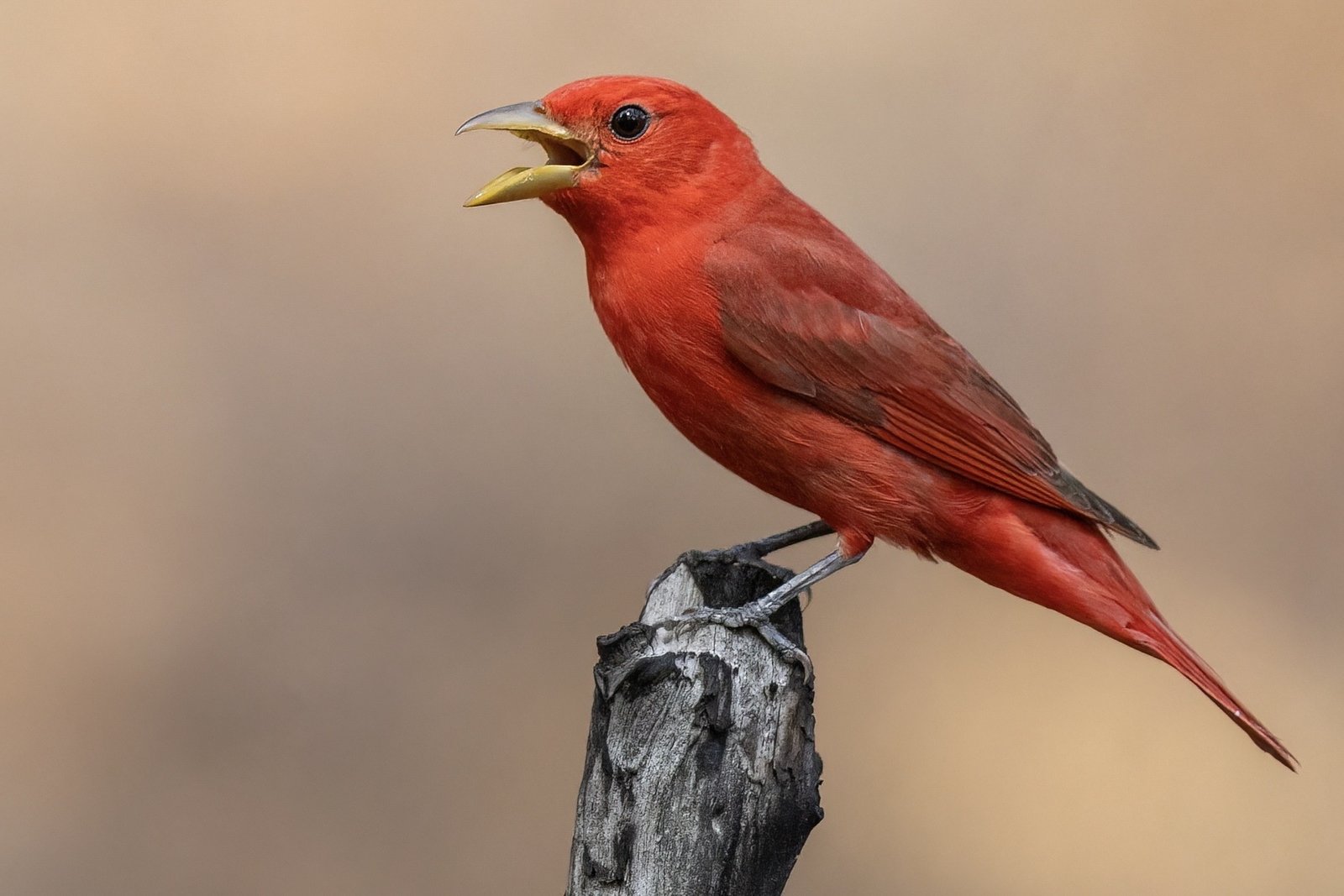
The Summer Tanager is the only entirely red bird of North America. It breeds in open deciduous and pine woods in the southern United States and northern Mexico and winters from Mexico to Bolivia and Brazil. In the Caribbean it passes mainly through the west. It is known for catching bees and wasps, whose stings it rubs off against a branch. In Cuba it is called cardenal.
Voice
The call is a distinctive, rapid staccato pi-tuck or pik-i-tuck-i-tuck, also heard in winter. The song is thrush-like, a series of clear whistled phrases, clearer and less hoarse than that of Scarlet Tanager.
Recording: Mario Reyes Jr — CC BY-NC-SA 4.0 · shortened to the first 60 s, mono · xeno-canto
Identification
17–19 cm, with a fairly long, thick, pale horn-coloured bill. The adult male is entirely rose-red, slightly darker on the wings, without wing bars. The female is olive-yellow to mustard-yellow, yellower below, sometimes with an orange tinge; some older females show red patches. First-year males are yellow with a variable amount of red blotching.
Confusion species
Scarlet Tanager Piranga olivacea has a smaller, darker bill; the male has black wings and tail, and the female has darker, greyish wings contrasting with the green back. Western Tanager Piranga ludoviciana, a rare vagrant, has clear wing bars. Female orioles such as Orchard Oriole Icterus spurius have pointed bills and white wing bars. On Trinidad, Hepatic Tanager Piranga flava has grey cheeks and a dark bill.
Habitat
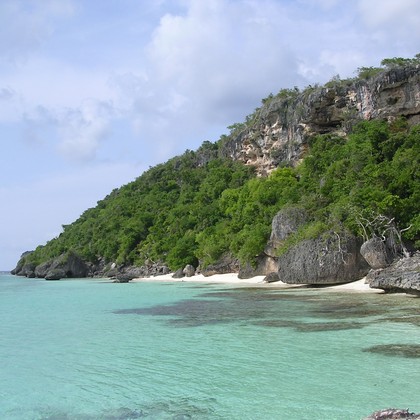
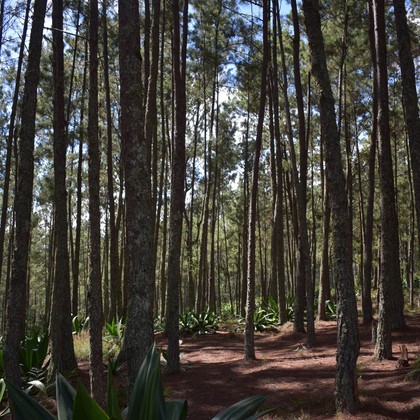
Forest edges, dry and semi-evergreen forest, coastal woodland, pine forest and open country with large trees, also parks and gardens. It searches the crowns for insects, which it also catches in flight, and eats fruit. Usually solitary in winter.
Where the bird is most at home, classified by the vegetation types of the Caribbean.



Range and movements
A fairly common to scarce passage migrant and scarce winter visitor in Cuba, the Bahamas, the Cayman Islands, Jamaica and San Andrés. Rare on Hispaniola, Puerto Rico, the Virgin Islands and in the Lesser Antilles. A scarce winter visitor to Trinidad and Tobago; a rare visitor to the ABC Islands. Breeds in the southern and central United States and northern Mexico; winters from central Mexico through Central America to Bolivia and Amazonian Brazil.
- Resident
- Summer visitor (c. Oct–Mar)
- Winter visitor (c. Apr–Sep)
- Passage (Mar–Apr, Oct–Nov)
- dark = core range, pale = thinly spread
How and when to look
Listening for the pi-tuck at forest edges and in gardens in western Cuba and the Cayman Islands, especially in October and April, is the best approach. Wintering birds hold a fixed territory and can often be found in the same trees day after day.
Conservation status
Not threatened. The population is large and stable to slightly declining across the range.
Scientific name
Piranga rubra | (Linnaeus, 1758)
Linnaeus described the species in 1758 as Fringilla rubra; because it was later moved to another genus, the author and year stand in brackets. The genus Piranga was introduced in 1808 by Vieillot. Piranga comes from the Tupi tijepiranga, the name of an unidentified small bird. rubra is Latin for 'red', after the all-red male. The specimen the first description was based on came from South Carolina.