All species › Owls › Typical owls › Spectacled Owl
Spectacled Owl | Pulsatrix perspicillata
Briluil | Búho de anteojos
The Spectacled Owl is the largest owl on Trinidad, a powerful forest owl without ear tufts that ranges from Mexico to northern Argentina. In the Caribbean it occurs only on Trinidad, where a separate subspecies (trinitatis) is recognised. It is nocturnal and lives hidden in tall forest.
Voice
The song is a series of low, knocking notes that speed up and fade, poop-poop-poo-po-po-po, like a sheet of corrugated iron being shaken. The female gives a hawk-like scream, ker-wheeer; young birds beg with a harsh, high keew. Heard most on calm, moonlit nights.
Recording: JAYRSON ARAUJO DE OLIVEIRA — CC BY-NC-SA 4.0 · converted to mono · xeno-canto
Identification
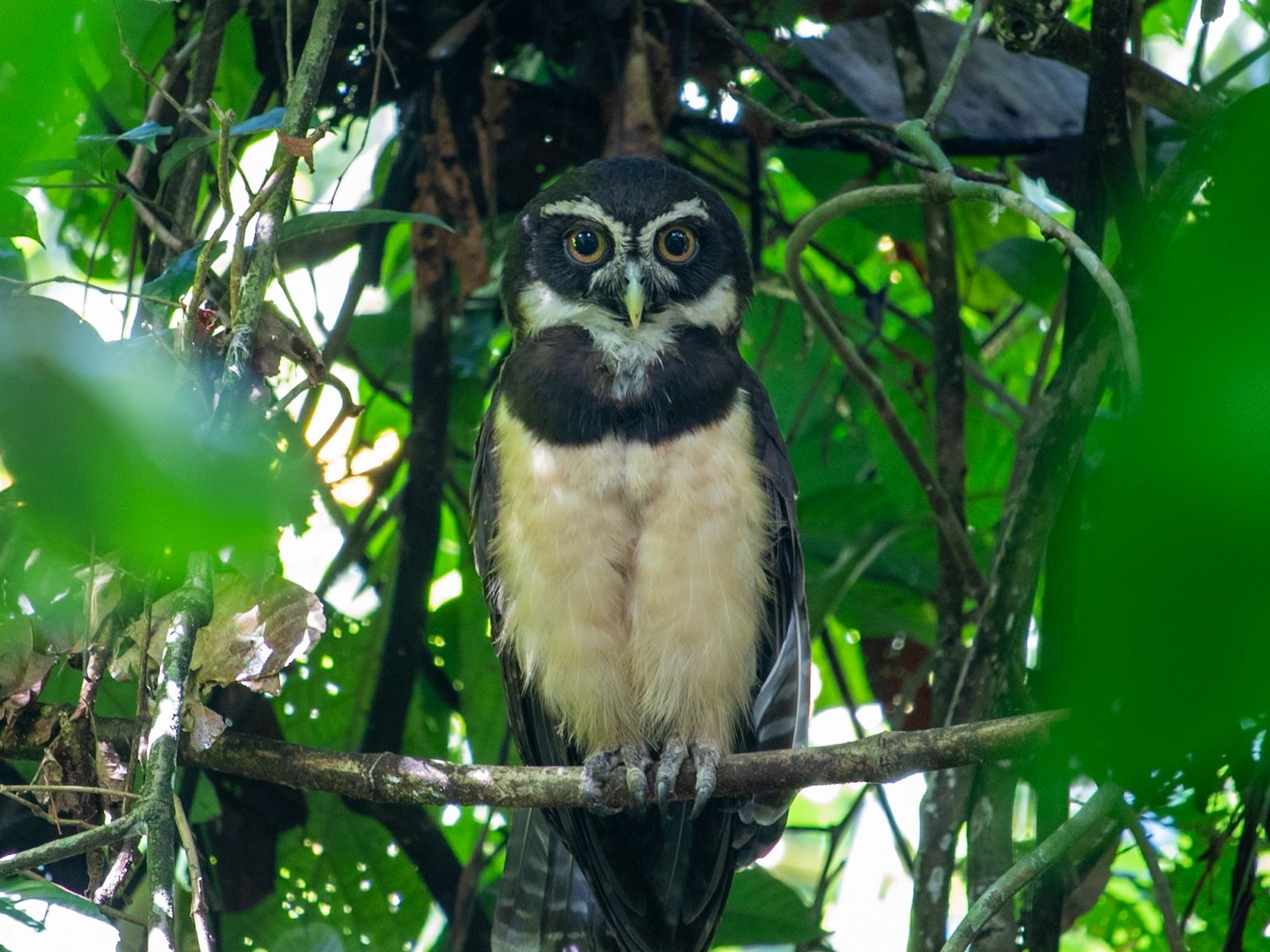
41–52 cm, large and heavy, with a round head without ear tufts. Head, upperparts and a broad breast band are dark chocolate-brown. White eyebrows and white lines beside the bill together form 'spectacles' around the yellow eyes; the throat is white. The belly is plain whitish to ochre-yellow. Females are larger than males. Juveniles are almost entirely white with a dark chocolate facial disc and keep this plumage for a long time.
Confusion species
Mottled Owl Strix virgata is much smaller, with dark eyes and a streaked, not plain, belly without a dark breast band. Stygian Owl Asio stygius, a rare vagrant to Trinidad, has long ear tufts and heavily marked underparts. A white juvenile may recall a barn owl Tyto furcata, but the dark face with yellow eyes is distinctive.
Habitat
Tall rainforest and moist forest in the lowlands and hills, often near water; also older secondary forest and forest edge. It hunts from a perch for nocturnal mammals such as rodents, opossums and bats, and also birds, frogs, crabs and large insects. It nests in large tree cavities and lays one or two eggs; the young remain dependent on the parents for a long time.
Where the bird is most at home, classified by the vegetation types of the Caribbean.




Range and movements
In the region only a scarce resident on Trinidad (subspecies trinitatis), in the forests of the Northern Range and the larger lowland forest tracts. Not recorded on Tobago. Outside the region from southern Mexico through Central and South America to northern Argentina.
- Resident
- dark = core range, pale = thinly spread
How and when to look
The best chance is to listen at night for the knocking song in undisturbed forest, or to go with a local guide who knows a day roost. A white juvenile stands out in the canopy more than the adults.
Conservation status
Not threatened as a species. On Trinidad the Spectacled Owl depends on larger, undisturbed forest areas and is therefore sensitive to forest loss.
Scientific name
Pulsatrix perspicillata | (Latham, 1790)
Latham described the species in 1790 as Strix perspicillata; because it was later moved to another genus, the author and year stand in brackets. The genus Pulsatrix was introduced in 1848 by Kaup. Pulsatrix is New Latin for 'female attacker' (from pulsator 'attacker, striker'), taken from the species name Strix pulsatrix. perspicillata is New Latin for 'spectacled' (from perspicillum 'spectacles'), after the white spectacle-like markings around the eyes. The specimen the first description was based on came from Cayenne, French Guiana.