All species › Passerines › Tyrant flycatchers › Short-tailed Pygmy Tyrant
Short-tailed Pygmy Tyrant | Myiornis ecaudatus
Kortstaartdwergtiran | Tirano enano colicorto
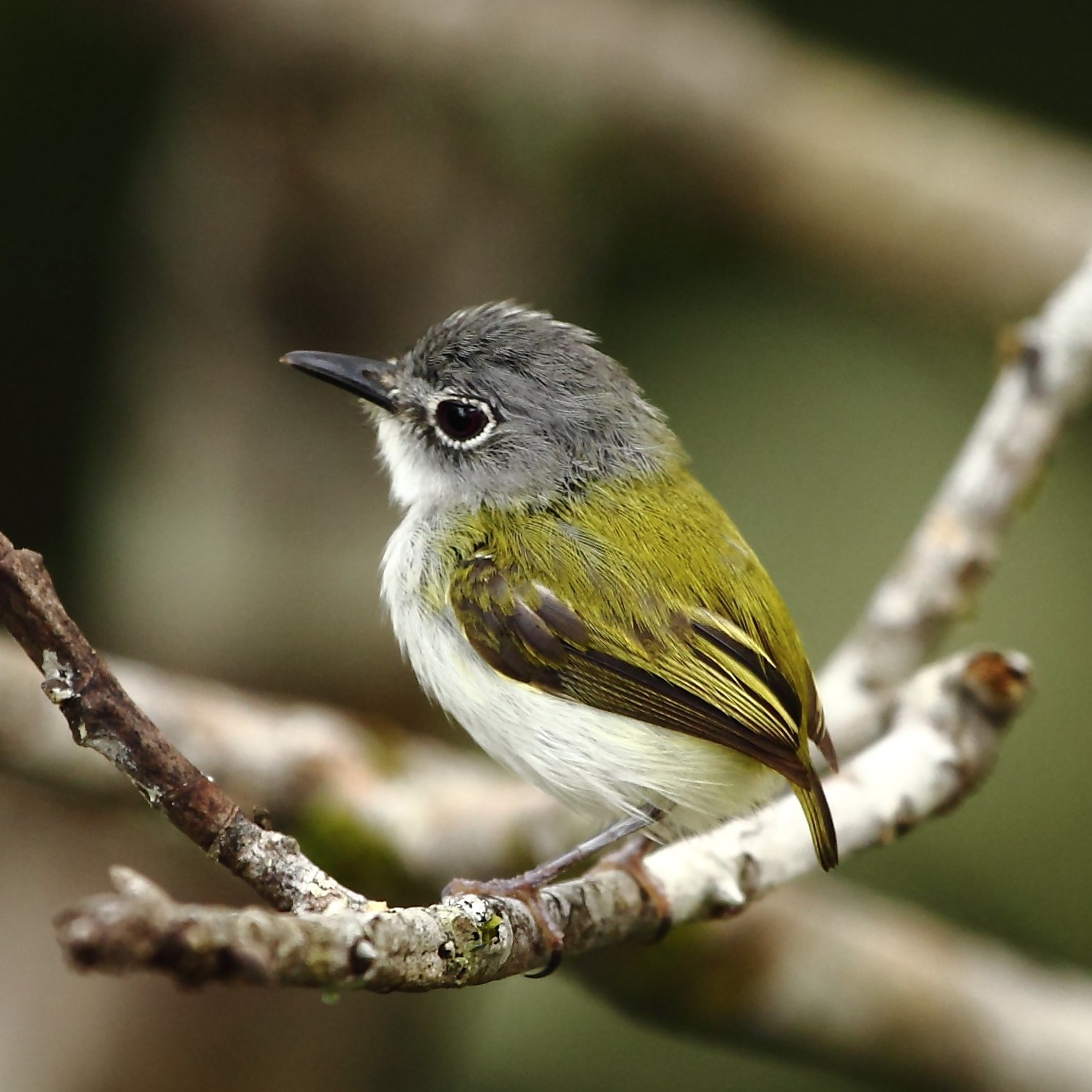
The Short-tailed Pygmy Tyrant is regarded as the smallest passerine in the world: a bird of 6–7 cm and about 4–5 g with an almost non-existent tail. In Trinidad it is a scarce and seldom-seen inhabitant of the canopy of lowland forest. Its size and insect-like calls mean it is often overlooked.
Voice
Sounds that suggest an insect or a frog rather than a bird: a soft, purring trill and short, squeaky notes that accelerate, and high, rising treet or peet notes.
Recording: Jacob Wijpkema — CC BY-NC-SA 4.0 · shortened to the first 60 s, mono · xeno-canto
Identification
6–7 cm, with a large head, a short bill and a very short, mostly black tail. The head is dark grey with blackish markings; white spots in front of and around the eye form distinct spectacles. The back is bright olive-green; the dusky wings have olive-green edges. The underparts are white with a pale yellow tinge, especially on the flanks and belly. The sexes are alike.
Confusion species
Its size and almost absent tail rule out confusion with any other bird in the region. Spotted Tody-Flycatcher Todirostrum maculatum is larger, with a long flat bill, a streaked throat, a yellow belly and an obvious tail. White-throated Spadebill Platyrinchus mystaceus has a broad bill, is browner and lives in the understorey, not the canopy. Hummingbirds have long, thin bills.
Habitat
The canopy, edges and gaps of humid lowland forest, also nearby secondary and transitional forest. It searches mainly in the canopy for small insects, picked from leaves in short sallies, and therefore usually stays out of view from the ground.
Where the bird is most at home, classified by the vegetation types of the Caribbean.


Range and movements
In Trinidad a scarce and local resident of forested areas, reported among other places from the Trinity Hills in the south-east; absent from Tobago and the rest of the region. Outside the region in northern and central South America, from Colombia and Venezuela through the Guianas and Amazonia to Bolivia and Brazil.
- Resident
- dark = core range, pale = thinly spread
How and when to look
Best located by ear: the insect-like trill from the canopy is usually the first sign. A spot with a view into the canopy, such as a forest edge or clearing, gives the best chance of seeing the bird itself.
Conservation status
Not threatened. The species has a very large range in South America. In Trinidad it is scarce and tied to forest, and therefore sensitive to deforestation.
Scientific name
Myiornis ecaudatus | (d'Orbigny, ACVMD & de Lafresnaye, 1837)
D'Orbigny, ACVMD & de Lafresnaye described the species in 1837 as T[odirostrum] ecaudatum; because it was later moved to another genus, the author and year stand in brackets. The genus Myiornis was introduced in 1901 by Bertoni. Myiornis is Greek, from muia 'fly' and ornis 'bird': 'fly-bird', after the tiny size. ecaudatus is Latin for 'tailless', from e- 'without' and cauda 'tail', after the extremely short tail. The specimen the first description was based on came from Yuracarés, Bolivia.