All species › Passerines › Cardinals › Scarlet Tanager
Scarlet Tanager | Piranga olivacea
Zwartvleugeltangare | Piranga escarlata
The Scarlet Tanager breeds in the canopy of deciduous and mixed forest in eastern North America and winters in montane forest along the foot of the Andes in north-western South America. It migrates through Central America and across the western Caribbean, and in the West Indies it is purely a passage migrant; virtually none remain for the winter.
Voice
The call is a distinctive, hoarse chip-burr. The song resembles a thrush's but is huskier and hoarser, as if the bird had a sore throat; sometimes heard on spring migration.
Recording: steve — CC BY-SA 4.0 · converted to mono · xeno-canto
Identification
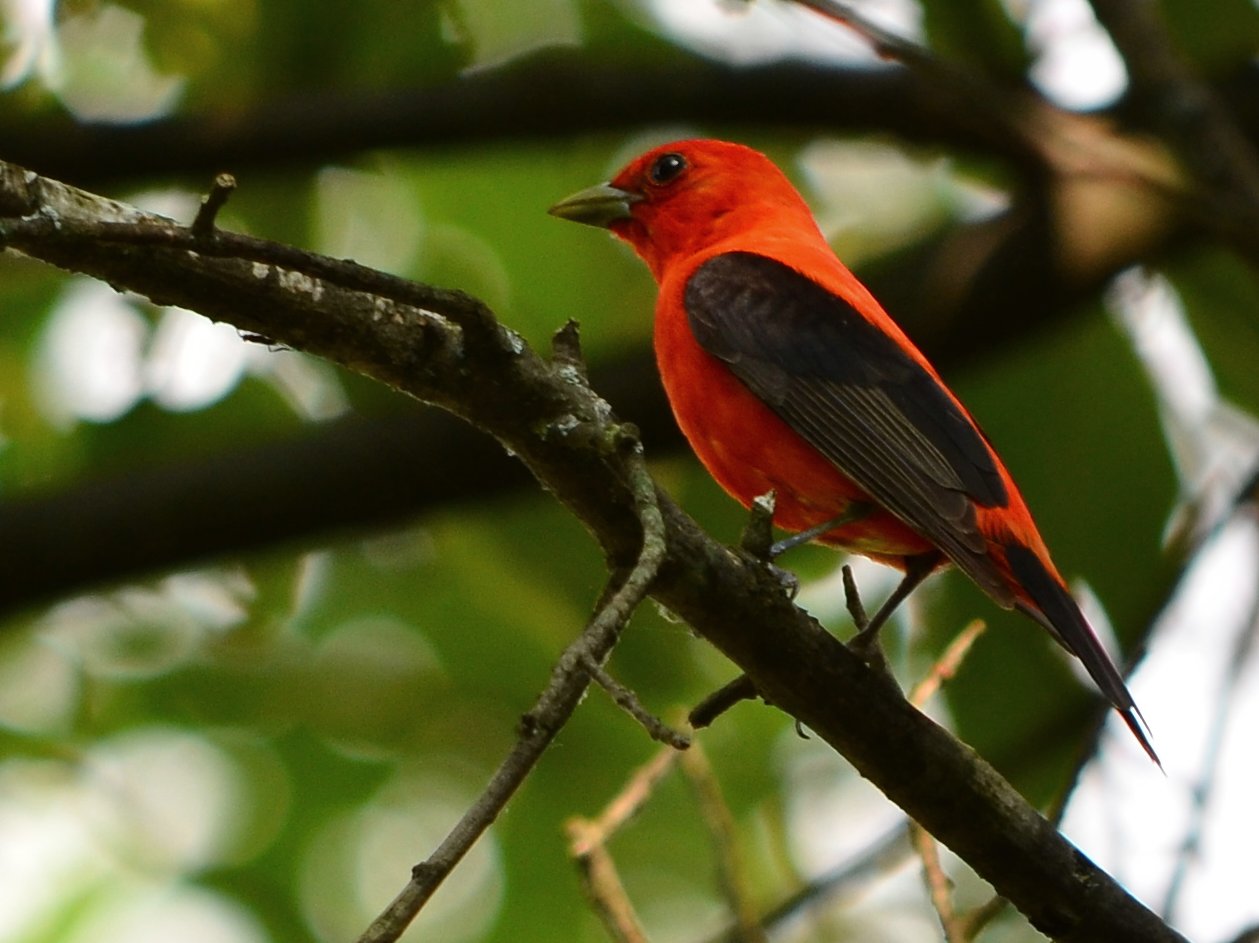
16–19 cm, with a fairly short, thick, pale bill. The breeding male is bright scarlet with jet-black wings and tail. In autumn the male is yellow-green like the female but keeps black wings and tail; during moult in spring and autumn red-and-green blotched birds can be seen. The female is olive-green above and yellow below, with dark grey, unbarred wings contrasting with the back.
Confusion species
Female Summer Tanager Piranga rubra is larger, with a longer, heavier bill, warmer mustard-yellow, and has wings the same colour as the back. Western Tanager Piranga ludoviciana, a rare vagrant, has clear yellow or white wing bars. Female Baltimore Orioles Icterus galbula have pointed bills and white wing bars.
Habitat
On migration forest edges, moist and semi-evergreen forest, montane forest, coastal woodland, dry forest and trees in gardens. It searches the crowns for insects and on migration also eats much fruit, including figs and gumbo-limbo.
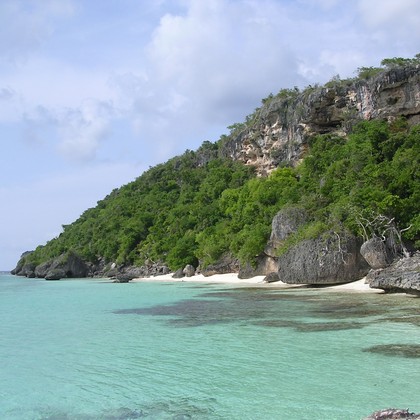
Where the bird is most at home, classified by the vegetation types of the Caribbean.




Range and movements
A fairly common to scarce passage migrant in Cuba, the Bahamas, the Cayman Islands, Jamaica and San Andrés, mainly in autumn. Rare on Hispaniola, Puerto Rico, the Virgin Islands, in the Lesser Antilles, the ABC Islands and Trinidad and Tobago. Wintering in the region is very rare. Breeds in south-eastern Canada and the eastern United States; winters from Panama and Colombia to Ecuador, Peru and Bolivia.
- Summer visitor (c. Oct–Mar)
- Passage (Mar–Apr, Oct–Nov)
- dark = core range, pale = thinly spread
How and when to look
The best chance is in October and late April to early May in western Cuba and the Cayman Islands, after northerly winds, in fruiting trees at forest edges. The chip-burr gives away birds sitting quietly high in the foliage.
Conservation status
Not threatened. The population is large, but the species is sensitive to forest fragmentation in the breeding range, where pairs in small woodlots have lower breeding success.
Scientific name
Piranga olivacea | (Gmelin, 1789)
Gmelin described the species in 1789 as Tanagra olivacea; because it was later moved to another genus, the author and year stand in brackets. The genus Piranga was introduced in 1808 by Vieillot. Piranga comes from the Tupi tijepiranga, the name of an unidentified small bird. olivacea is Latin for 'olive-coloured', after the olive-green female and winter plumage. The specimen the first description was based on came from New York.