All species › Waders, gulls and terns › Gulls and terns › Sabine's Gull
Sabine's Gull | Xema sabini
Vorkstaartmeeuw | Gaviota de Sabine
Sabine's Gull is a small, tern-like gull that breeds on the Arctic tundra and lives at sea outside the breeding season. Atlantic birds migrate past western Europe and West Africa to the cold waters off Namibia and South Africa, Pacific birds to the coast of Peru and Chile. The Caribbean lies outside both routes, and the species is a very rare vagrant here.
Voice
Almost silent away from the breeding grounds. At the breeding site a high, grating, tern-like kreee.
Recording: Stein Ø. Nilsen — CC BY-NC-SA 4.0 · shortened to the first 60 s, mono · xeno-canto
Identification
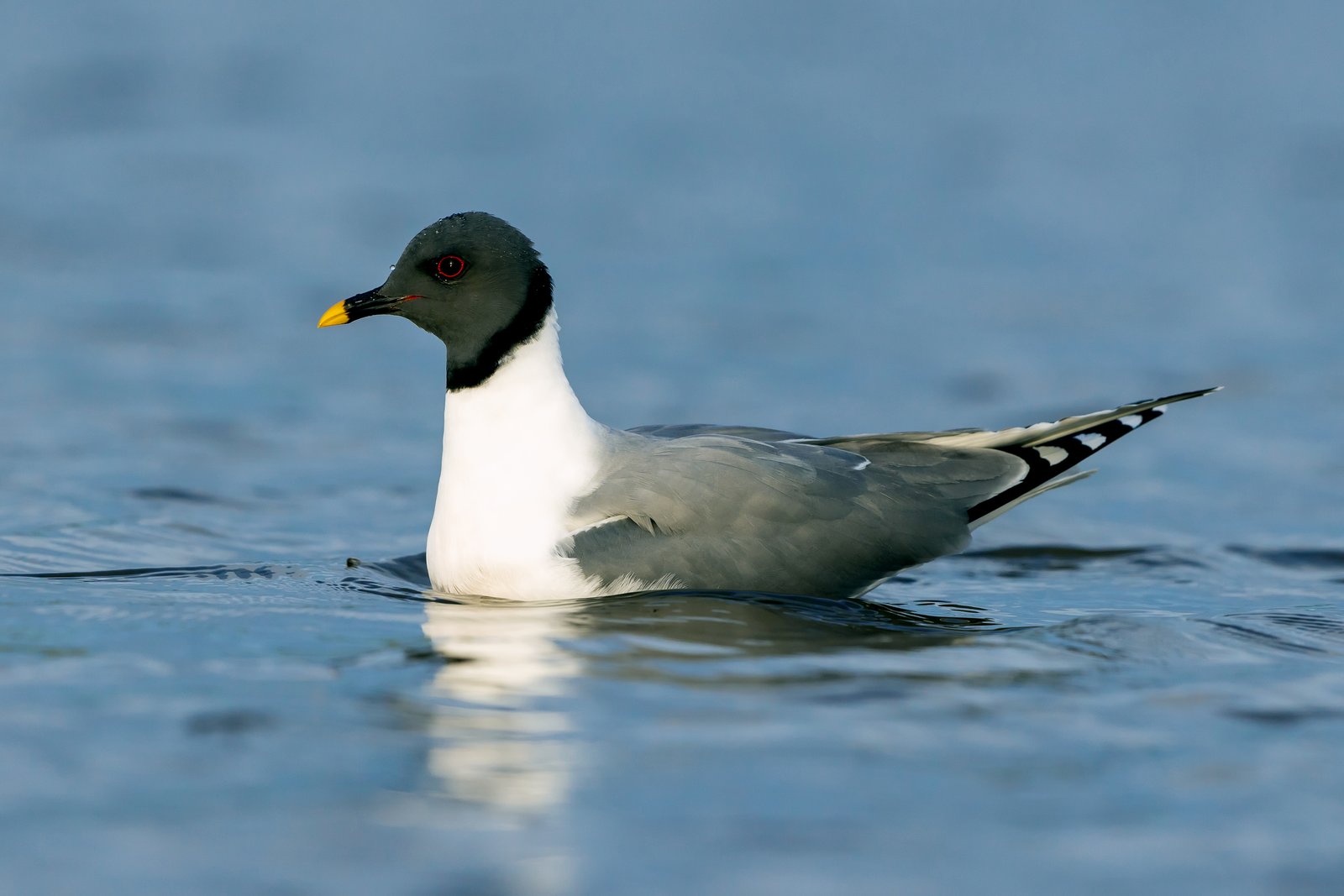
27–33 cm, small, with a slightly forked tail and long, pointed wings. In all plumages the upperwing is tricoloured: grey (grey-brown in juveniles) mantle and wing coverts, black outer primaries and a large white triangle on the inner primaries and secondaries. Breeding adults have a dark slate-grey hood with a narrow black border and a black, yellow-tipped bill; outside the breeding season the head is white with a dark hindneck. Juveniles are scaly grey-brown on the head, mantle and coverts, with a black tail band and a dark bill.
Confusion species
Bonaparte's Gull Chroicocephalus philadelphia and Black-headed Gull Chroicocephalus ridibundus have a white leading edge to the primaries rather than a white triangle on the rear of the wing, and a square tail. Juvenile Black-legged Kittiwakes Rissa tridactyla, found elsewhere in the Atlantic, have a black zigzag across the wing and a black collar. Young Laughing Gulls Leucophaeus atricilla are larger and darker, without a white wing triangle.
Habitat
Open sea and the edge of the continental shelf, where birds pick small prey from the surface in flight. It rarely comes close inshore except after storms.
Where the bird is most at home, classified by the vegetation types of the Caribbean.

Range and movements
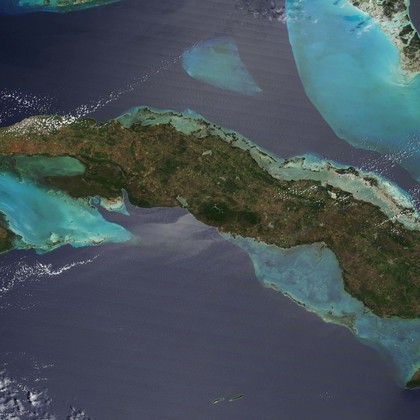
Only a few records in the region, scattered and mostly at sea. The map shows a handful of reports; those outside migration periods and from land merit checking. Beyond the region it breeds circumpolarly on the Arctic tundra and winters off south-western Africa and the west coast of South America.
How and when to look
Pelagic trips and seawatching during or after storms in migration seasons give the best chance. The tricoloured wing pattern is visible from far off in flight and rules out confusion with the other small gulls of the region.
Conservation status
Not threatened globally. In the Caribbean a very rare vagrant with no established population.
Scientific name
Xema sabini | (Sabine, 1819)
Sabine described the species in 1819 as Larus Sabini; because it was later moved to another genus, the author and year stand in brackets. The genus Xema was introduced in 1819 by Leach. Xema appears to be an invented name without meaning; William Leach introduced it in 1819 without explanation. sabini honours the British polar explorer Edward Sabine (1788–1883), who collected the first specimens on islets off the west coast of Greenland; his brother Joseph described the species from that material. The specimen the first description was based on came from the Sabine Islands, Greenland.