All species › Passerines › Tanagers › Red-legged Honeycreeper
Red-legged Honeycreeper | Cyanerpes cyaneus
Blauwe suikervogel | Mielero patirrojo
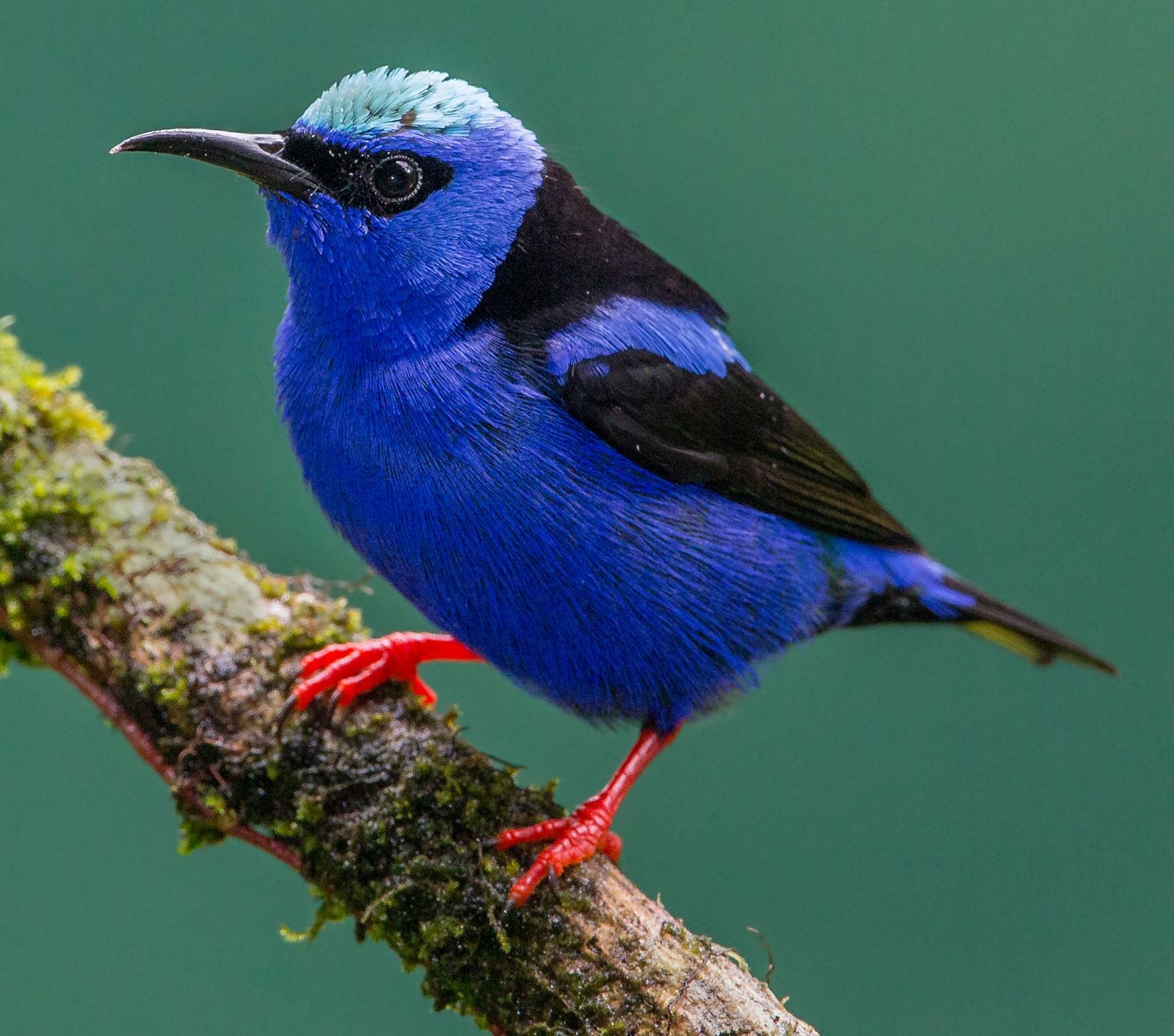
The Red-legged Honeycreeper is a small tanager with a long, slightly curved bill that eats nectar, fruit and insects. In the Caribbean it lives on Trinidad and Tobago and in Cuba, where it is called aparecido de San Diego. Whether the Cuban population is native or derives from escaped or released cage birds is debated.
Voice
Calls almost constantly, mostly with buzzy or lisping notes, such as a thin, whiny chee-eeez and a high, thin, piercing tseet. The dawn song is rarely heard: a weak tsip-tsip-chaa series.
Recording: JAYRSON ARAUJO DE OLIVEIRA — CC BY-NC-SA 4.0 · shortened to the first 60 s, mono · xeno-canto
Identification
11–13 cm, with a short tail and a long, slightly curved black bill. The breeding male is purplish blue with a pale turquoise crown, a small black mask, a black triangle on the nape and mantle and black wings and tail. The legs are bright red. In flight the bright yellow underwing and the yellow inner webs of the flight feathers stand out. Outside the breeding season the male resembles the female but keeps the black wings and tail. The female is dull olive-green above, with a faint pale supercilium, a greyish-white throat and pale yellow underparts with faint green streaks; her legs are dull reddish.
Confusion species
Male Purple Honeycreeper Cyanerpes caeruleus on Trinidad has yellow legs, a black throat and no pale crown; the female has a buffy face and a blue malar stripe. Blue Dacnis Dacnis cayana has a short, straight bill. In Cuba the male is superficially like Indigo Bunting Passerina cyanea, which has a short conical bill and no black on the back. The female resembles a vireo or warbler, but stands out by its long, curved bill and reddish legs.
Habitat
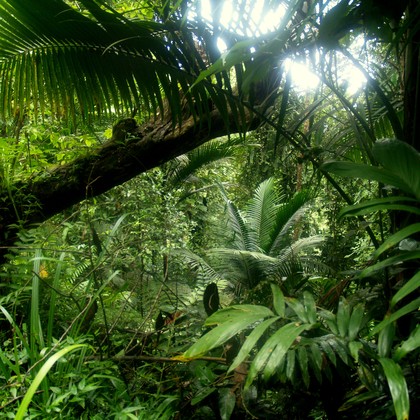
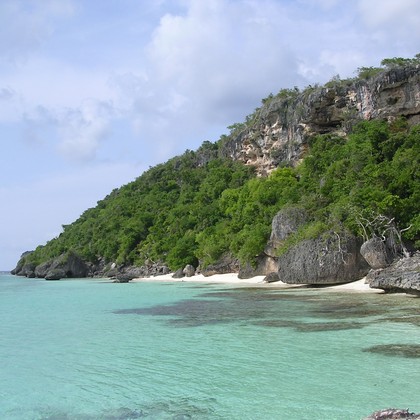
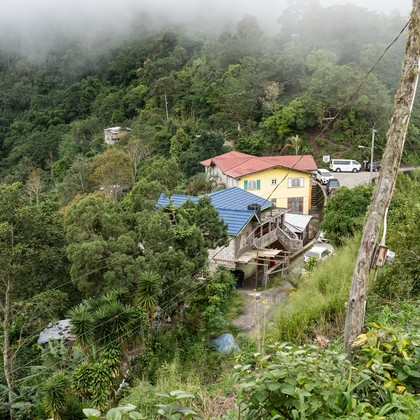
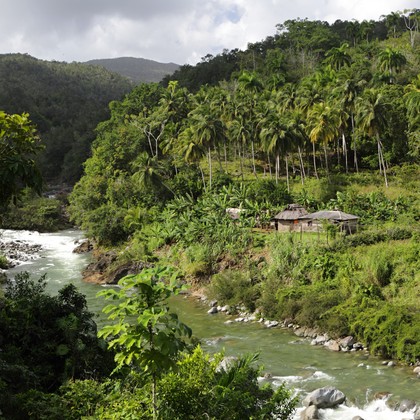
Semi-open country: forest edges, mature second growth, clearings with large trees, shaded coffee and cacao plantations, coastal woodland and parks and gardens with trees. In continuous forest it stays mainly in the crowns of flowering trees. It forages in pairs or groups, often with other tanagers and Bananaquits, and comes to feeders. The nest is a small cup in a tree.
Where the bird is most at home, classified by the vegetation types of the Caribbean.



Range and movements
Resident in Cuba, where it is common in many places in the lowlands and hills, and on Trinidad and Tobago; Tobago has its own subspecies. There are a few records from Jamaica, probably of escaped cage birds; it is a vagrant to Bonaire and Curaçao. Outside the region from southern Mexico through Central America to Bolivia and Brazil.
- Resident
- dark = core range, pale = thinly spread
How and when to look
In Cuba often in flowering trees in gardens, parks and along forest edges, for example around the Zapata Peninsula. On Trinidad and Tobago birds come to feeders with fruit and sugar water. Males in non-breeding plumage are identified by the black wings and red legs.
Conservation status
Not threatened. A widespread species of semi-open country that does well in gardens and plantations. In some places birds are trapped for the cage-bird trade.
Scientific name
Cyanerpes cyaneus | (Linnaeus, 1766)
Linnaeus described the species in 1766 as Certhia cyanea; because it was later moved to another genus, the author and year stand in brackets. The genus Cyanerpes was introduced in 1899 by Oberholser. Cyanerpes is Greek, from kuanos 'dark blue' and herpēs 'creeper'. cyaneus is Latin, from the Greek kuaneos 'dark blue'. The specimen the first description was based on came from Suriname.