All species › Gannets and cormorants › Gannets and boobies › Red-footed Booby
Red-footed Booby | Sula sula
Roodpootgent | Piquero patirrojo
The Red-footed Booby is the smallest booby in the region and the only one that nests in trees and shrubs. It forages far out at sea, often at dusk, and comes close inshore only at the colonies and a few headlands. Most of the Caribbean population breeds in a handful of colonies, of which the one on Little Cayman is the best known.
Voice
Silent at sea. At the colony a harsh, rasping karrr and rattling series ra-ra-ra-ra.
Recording: GABRIEL LEITE — CC BY-NC-SA 4.0 · converted to mono · xeno-canto
Identification
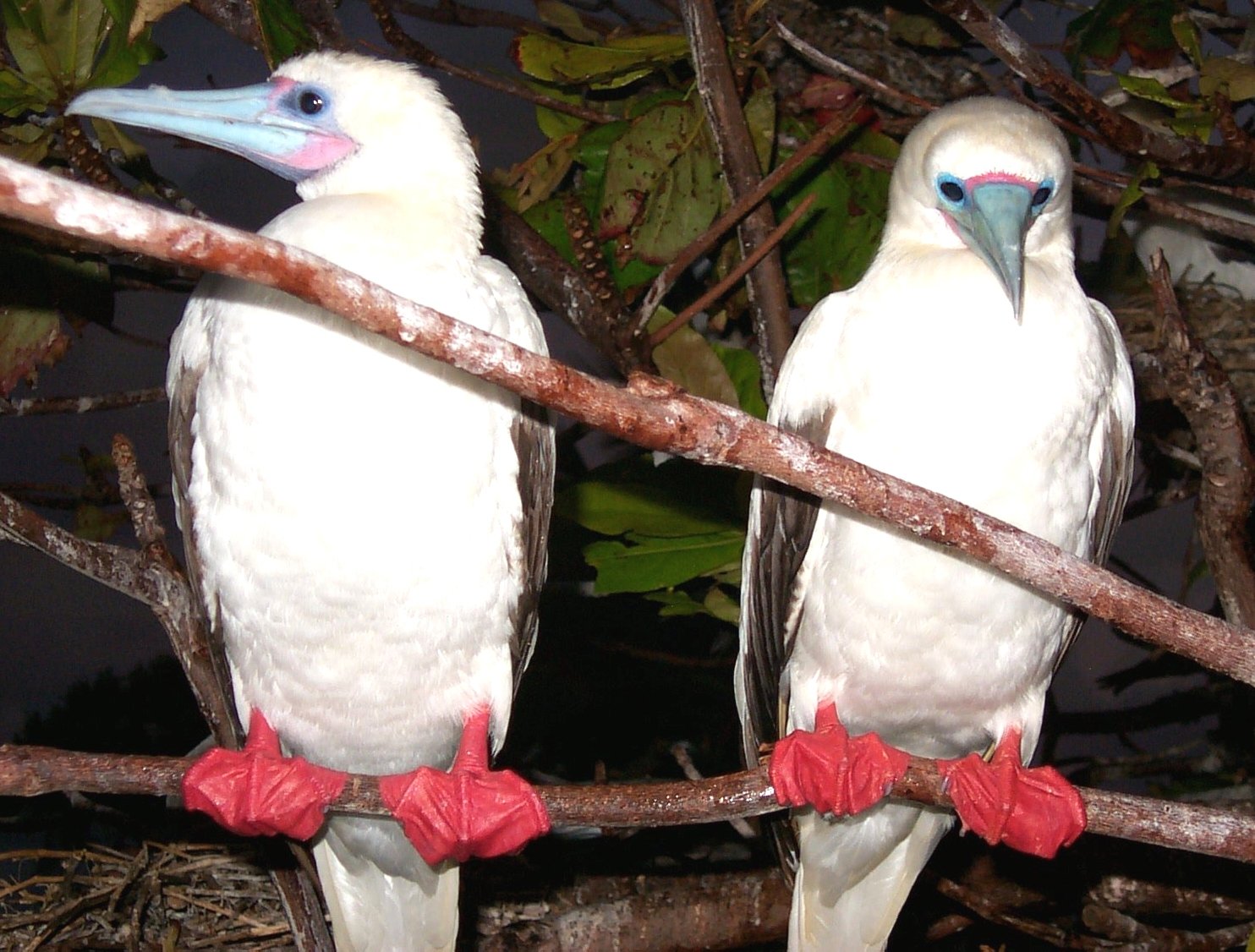
66–77 cm; slimmer and smaller than the other boobies, with a fairly long, pointed tail. Adults have bright red feet. The bill is pale blue, the bare skin at its base pink and blue. There are several colour morphs, which occur side by side in the same colony. The white morph is white with a yellowish tinge to head and neck and black primaries and secondaries; on the underwing a black patch at the carpal stands out. The brown morph is uniformly grey-brown, and the white-tailed brown morph has a white tail, rump and undertail coverts. Juveniles are brown with a dark bill and greyish to yellowish feet; adult plumage is reached in two to three years.
Confusion species
Masked Booby Sula dactylatra is larger and bulkier, with a yellow bill, a black mask, a black tail and black secondaries forming a broad trailing edge along the whole wing. Brown Booby Sula leucogaster has a sharply demarcated white belly against a dark breast and yellow feet; young Brown Boobies have a paler, mottled belly, young Red-footed Boobies uniformly brown underparts. Almost any booby perched in a tree is a Red-footed.
Habitat
Open, deep tropical water far from shore, where birds catch flying fish and squid by plunging at an angle or snatching them above the water. They also follow ships and rest on rigging and buoys. They breed colonially in mangroves, scrub and low coastal woodland on islands and islets, with a stick nest in a tree or shrub.
Where the bird is most at home, classified by the vegetation types of the Caribbean.


Range and movements
The largest colony in the region is at the Booby Pond Nature Reserve on Little Cayman. Other colonies include Little Tobago and the St Giles Islands off Tobago, Mona off Puerto Rico, the Grenadines and islets in the Lesser Antilles. Away from colonies a scarce visitor at sea around almost all islands, from the Bahamas to Trinidad, the ABC Islands and San Andrés. Outside the region in all tropical oceans.
- Resident
- Summer visitor (c. Oct–Mar)
- Winter visitor (c. Apr–Sep)
- Passage (Mar–Apr, Oct–Nov)
- dark = core range, pale = thinly spread
How and when to look
On Little Cayman the birds can be watched from the viewing point at Booby Pond, especially in the early evening as they return from sea and are chased by frigatebirds. On Tobago they are seen from the lookout on Little Tobago.
Conservation status
Not threatened. Colonies are threatened by introduced predators, clearance of mangroves and coastal woodland, disturbance and the taking of eggs and chicks. A former colony on Desecheo off Puerto Rico disappeared after rhesus monkeys were introduced.
Scientific name
Sula sula | (Linnaeus, 1766)
Linnaeus described the species in 1766 as Pelecanus Sula; because it was later moved to another genus, the author and year stand in brackets. The genus Sula was introduced in 1760 by Brisson. Sula goes back to súla, the Old Norse and Icelandic word for the gannet; the name passed to the boobies. sula comes from the Old Norse and Icelandic súla, the name for the gannet. The specimen the first description was based on came from Barbados (designated later).