All species › Parrots › Parrots › Red-and-green Macaw
Red-and-green Macaw | Ara chloropterus
Groenvleugelara | Guacamayo aliverde
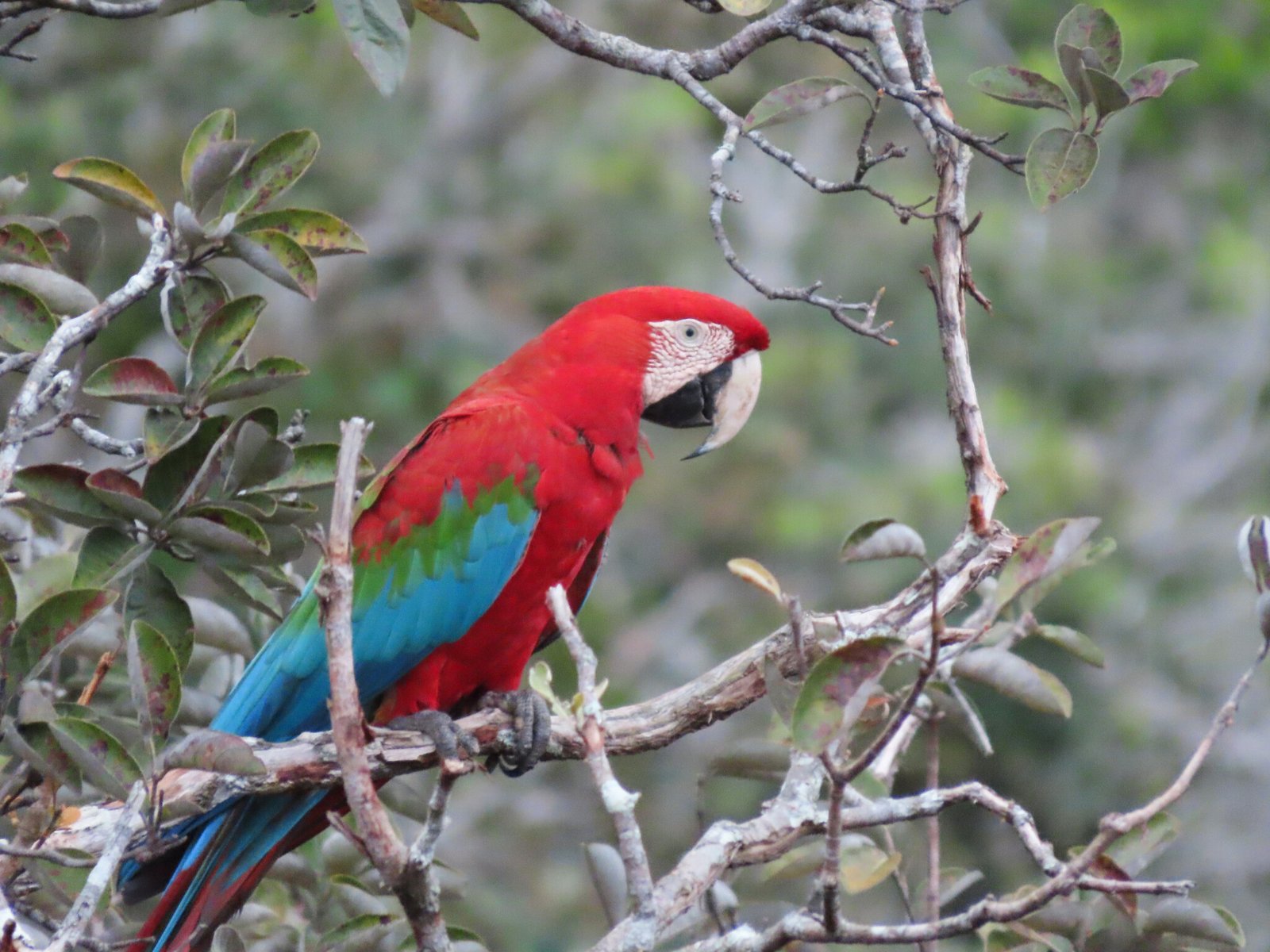
The Red-and-green Macaw is the largest red macaw, with a green wing band and a long red tail. It is not native to the Caribbean. A small population has lived on Trinidad since 1999; whether it derives from escaped cage birds or from birds that crossed from Venezuela is unknown.
Voice
A deep, raw, rasping raaah, lower and coarser than that of Blue-and-yellow Macaw, mainly in flight. While feeding also growling and creaking sounds.
Recording: JAYRSON ARAUJO DE OLIVEIRA — CC BY-NC-SA 4.0 · converted to mono · xeno-canto
Identification
90–95 cm, heavy-headed and with a very long pointed tail. Head, breast and belly are deep crimson. A broad green band of median coverts runs across the wing; flight feathers, rump and undertail coverts are blue. The tail is red with blue tips. The bare white face shows lines of tiny red feathers. The upper mandible is pale horn, the lower black. The sexes are alike. Flight is on slow, deep beats, usually in pairs.
Confusion species
Scarlet Macaw Ara macao, which occurs in the region only as a cage bird, has a yellow instead of green wing panel, a bare face without red feather lines and is slightly smaller. Blue-and-yellow Macaw Ara ararauna is blue and yellow. Red-bellied Macaw Orthopsittaca manilatus on Trinidad is much smaller and green.
Habitat
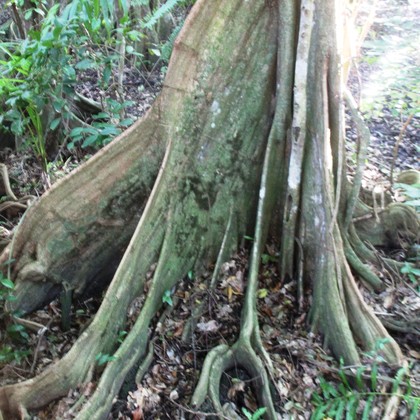
On Trinidad forest edge, secondary forest and semi-open farmland with tall trees, mainly in the west and south of the island and on the outskirts of Port of Spain. It eats seeds, nuts and fruit of trees and palms. In its native range a bird of lowland rainforest and forest edge, nesting in holes in large trees.
Where the bird is most at home, classified by the vegetation types of the Caribbean.



Range and movements
Trinidad: small population since 1999, with records scattered across the island, including Siparia, Penal-Debe, San Juan-Laventille and Tunapuna-Piarco. A few records are known from Grenada, and single birds elsewhere in the region are escapes. Native from eastern Panama and Colombia through Venezuela and the Guianas to Bolivia, Paraguay, northern Argentina and Brazil.
- Resident
- dark = core range, pale = thinly spread
How and when to look
On Trinidad worth searching for in the south and west of the island, where pairs fly over open country with tall trees in the morning. The low, coarse call and slow wingbeats are the first clue; in good light the green wing band can be seen.
Conservation status
Not threatened globally, but declining in many areas through trapping for trade and deforestation; extirpated in Argentina, where it is being reintroduced in the Iberá wetlands. On Trinidad an alien with a small, vulnerable population.
Scientific name
Ara chloropterus | Gray, 1859
Gray described the species in 1859 and placed it straight away in the genus where it still stands. The genus Ara was introduced in 1799 by De Lacépède. Ara comes from Tupí, where ará is an onomatopoeic name for the macaws. chloropterus is Greek for 'green-winged', from khlōros 'green' and pteron 'wing', after the green median wing coverts. The specimen the first description was based on came from not stated.