All species › Passerines › Swallows and martins › Purple Martin
Purple Martin | Progne subis
Purperzwaluw | Golondrina purpúrea
The Purple Martin is the largest swallow in North America. In the east of its range it nests almost exclusively in colonies in martin houses and gourds put up by people; it winters in South America, mainly in Brazil. Most birds migrate through Central America and across the Gulf of Mexico; only a small proportion passes through the western Caribbean.
Voice
Rich, throaty and gurgling calls such as tchew-wew and cher; the song is a gurgling twitter.
Recording: David A. Brinkman — CC BY-NC-SA 4.0 · shortened to the first 60 s, mono · xeno-canto
Identification
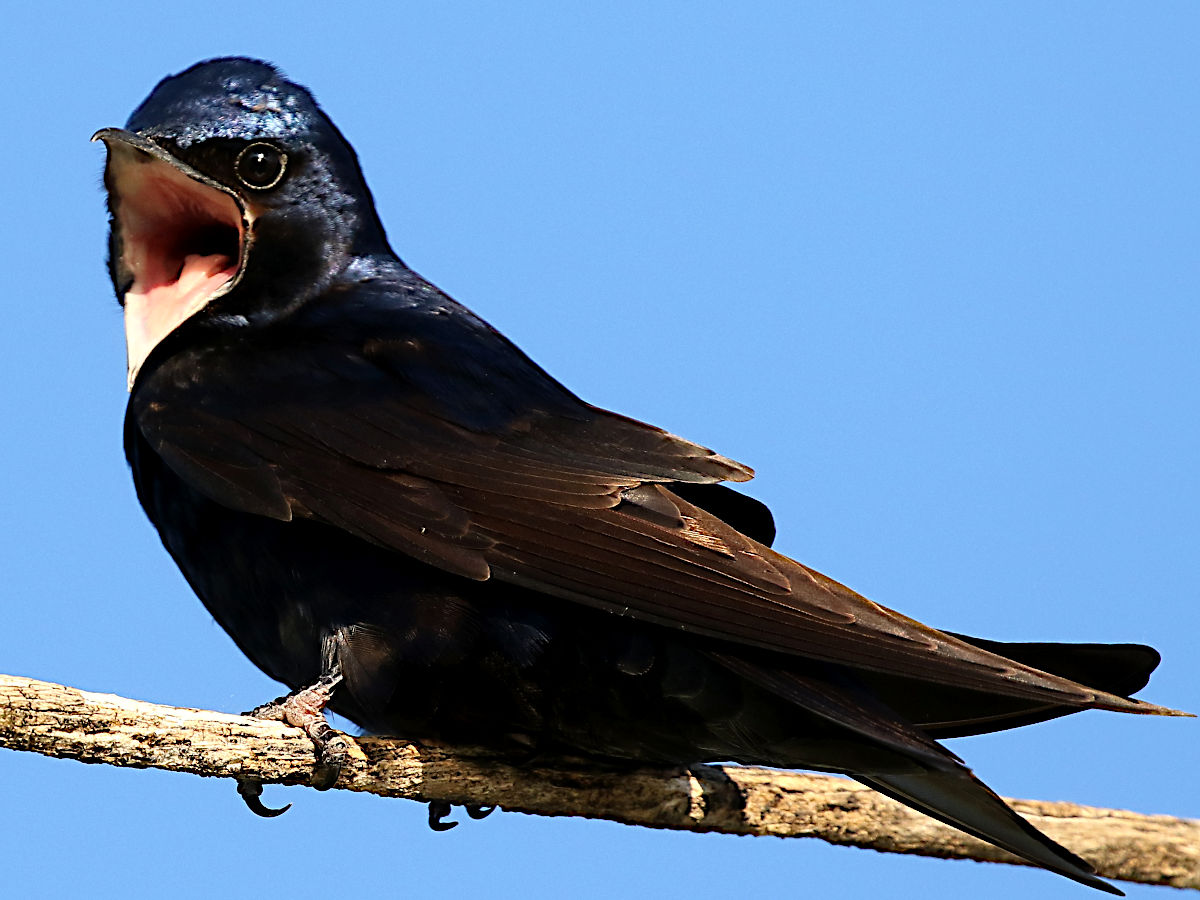
19–20 cm, large and robust, with broad, triangular wings and a forked tail. The adult male is entirely dark glossy purple-blue. The female is duller blue-grey above with a pale greyish collar; throat and breast are grey-brown and somewhat scaled, and the belly is dingy white with fine dark streaks, blending gradually into the breast. First-year males resemble females, with scattered dark feathers on throat and breast. The flight alternates flapping and gliding.
Confusion species
The male cannot be reliably told in the field from the male Cuban Martin Progne cryptoleuca. Females of Cuban and Caribbean Martin Progne dominicensis have a clean white belly sharply set off from the dark breast, without scaling or streaks; male Caribbean Martins have a white belly. Grey-breasted Martin Progne chalybea on Trinidad and Tobago is smaller, with a grey-brown throat and breast in both sexes.
Habitat
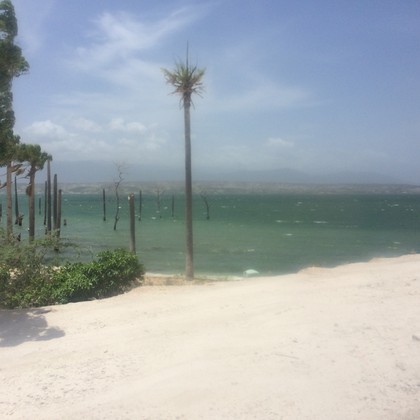
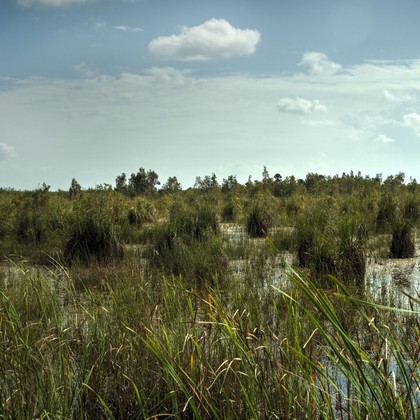
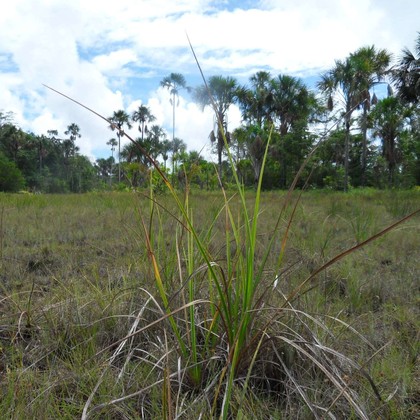
On migration over open country, marshes, ponds, coastal lagoons and settlements, often with other swallows. It eats large flying insects, often caught high in the air, and rests on wires and antennas.
Where the bird is most at home, classified by the vegetation types of the Caribbean.


Range and movements
A scarce passage migrant in the Bahamas, Cuba and the Cayman Islands. Elsewhere rare, with records from Jamaica, Hispaniola, Puerto Rico, the Lesser Antilles, the ABC Islands, San Andrés and Trinidad and Tobago, among others. It breeds from southern Canada to Mexico and winters mainly in Brazil, Bolivia and Peru.
- Resident
- dark = core range, pale = thinly spread
How and when to look
A large, dark swallow among flocks of Barn Swallows in August and September on Cuba or in the Bahamas may be this species. On Cuba a male in the breeding season cannot be separated from Cuban Martin; females and young birds are identified by the grey, scaled breast, pale collar and streaked belly.
Conservation status
Not threatened. The species is numerous; in eastern North America it depends almost entirely on nest sites provided by people.
Scientific name
Progne subis | (Linnaeus, 1758)
Linnaeus described the species in 1758 as Hirundo subis; because it was later moved to another genus, the author and year stand in brackets. The genus Progne was introduced in 1826 by Boie. Progne (also Procne) is the daughter of King Pandion of Athens in Greek myth, who was turned into a swallow; in Latin also a word for 'swallow'. subis is Latin for a bird that, according to the Roman author Nigidius Figulus, could break eagles' eggs; possibly a nod to the bird's fierce mobbing of raptors near the nest. The specimen the first description was based on came from Hudson Bay, Canada.