All species › Passerines › Puerto Rican tanager › Puerto Rican Tanager
Puerto Rican Tanager | Nesospingus speculiferus
Puerto Ricaanse tangare | Llorosa
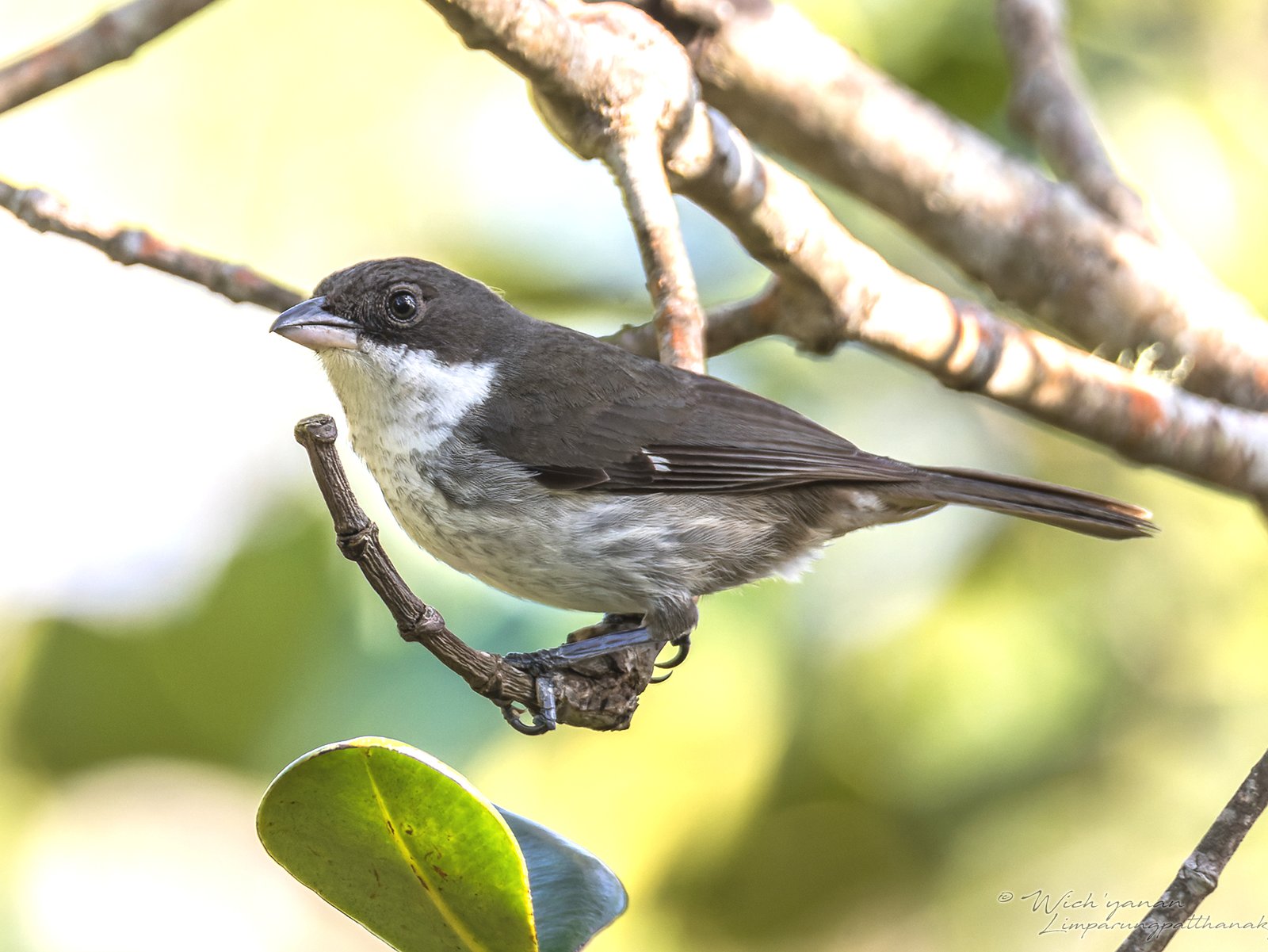
The Puerto Rican Tanager is a brown and white forest bird of the Puerto Rican mountains and the only member of the family Nesospingidae. Despite its name it is not a true tanager; DNA studies place it in a family of its own, found only in Puerto Rico. Flocks are noisy and often form the core of mixed feeding flocks. In Puerto Rico it is called llorosa.
Voice
In flocks a harsh chewp or chuck, also soft sighing sounds and a thin tsip-tsip-tsip. The breeding-season song is a light, rapidly delivered series of repeated notes.
Recording: Nick Komar — CC BY-NC-SA 4.0 · converted to mono · xeno-canto
Identification
18–20 cm, with a fairly long tail and a stout bill. The upperparts are olive-brown, the crown and face darker. The throat is pure white, the rest of the underparts pale grey to white with faint dusky streaking on the breast. There is a white spot on the wing. The male has a brown-black upper mandible and a white lower mandible; the female's bill is all black. Immatures are brownish below and lack the white wing spot.
Confusion species
Pearly-eyed Thrasher Margarops fuscatus is larger, with a white iris, a pale bill and scaly underparts, and has no white wing spot. Eastern Red-legged Thrush Turdus ardosiaceus is grey, with red legs and a red eye-ring. Puerto Rican Vireo Vireo latimeri is much smaller, with a yellowish belly and a white eye-ring.
Habitat
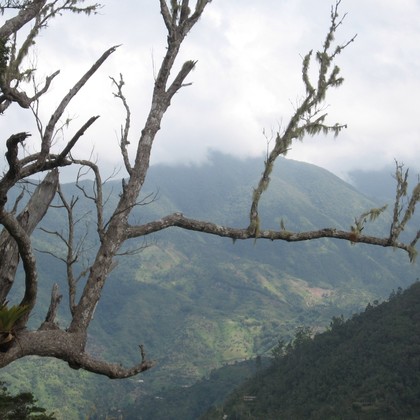
Humid and wet montane forest, lower montane rainforest and elfin forest, between about 300 and 1,350 m. It forages in flocks in the middle and upper levels for insects and fruit and is the nucleus of mixed flocks, especially outside the breeding season. It roosts communally in large bamboo clumps or palms. In the breeding season, from January to late July, pairs are territorial.
Where the bird is most at home, classified by the vegetation types of the Caribbean.


Range and movements
Only in Puerto Rico, in the mountains of the Cordillera Central and the Sierra de Luquillo, with the largest numbers in El Yunque and Maricao forest. The range has been fragmented by deforestation. The species does not occur outside Puerto Rico.
- Resident
- dark = core range, pale = thinly spread
How and when to look
Along the roads and trails in the montane forest of El Yunque and in Maricao forest, flocks are often heard first by their harsh chuck. Other forest birds travel with them, so a passing flock is worth checking carefully.
Conservation status
Vulnerable. Past deforestation has split the range into separate forest blocks; the largest numbers now live in protected forests.
Scientific name
Nesospingus speculiferus | (Lawrence, 1875)
Lawrence described the species in 1875 as Chlorospingus (?) speculiferus; because it was later moved to another genus, the author and year stand in brackets. The genus Nesospingus was introduced in 1885 by Sclater. Nesospingus is Greek, from nēsos 'island' and spingos 'finch': 'island finch'. speculiferus is Latin, from speculum 'mirror' and -fer 'bearing', after the small white wing patch. The specimen the first description was based on came from Puerto Rico.