All species › Passerines › Tyrant flycatchers › Olive-striped Flycatcher
Olive-striped Flycatcher | Mionectes olivaceus
Olijfstreeppipratiran | Mosquerito olivirrayado
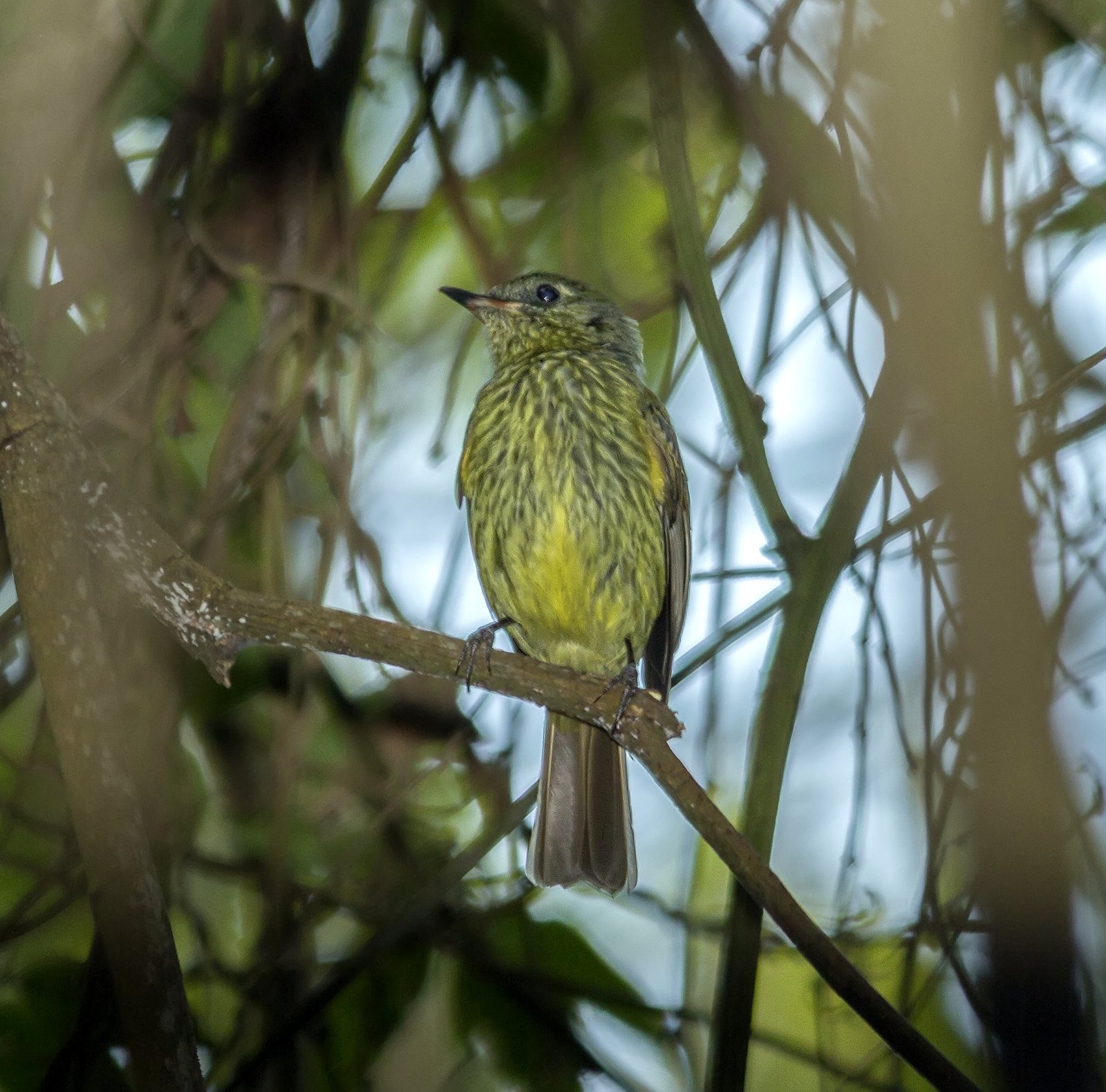
The Olive-striped Flycatcher is an inconspicuous, olive-green tyrant flycatcher with streaked underparts, found in the region only in the montane forests of Trinidad. Like the related Ochre-bellied Flycatcher it eats many berries and regularly lifts one wing. Recent classifications split off the birds of Costa Rica and Panama as a separate species; the South American birds, including those of Trinidad, are then called Mionectes galbinus.
Voice
Very high, thin notes that suggest an insect or a hummingbird rather than a flycatcher; heard mainly early in the morning, low in dense vegetation. Largely silent outside the breeding season.
Recording: Carlos Delgado JUMABITA — CC BY-NC-SA 4.0 · shortened to the first 60 s, mono · xeno-canto
Identification
13–14 cm. Head, back and rump yellowish green to olive. The face is dark olive with fine pale streaks and a small white spot just behind the eye. Throat and breast densely streaked dark olive and yellowish white, the flanks streaked olive and yellow; the belly is pale yellow. Wings and tail dusky olive with narrow yellow-green edges, without distinct wing bars. The bill is narrow and black, with an orange-tinged base in older birds. The sexes are alike.
Confusion species
Ochre-bellied Flycatcher Mionectes oleagineus is unstreaked, with an ochre belly. Slaty-capped Flycatcher Leptopogon superciliaris has a grey crown, a dark crescent on the ear-coverts and distinct wing bars. Female manakins such as Golden-headed Manakin Ceratopipra erythrocephala are stockier, shorter-tailed and unstreaked.
Habitat
Humid forest, forest edge and older secondary forest in the mountains, in Trinidad mainly in the higher parts of the Northern Range. It forages in the lower and middle storeys on small berries, including those of mistletoes and Melastomataceae, and on insects picked from leaves. The nest is a hanging ball of moss and plant fibres with a side entrance.
Where the bird is most at home, classified by the vegetation types of the Caribbean.


Range and movements
In Trinidad an uncommon resident of the Northern Range; absent from Tobago and the rest of the region. Outside the region in the coastal mountains of Venezuela and along the Andes from Colombia to Bolivia; in the broad sense also in the mountains of Costa Rica and Panama.
- Resident
- dark = core range, pale = thinly spread
How and when to look
In Trinidad best searched for along the road to Blanchisseuse and at other high sites in the Northern Range, at fruiting shrubs along forest edges. The bird often sits still in the shade and gives itself away by lifting a wing.
Conservation status
Not threatened. The species has a large range in the Andes and neighbouring mountains. In Trinidad it is confined to montane forest and therefore vulnerable to its loss.
Scientific name
Mionectes olivaceus | Lawrence, 1868
Lawrence described the species in 1868 and placed it straight away in the genus where it still stands. The genus Mionectes was introduced in 1844 by Cabanis. Mionectes is Greek meionektēs 'small, having suffered loss', from meionekteō 'to have too little'. olivaceus is Modern Latin for 'olive-coloured', after the olive-green plumage. The specimen the first description was based on came from Barranca, Costa Rica.