All species › Passerines › Tyrant flycatchers › Ochre-lored Flatbill
Ochre-lored Flatbill | Tolmomyias flaviventris
Geelbuikbreedbektiran | Picoplano pechiamarillo
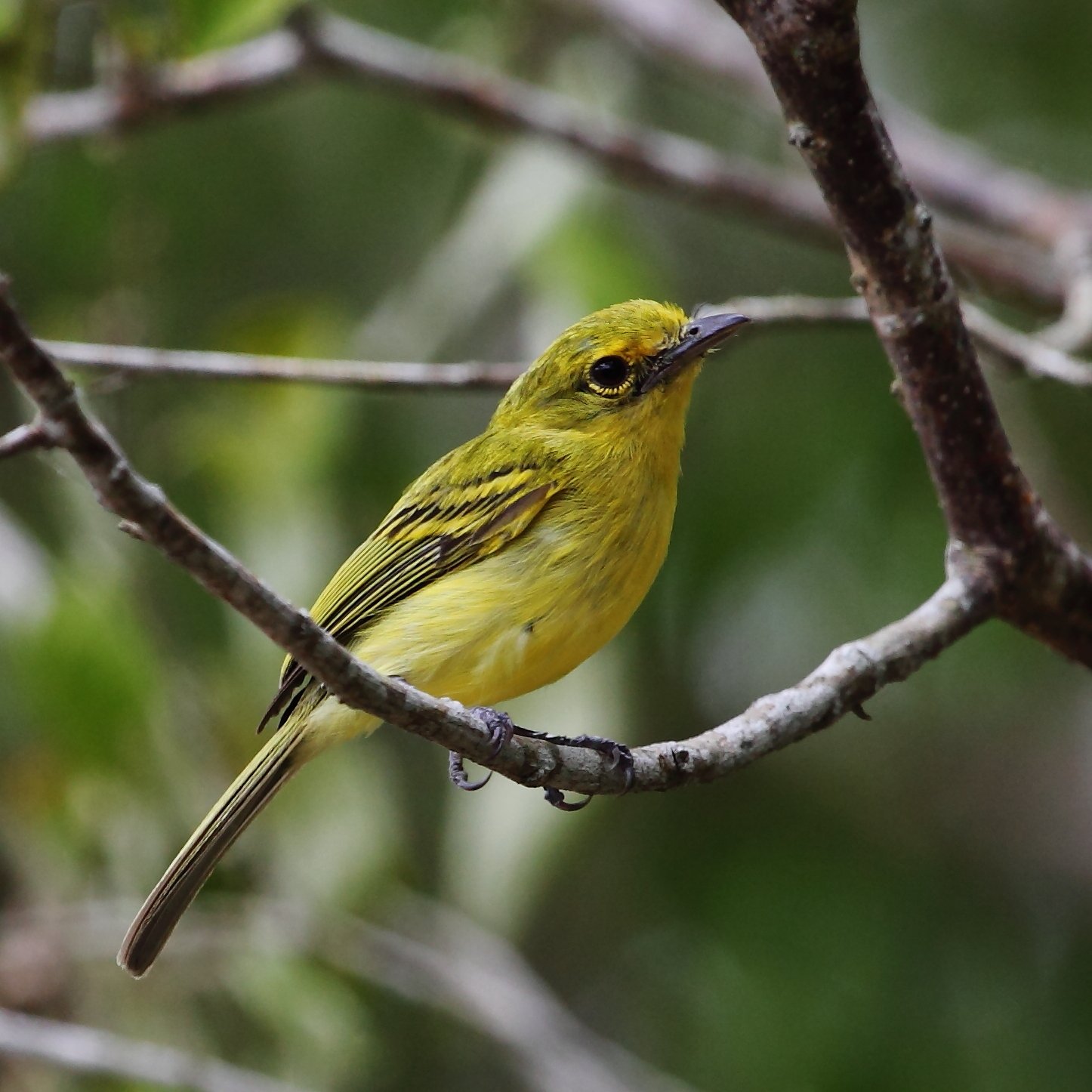
The Ochre-lored Flatbill is a yellowish-green tyrant flycatcher with a broad, flat bill, found in Trinidad and Tobago in mangroves, drier forest, forest edges and plantations. It is heard far more often than seen: its loud, penetrating whistles carry from the canopy, where the bird itself usually stays hidden.
Voice
A series of three to five loud, penetrating whistles separated by short pauses, like shreeep... shreeep... shreeep, often from a hidden canopy perch and mainly around dawn. Also a single swee-eep and a short, dry rattle.
Recording: Mateus Gonçalves Santos — CC BY-NC-SA 4.0 · shortened to the first 60 s, mono · xeno-canto
Identification
12–13 cm. Head and upperparts yellowish olive-green. Lores and eye-ring are ochre-yellow, giving the face a warm tone; the iris is dark brown. The dusky wings have two yellow wing bars. The underparts are bright yellow, with an olive-ochre wash on the throat and breast. The bill is broad and flat, dark grey to black. The sexes are alike.
Confusion species
Yellow-olive Flatbill Tolmomyias sulphurescens has a greyish crown, a whitish line above the lores, a pale iris and a greyer throat and breast. Yellow-bellied Elaenia Elaenia flavogaster is larger, with a crest and a narrow bill. Golden-fronted Greenlet Pachysylvia aurantiifrons has a pointed bill, no wing bars and a golden-yellow forehead.
Habitat
Mangroves, dry and semi-evergreen forest, coastal woodland, forest edges, wooded savanna and cacao, also gardens with large trees, in the lowlands. It searches the canopy and middle storey for insects and also eats berries. The nest is a pear-shaped bag of rootlets and plant fibres with an entrance tube leading in from below, hanging from a branch.
Where the bird is most at home, classified by the vegetation types of the Caribbean.





Range and movements
Resident in Trinidad and Tobago, widespread in the lowlands of both islands. Absent from the rest of the region. Outside the region in northern South America, from Colombia and Venezuela through the Guianas to Amazonia and eastern Brazil.
- Resident
- dark = core range, pale = thinly spread
How and when to look
In Trinidad, among other places, at the Aripo Savannas and in mangroves; in Tobago at forest edges and in gardens. The whistles are the best clue; then scan the canopy patiently for a small yellow bird with a broad bill.
Conservation status
Not threatened. The species has a large range and also occurs in secondary growth, plantations and gardens.
Scientific name
Tolmomyias flaviventris | (Wied-Neuwied, 1831)
Wied-Neuwied described the species in 1831 as Muscipeta flaviventris; because it was later moved to another genus, the author and year stand in brackets. The genus Tolmomyias was introduced in 1927 by Hellmayr. Tolmomyias is Greek, from tolma 'boldness' and muias 'fly' (flycatcher): 'bold flycatcher'. flaviventris is Latin, from flavus 'yellow' and venter 'belly', after the yellow underparts. The specimen the first description was based on came from southern Bahia, Brazil.