All species › Waterfowl › Ducks and geese › Northern Shoveler
Northern Shoveler | Spatula clypeata
Slobeend | Cuchara común
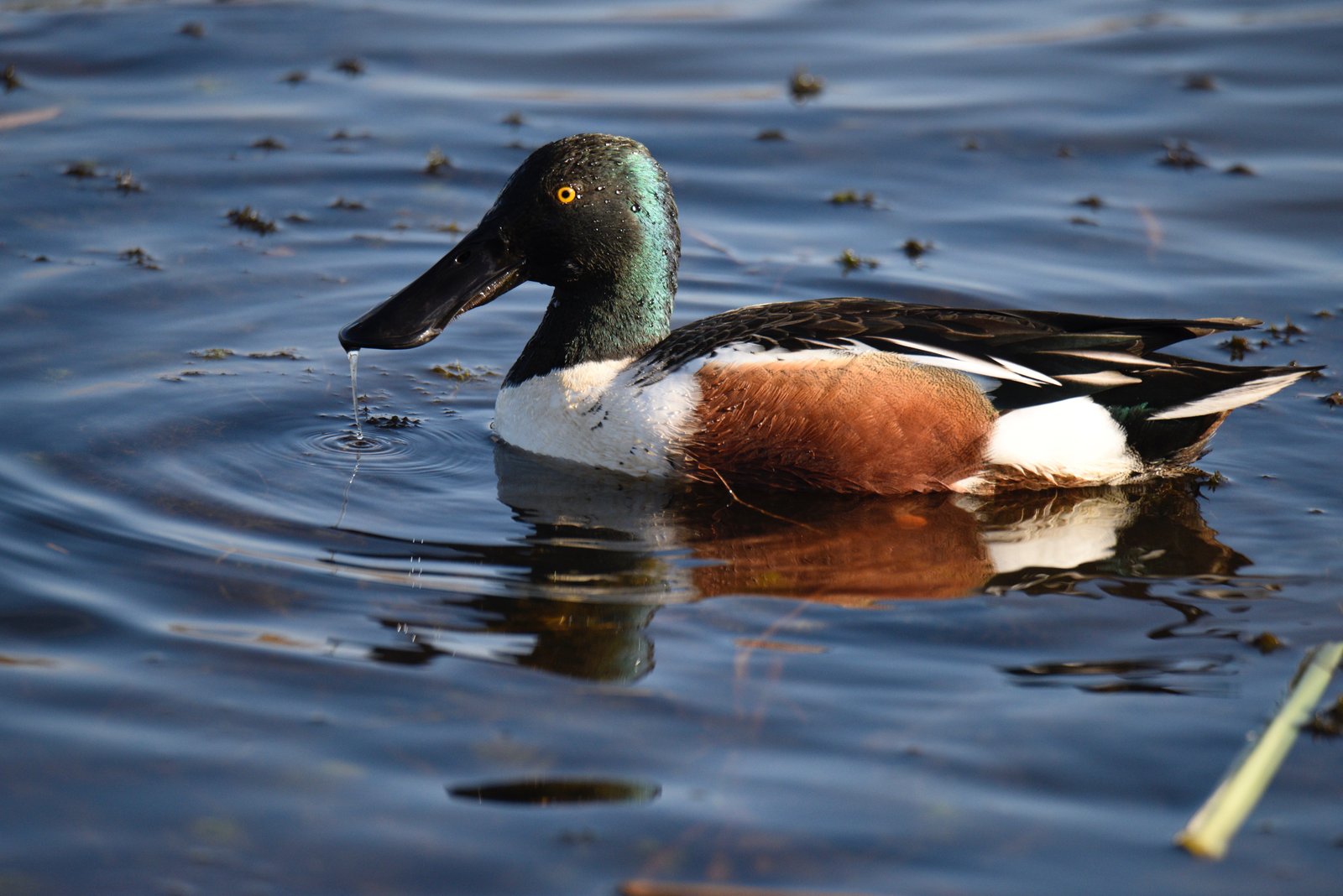
The Northern Shoveler can be recognised by shape alone, thanks to its long, spoon-shaped bill. In the Caribbean it is a winter visitor from North America, regular in the Bahamas, Cuba, Jamaica and Hispaniola and increasingly rare towards the east. In Cuba it is called pato cuchareta.
Voice
Usually silent in winter. The drake gives a hollow, repeated took-took; the female a descending quacking quack-quack-quack.
Recording: Sonothèque ADVL — CC0 · converted to mono · xeno-canto
Identification
44–52 cm, a medium-sized dabbling duck that sits low in the water, its long bill, strongly broadened at the tip, often pointed at the surface. The breeding drake has a dark green head, a yellow eye, a white breast, chestnut flanks and belly and a white patch in front of the black stern; the bill is black. The female is mottled brown, with an orange edge to the bill. In autumn many drakes are still in a brown, female-like plumage, sometimes with a white crescent on the face. In flight a pale blue forewing, a white bar and a green speculum, and the heavy bill makes the wings look set far back.
Confusion species
Blue-winged Teal Spatula discors and Cinnamon Teal S. cyanoptera share the pale blue forewing but are smaller with a much smaller bill. At a distance the green-headed drake may recall a drake Mallard Anas platyrhynchos, but the white breast, rufous flanks and bill rule out confusion.
Habitat
Shallow, nutrient-rich fresh and brackish waters: ponds, lagoons, salt pans and inland brackish lakes, marshes and rice fields. It filters plankton, small crustaceans, insects and seeds from the surface water while swimming, often in small groups that circle together.
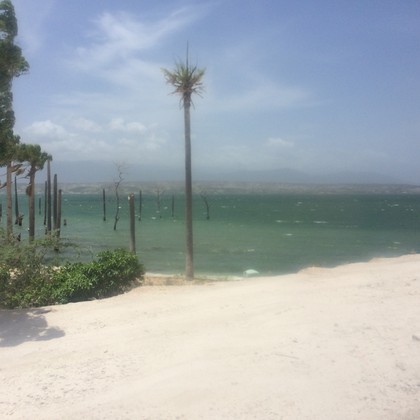
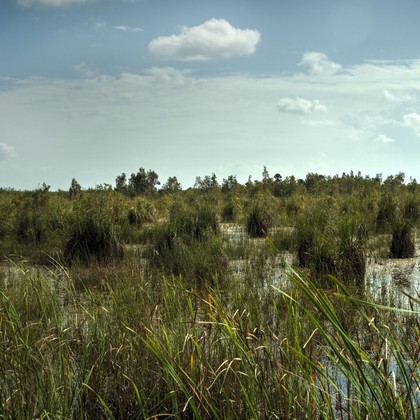
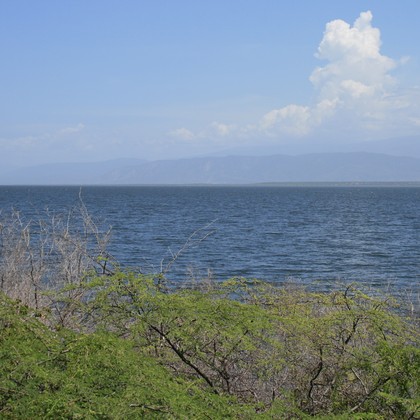
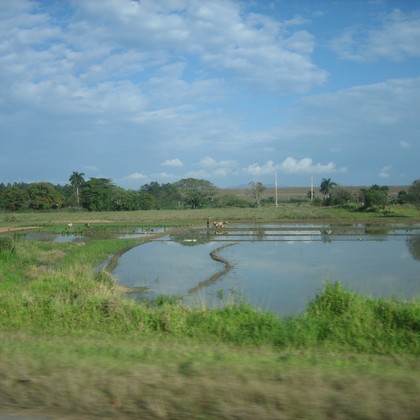
Where the bird is most at home, classified by the vegetation types of the Caribbean.

Range and movements
Winter visitor to the Bahamas, Cuba, Jamaica and Hispaniola (Haiti and the Dominican Republic), mostly in small numbers. In Puerto Rico, the Cayman Islands, Guadeloupe, Barbados and Trinidad and Tobago a vagrant. Breeds in North America, Europe and Asia; North American birds winter from the United States through Mexico and Central America to northern South America.
- Resident
- Winter visitor (c. Apr–Sep)
- Passage (Mar–Apr, Oct–Nov)
- dark = core range, pale = thinly spread
How and when to look
In Cuba and the Bahamas in winter on shallow ponds and brackish lagoons, often among Blue-winged Teal. The low profile in the water and heavy bill identify it even at a distance and in female-type plumage.
Conservation status
Least Concern. Ducks are hunted on the Caribbean islands, and the wetlands are under pressure from draining and development.
Scientific name
Spatula clypeata | (Linnaeus, 1758)
Linnaeus described the species in 1758 as Anas clypeata; because it was later moved to another genus, the author and year stand in brackets. The genus Spatula was introduced in 1822 by Boie. Spatula is Latin for 'spoon' or 'spatula', after the broad, spoon-shaped bill of the shoveler. clypeata is Latin for 'shield-bearing', from clypeus 'shield'. The specimen the first description was based on came from southern Sweden.