All species › Parrots › Parrots › Monk Parakeet
Monk Parakeet | Myiopsitta monachus
Monniksparkiet | Cotorra argentina
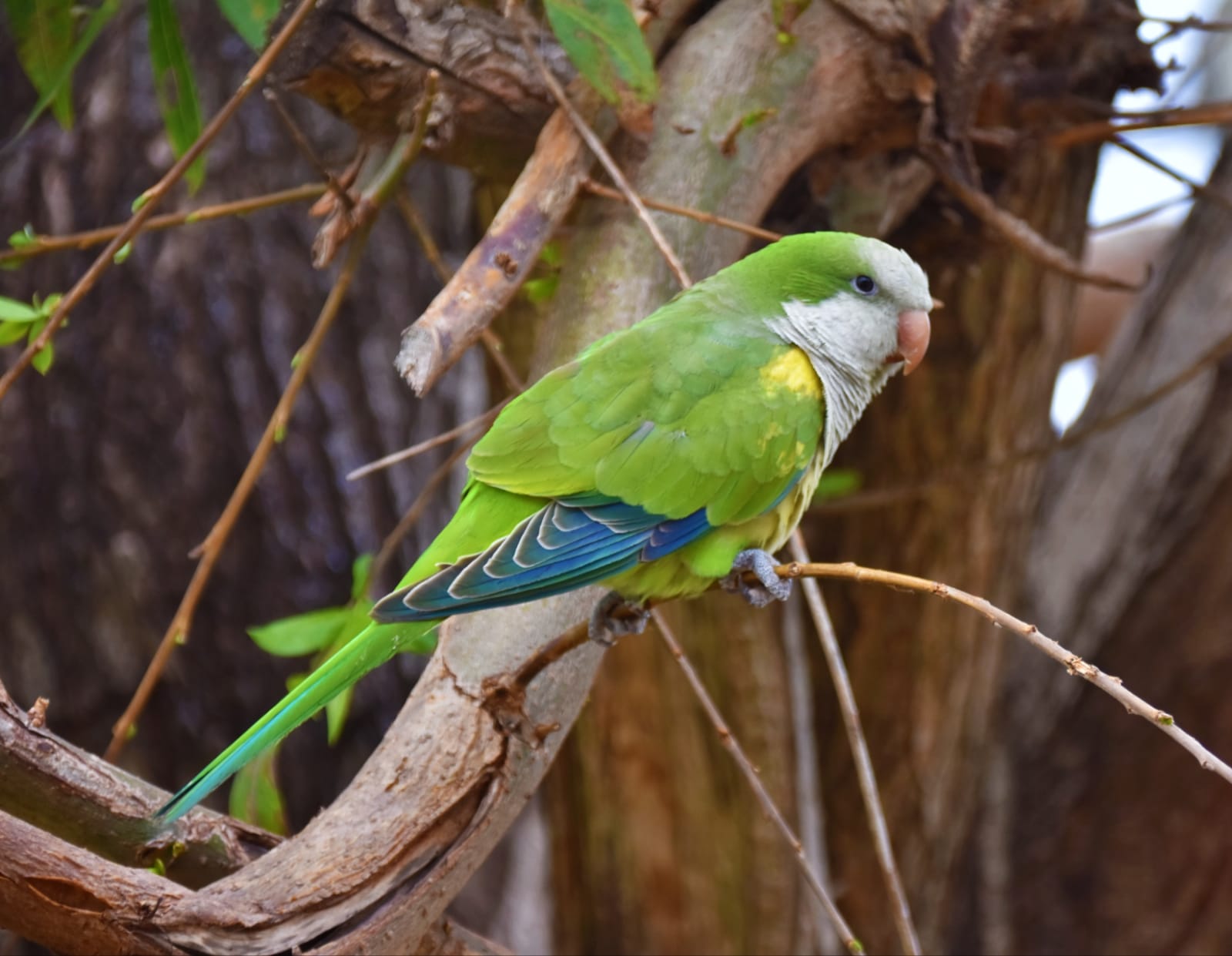
The Monk Parakeet is a green parakeet with a grey face and breast, and the only parrot that builds large communal stick nests. It is not native to the Caribbean: the birds here descend from escaped and released cage birds from southern South America. In Puerto Rico it has been established since the 1980s and is still spreading.
Voice
Loud and harsh: a grating, repeated kweek-kweek and kree-kree, in flight and at the nest; flocks keep up a continuous chatter.
Recording: Joan Theng — CC BY-NC-SA 4.0 · shortened to the first 60 s, mono · xeno-canto
Identification
28–29 cm, with a long pointed tail. The upperparts are bright green; forehead, face, throat and breast pale grey, the breast with pale scaly scalloping. The belly is yellowish-green and the flight feathers blue, visible in flight. The bill is pale horn to orangey. The sexes are alike. Flight is fast on rapid shallow beats, usually in noisy small flocks.
Confusion species
The grey forehead and breast separate it from every other green parakeet in the region. White-winged Parakeet Brotogeris versicolurus, also established in Puerto Rico, is smaller, with a shorter tail and a yellow-and-white wing panel. Orange-fronted Parakeet Eupsittula canicularis has an orange forehead and Red-masked Parakeet Psittacara erythrogenys a red face. The native parakeets of Cuba and Hispaniola, Cuban Parakeet Psittacara euops and Hispaniolan Parakeet P. chloropterus, show red in the wing and no grey on head and breast.
Habitat
Towns, villages, parks and gardens, coconut and palm plantings, farmyards and open country with scattered trees near the coast. It eats seeds, fruit, flowers and buds, and visits bird tables. The nest is a large ball of sticks built jointly by several pairs, in a palm at the base of the fronds or on an electricity pylon, and is used all year for roosting.
Where the bird is most at home, classified by the vegetation types of the Caribbean.



Range and movements
Established in Puerto Rico, where the first records date from 1979, around San Juan and Ponce. By 1987 flocks of up to thirty birds were seen; from the late 1990s the species spread across the island, and it is now common on the coastal plain and in urban areas. Grand Cayman holds an established population of escaped or released birds, estimated in 2026 at well over a hundred. On Eleuthera (Bahamas) a population bred from 1985 until the mid-1990s; on Grand Bahama a small free-flying group was reported around Freeport between about 2010 and 2020, with no recent records. There have been a few records on Tortola since 2023. From other islands only single birds, probably escapes, are known. Native to southern South America, in Bolivia, Paraguay, Uruguay, Argentina and southern Brazil; feral populations live in the United States, Mexico and southern Europe, among other places.
- Resident
- dark = core range, pale = thinly spread
How and when to look
In Puerto Rico in parks and residential districts on the coastal plain, where the nests in palms and on pylons are visible from afar. At the nest the comings and goings of the birds can be followed all year.
Conservation status
Not threatened globally. In the Caribbean an alien. In Puerto Rico the population is growing strongly and the range expanding. Nests on electricity pylons can cause short circuits and fires; on Grand Cayman such nests are removed, but there is no eradication programme.
Scientific name
Myiopsitta monachus | (Boddaert, 1783)
Boddaert described the species in 1783 as Psittacus monachus; because it was later moved to another genus, the author and year stand in brackets. The genus Myiopsitta was introduced in 1854 by Bonaparte. Myiopsitta combines Greek mus, muos 'mouse' with New Latin psitta 'parrot', alluding to the mouse-grey face and underparts. monachus is Late Latin for 'monk'. The specimen the first description was based on came from Montevideo, Uruguay.