All species › Waders, gulls and terns › Gulls and terns › Large-billed Tern
Large-billed Tern | Phaetusa simplex
Grootsnavelstern | Charrán picudo
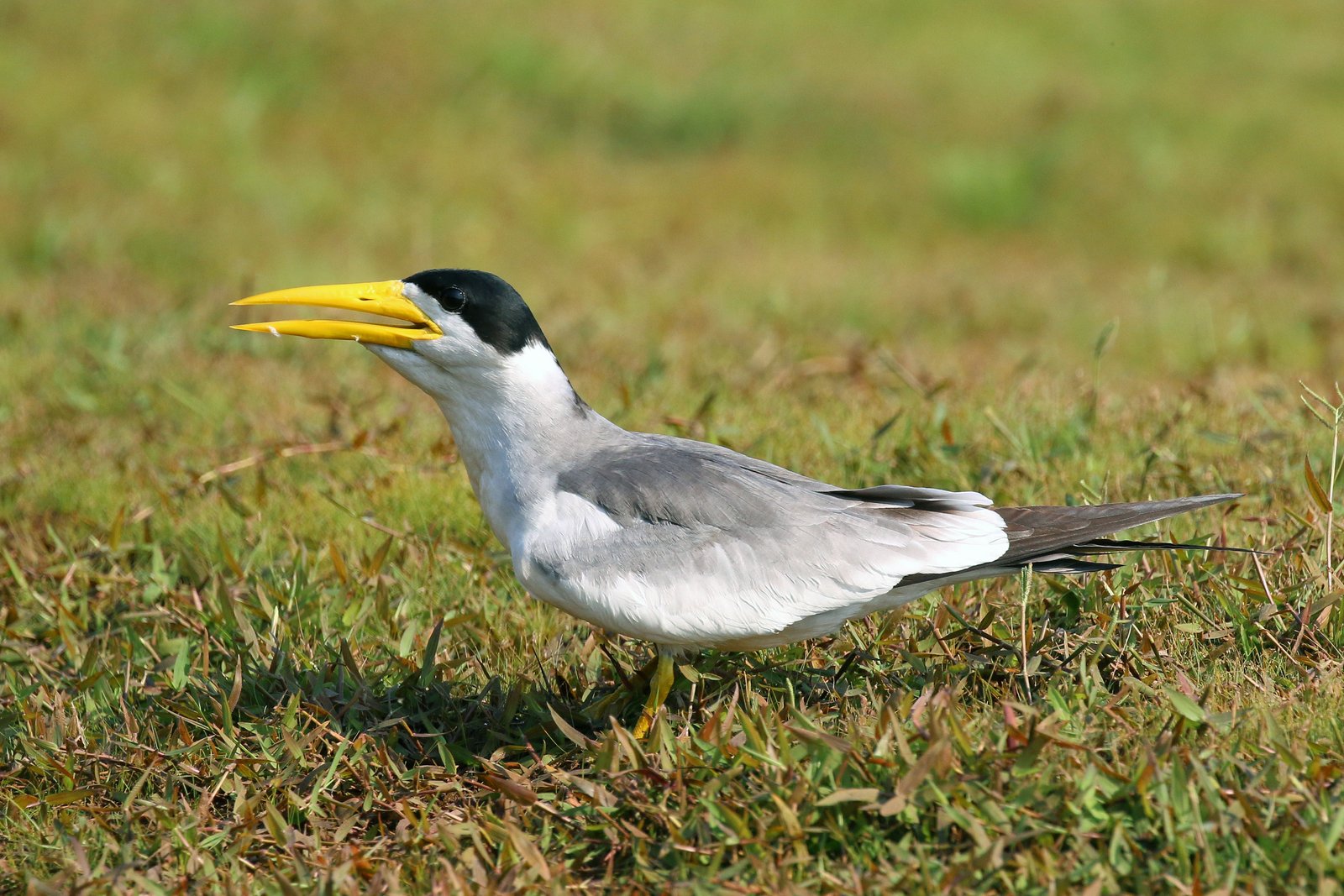
The Large-billed Tern is a robust freshwater tern of South American rivers, with a thick yellow bill and a three-toned wing pattern. It breeds on sandbars in large rivers. On Trinidad it is a fairly regular visitor from the mainland, mainly at freshwater ponds, rice fields and in the Caroni Swamp; on the other islands it is a vagrant.
Voice
Loud, harsh, somewhat gull-like calls, louder and lower than those of smaller terns; often given in flight.
Recording: JAYRSON ARAUJO DE OLIVEIRA — CC BY-NC-SA 4.0 · shortened to the first 60 s, mono · xeno-canto
Identification
37–39 cm, with a short, slightly forked tail. The bill is long, very thick and bright yellow. Cap and ear coverts are black, the forehead speckled white outside the breeding season. Back, inner wing coverts and tail are grey, the underparts white. In flight the wing pattern is distinctive: black primaries, a broad white triangle across the secondaries and greater coverts, and a grey forewing. The legs are yellowish. The sexes are alike. Juveniles have brown-scaled upperparts, a browner cap and a duller bill.
Confusion species
Sabine's Gull Xema sabini has a similar three-toned wing pattern, but is smaller, with a small black bill with a yellow tip, a deeply forked tail and a dark hood in breeding plumage; it occurs almost only at sea. Gull-billed Tern Gelochelidon nilotica has a black bill and uniformly pale wings. Royal Tern Thalasseus maximus has an orange bill, a short crest and pale grey wings without a white triangle.
Habitat
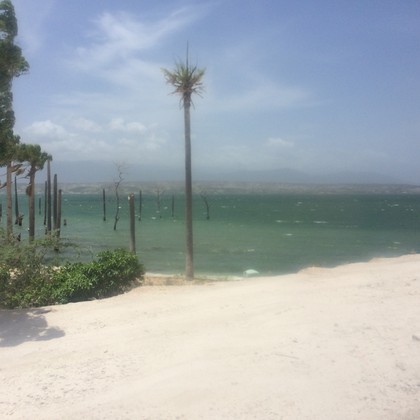
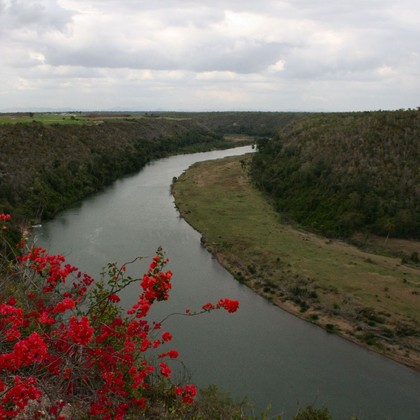
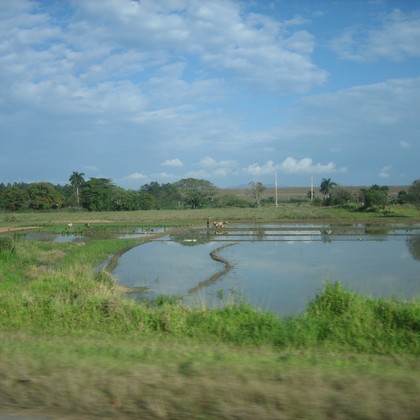
On Trinidad mainly freshwater ponds, sewage ponds, rice fields, the Caroni Swamp and the mangrove and lagoon coast. In its breeding range large rivers with sandbars, lakes and river mouths. It fishes by dropping into the water from a searching flight.
Where the bird is most at home, classified by the vegetation types of the Caribbean.


Range and movements
A fairly regular visitor to Trinidad, mainly in the west and centre of the island, with most reports from Trincity, Caroni and the west coast. Elsewhere in the region a vagrant, with a few records from Aruba, Cuba, Grenada and San Andrés. Beyond the region in most of South America east of the Andes, south to northern Argentina; as a vagrant also in Panama, Bermuda and the United States.
- Resident
- Summer visitor (c. Oct–Mar)
- Winter visitor (c. Apr–Sep)
- Passage (Mar–Apr, Oct–Nov)
- dark = core range, pale = thinly spread
How and when to look
On Trinidad the best chances are at freshwater ponds and rice fields around Caroni and at the Trincity sewage ponds. In flight the wing pattern is recognisable from afar; perched, the heavy yellow bill stands out.
Conservation status
Not threatened. The species is widespread along South American rivers. Dams and changing water levels can affect breeding sites on sandbars. On Trinidad it is a visitor that does not breed.
Scientific name
Phaetusa simplex | (Gmelin, 1789)
Gmelin described the species in 1789 as Sterna simplex; because it was later moved to another genus, the author and year stand in brackets. The genus Phaetusa was introduced in 1832 by Wagler. Phaetusa comes from Greek mythology: Phaethusa was a daughter of Helios and sister of Phaethon. simplex is Latin for 'simple, plain', after the plain plumage. The specimen the first description was based on came from Cayenne, French Guiana.