All species › Waders, gulls and terns › Gulls and terns › Gull-billed Tern
Gull-billed Tern | Gelochelidon nilotica
Lachstern | Charrán piquigrueso
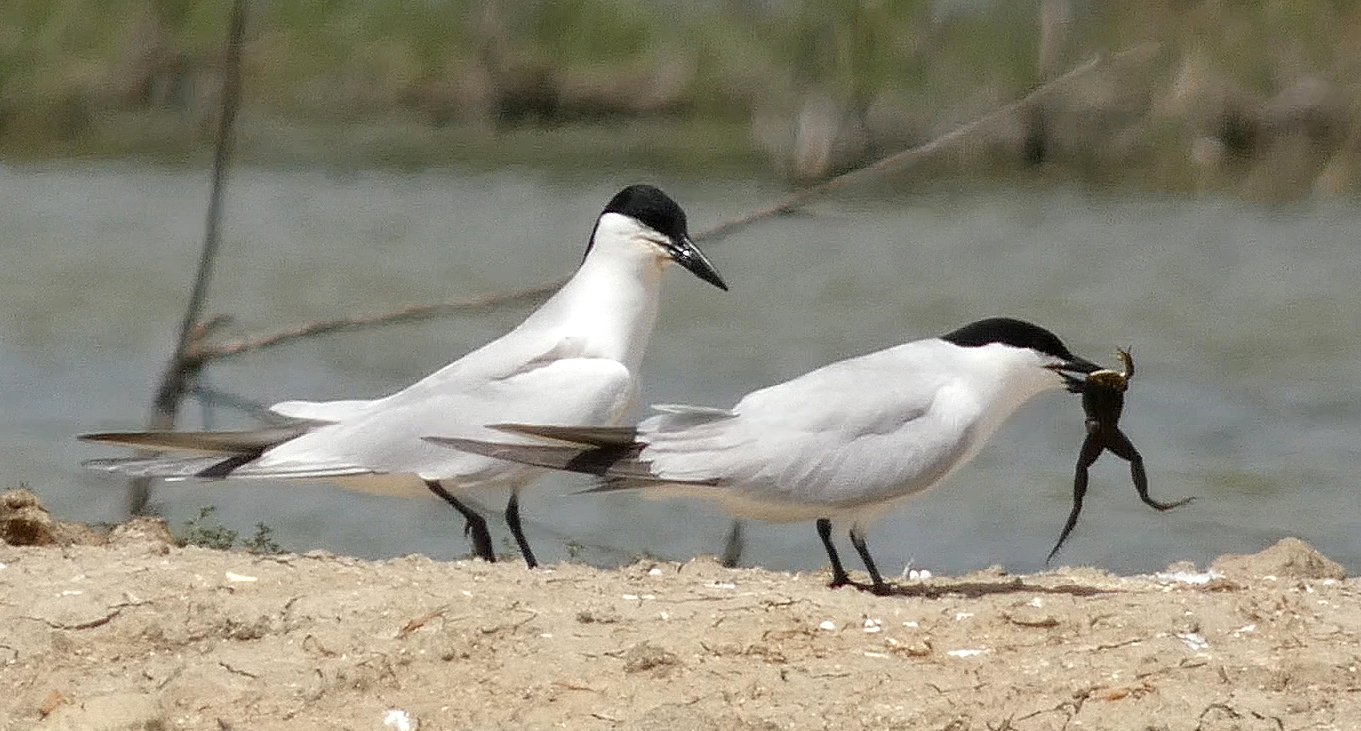
The Gull-billed Tern often behaves like a gull: it rarely dives, but picks its food from the water or ground in flight and hunts a great deal over land. Insects, crabs, lizards and small fish are all taken. In the Caribbean it breeds on several islands and is otherwise a winter visitor and passage migrant from North America. Birds here belong to the subspecies aranea.
Voice
A nasal, somewhat hoarse ker-wik or kay-wek, often repeated in flight; at the colony also a harsh kraak.
Recording: Walter Wallner — CC BY-NC-SA 4.0 · converted to mono · xeno-canto
Identification
33–42 cm, stocky for a tern, with broad wings, a short, shallowly forked tail and long black legs. The key feature is the short, thick, all-black bill, more like a gull's than that of other terns. In breeding plumage the cap is entirely black; in winter the head is white with a dark patch behind the eye. The upperparts are very pale silver-grey, and the rump and tail are also grey. In flight there is a narrow dark trailing edge to the wingtip. Juveniles have a pale brown wash on the crown and back and a dark eye patch.
Confusion species
Sandwich Tern Thalasseus sandvicensis is slimmer, with a longer, thin black bill with a yellow tip, a shaggy crest and shorter legs. Forster's Tern Sterna forsteri also shows a dark eye patch in winter, but is smaller, with a thin bill, a longer, deeply forked tail and orange legs. Caspian Tern Hydroprogne caspia is much larger and has a thick red bill.
Habitat
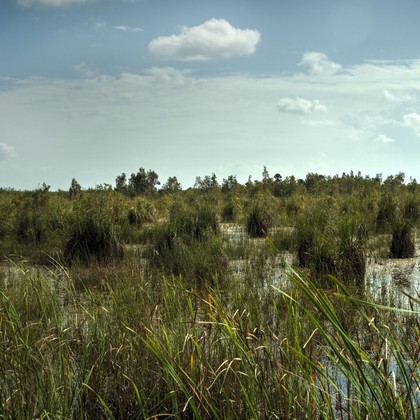
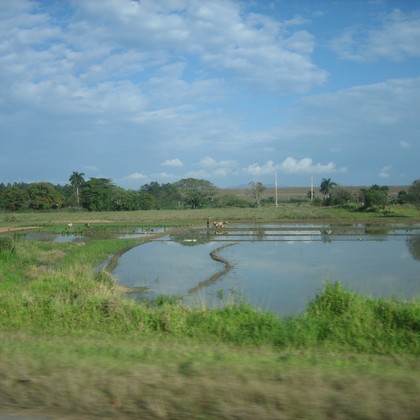
Salt pans, lagoons, mudflats, coastal marshes, rice fields and wet pastures; more often over land and shallow water than over open sea. It flies low and steadily back and forth and swoops down at an angle to pick prey from the surface. It nests in small colonies on bare sandbars, shell beaches and salt-pan dykes, in a shallow scrape.
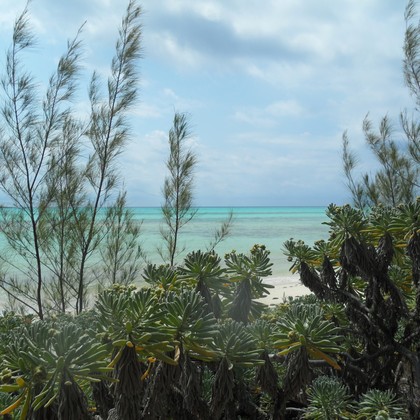
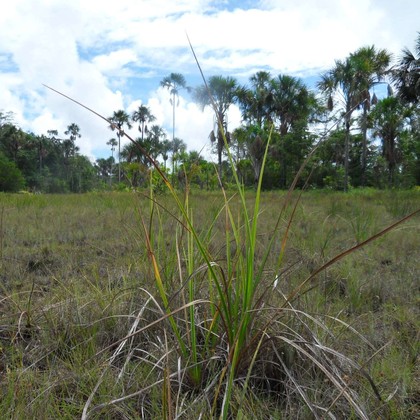
Where the bird is most at home, classified by the vegetation types of the Caribbean.


Range and movements
Breeds locally in the Bahamas, the Turks and Caicos Islands and the Virgin Islands, and in smaller numbers in the Greater Antilles; the size of the populations on individual islands is poorly known. Winter visitor and passage migrant on Cuba, Hispaniola, Puerto Rico, the Cayman Islands and Jamaica; common on Trinidad, a vagrant on Tobago. Regular in small numbers on the ABC Islands, Barbados and Guadeloupe, scarce elsewhere in the Lesser Antilles. Outside the region it breeds along the coasts of the United States and Mexico, locally in South America, and in Europe, Africa and Asia.
- Resident
- Summer visitor (c. Oct–Mar)
- Winter visitor (c. Apr–Sep)
- Passage (Mar–Apr, Oct–Nov)
- dark = core range, pale = thinly spread
How and when to look
Salt pans and shallow lagoons are the places to look, for example in the Bahamas, the Turks and Caicos Islands and on Bonaire. A pale tern hunting low over dry ground or a rice field without diving is often this species. The short black bill is the decisive feature in every plumage.
Conservation status
Not threatened. Widespread globally, but declining in many parts of North America and Europe through loss of nesting sites and disturbance. Colonies on sandbars are vulnerable to flooding, recreation and predation by introduced mammals.
Scientific name
Gelochelidon nilotica | (Gmelin, 1789)
Gmelin described the species in 1789 as Sterna nilotica; because it was later moved to another genus, the author and year stand in brackets. The genus Gelochelidon was introduced in 1830 by Brehm. Gelochelidon is Greek, from gelaō 'to laugh' and khelidōn 'swallow'. nilotica is Latin for 'of the River Nile', after the region the described bird came from. The specimen the first description was based on came from Egypt.