All species › Cuckoos › Cuckoos › Groove-billed Ani
Groove-billed Ani | Crotophaga sulcirostris
Groefsnavelani | Garrapatero piquiestriado
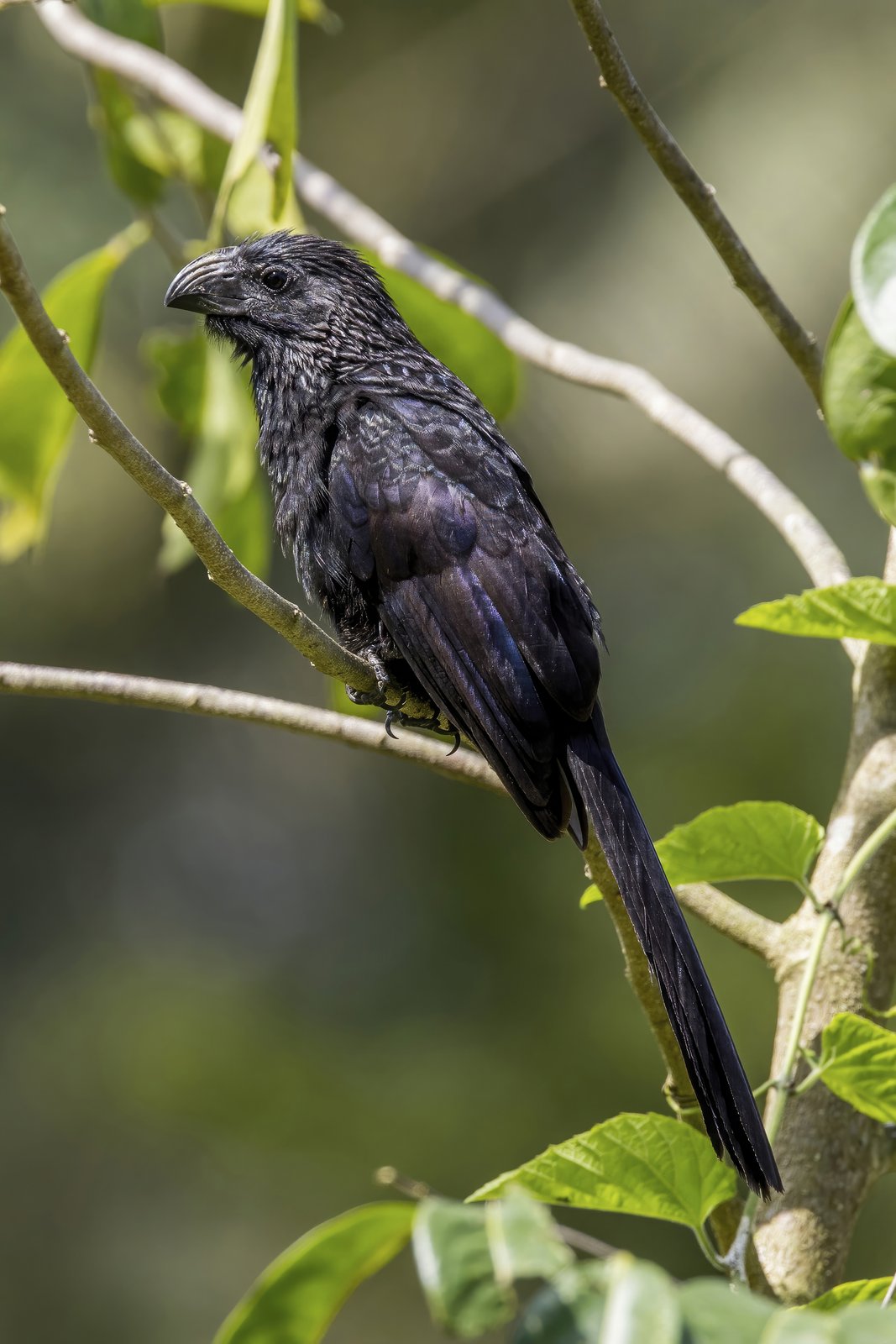
The Groove-billed Ani is the ani of Aruba, Curaçao and Bonaire, where it takes the place of the Smooth-billed Ani of the rest of the region. It is a black, long-tailed cuckoo with a deep, grooved bill that moves in small groups through the dry scrub, gardens and kunukus. Like all anis it lives in groups that share a single nest and raise the young together.
Voice
The usual call is a liquid, two-syllable tee-ho, the first syllable higher and the second dropping, often repeated rapidly by the members of a group. When alarmed a short, sharp chek, which sets the whole group moving. Also soft clucking and chuckling among group members while foraging, often from dense cover.
Recording: Johan Chaves — CC BY-NC-SA 4.0 · converted to mono · xeno-canto
Identification
32–34 cm, about half of it tail. Entirely black, in good light with a purple or green gloss on the back and wings and fine scaling on head and neck. The bill is black, deep and laterally compressed, with an evenly curved ridge and three or four grooves along the side of the upper mandible, visible only at close range. The eye is dark. The wings are short and rounded; the tail is long, almost as long as the body, loosely attached and bobs on landing. The flight is weak and fluttering, with short glides. The sexes are alike; young birds are duller black and have a lower, smoother bill that still lacks the grooves.
Confusion species
Smooth-billed Ani Crotophaga ani is only rarely reported on the ABC islands; it has a higher, smooth hump on the bill that rises above the crown line, no grooves, and gives a rising, whining oo-leek. Young Groove-billed Anis without grooves are best identified by call. Carib Grackle Quiscalus lugubris, common on the islands, has a pale eye, a thin, pointed bill and a V-shaped tail, and walks purposefully on the ground. Shiny Cowbird Molothrus bonariensis is smaller, with a short, conical bill and a short tail.
Habitat
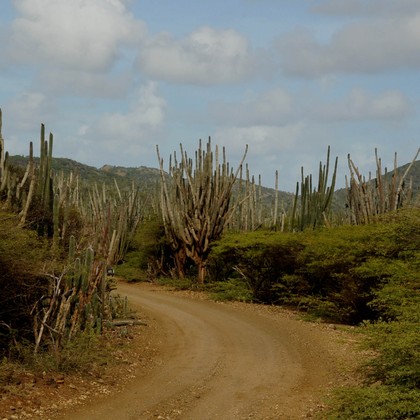
Open and semi-open dry country: thorn and cactus scrub, dry woodland, the kunukus with their hedges and yards, gardens, parks and village edges, and the edges of mangroves and salt pans. It forages in small groups on and near the ground, taking grasshoppers and other insects, sometimes flushed by grazing goats and other livestock, as well as spiders, lizards, seeds and fruit. Groups like to sun themselves on an open branch with wings half spread. A group consists of one to five breeding pairs, sometimes with helpers, which defend a territory together and lay their eggs in a single communal nest, a cup of twigs in a dense bush or tree. All group members incubate the eggs and feed the young.
Where the bird is most at home, classified by the vegetation types of the Caribbean.




Range and movements
In the region on Aruba, Curaçao and Bonaire, where it is a common resident in dry scrub and farmland. Elsewhere in the region at most a rare vagrant. Outside the region from southern Texas through Mexico and Central America to northern Colombia and Venezuela, and along the western side of South America through Ecuador to Peru; it largely withdraws from the northernmost part of its range in winter.
- Resident
- dark = core range, pale = thinly spread
How and when to look
On Curaçao, Aruba and Bonaire in almost any patch of scrub and in the kunukus, including the edges of built-up areas. Small groups often sun themselves on an open branch or a fence; the two-syllable tee-ho is usually the first sign of a group. When they take off, the short, round wings and the long, limply swinging tail stand out.
Conservation status
Not threatened. The species has a large range and adapts well to land altered by people. On the ABC islands it is a familiar sight in farmland and gardens.
Scientific name
Crotophaga sulcirostris | Swainson, 1827
Swainson described the species in 1827 and placed it straight away in the genus where it still stands. The genus Crotophaga was introduced in 1758 by Linnaeus. Crotophaga is Greek, from krotōn 'tick' and -phagos '-eating': 'tick-eater', as anis were thought to feed on ticks. sulcirostris is Latin, from sulcus 'furrow' and rostrum 'bill', after the grooved bill. The specimen the first description was based on came from Temascaltepec, Mexico.