All species › Pigeons and doves › Pigeons and doves › Grey-fronted Dove
Grey-fronted Dove | Leptotila rufaxilla
Grijskruinduif | Paloma frentigrís
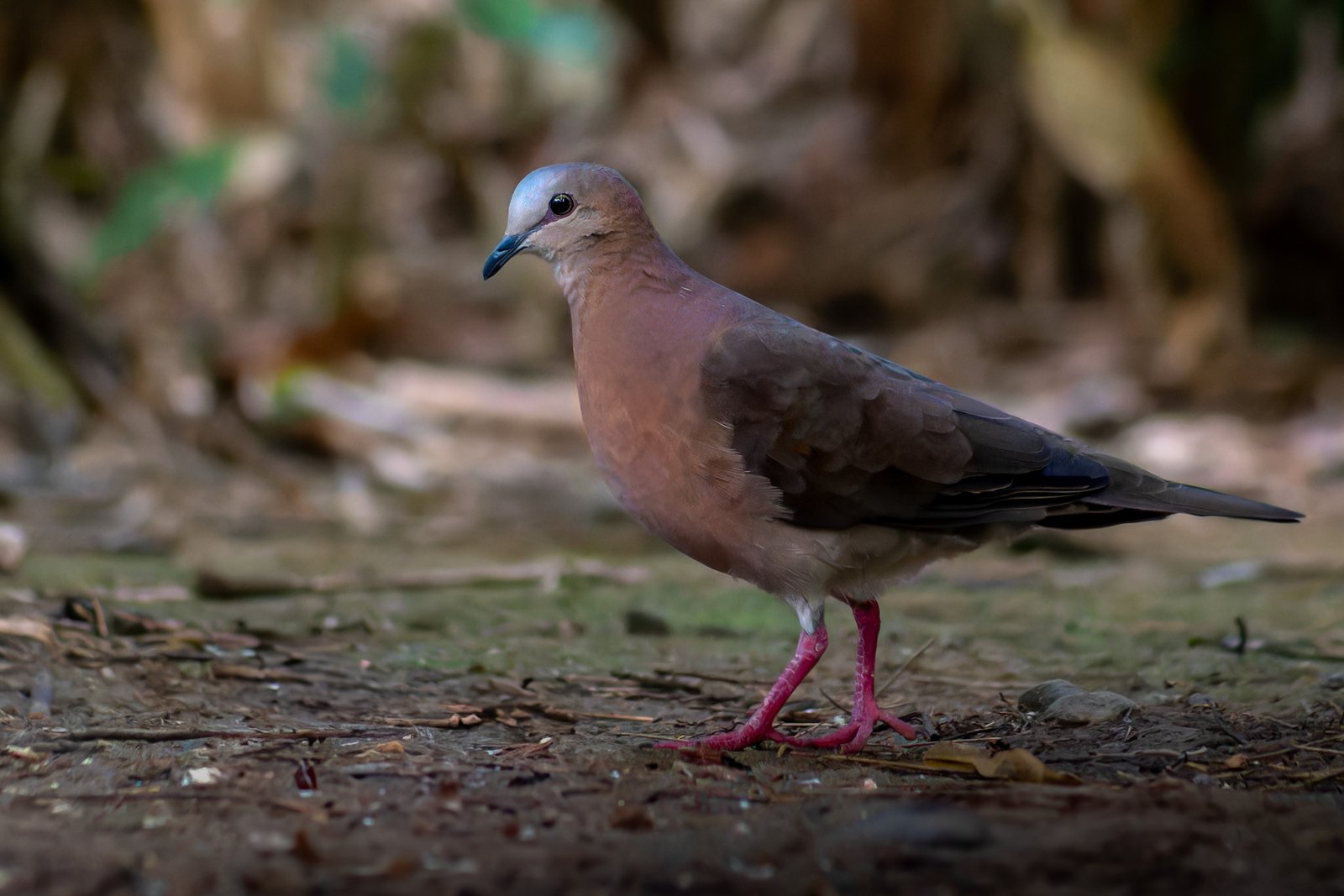
The Grey-fronted Dove is a ground dove of moist forest which in the Caribbean occurs only in Trinidad and is otherwise widespread across much of South America. It closely resembles White-tipped Dove but lives more in the interior of the forest, where it walks over the ground in the gloom of the undergrowth. It is usually noticed first by its drawn-out, swelling call, which carries through the forest while the bird itself stays out of sight.
Voice
A single drawn-out, mournful note at one pitch, swelling and fading: wooOOOoo. The call is repeated at intervals, often from the ground or a low branch in the forest, and is heard mainly in the early morning and late afternoon. White-tipped Dove, by contrast, has a two-part call with a short opening note.
Recording: JAYRSON ARAUJO DE OLIVEIRA — CC BY-NC-SA 4.0 · converted to mono · xeno-canto
Identification
About 28 cm, a medium-sized, compact ground dove with a fairly short, rounded tail. The forehead is grey to bluish, the crown blue-grey and the nape greyish purple. The cheeks and neck have a warm, rufous-pink tone, and the throat is whitish. The upperparts are plain olive-brown, the breast pinkish brown and the belly white. Around the eye there is bare skin, usually reddish. The tail is dark with narrow white tips to the outer feathers; the underwing is rufous. The female is browner than the male, with a more olive tone on the flanks and a greenish tinge to the upperparts.
Confusion species
White-tipped Dove Leptotila verreauxi, which also occurs in Trinidad, is paler, with a lighter, more whitish forehead, a greyer head without a blue crown and broader white tail corners; it lives more at forest edges and in open country. Ruddy Quail-Dove Geotrygon montana is rusty brown, with a pale cheek stripe, and has no white in the tail. Eared Dove Zenaida auriculata is smaller, with black spots on the wing, and keeps mainly to open land.
Habitat
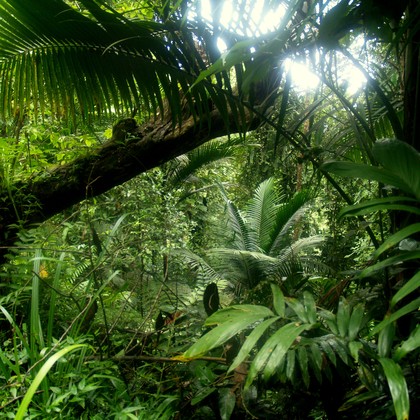
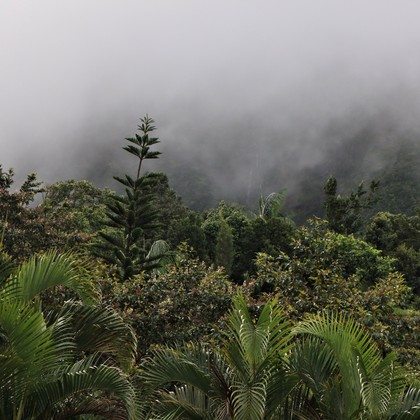
Moist forest, especially the interior of closed lowland and hill forest, but also forest edges and clearings. In Trinidad in the forests of the Northern Range and elsewhere in the lowlands where enough forest remains. It walks over the forest floor in search of seeds, fallen fruit and small invertebrates. The nest is a loose platform of twigs in a shrub, a low tree or in creepers.
Where the bird is most at home, classified by the vegetation types of the Caribbean.

Range and movements
In the region only in Trinidad, where the species is a fairly common resident in forested areas; it is absent from Tobago. The birds in Trinidad belong to a subspecies that also occurs on the Paria Peninsula in north-eastern Venezuela. Further in almost every country of South America east of the Andes, except Chile, south to northern Argentina.
- Resident
- dark = core range, pale = thinly spread
How and when to look
In the forests of Trinidad's Northern Range, for example around the Asa Wright Nature Centre in the Arima Valley, where the bird walks along the trails and sometimes picks up food dropped beneath feeders. The drawn-out call betrays its presence; waiting patiently on a forest trail produces more than walking about. The difference from White-tipped Dove lies mainly in the blue-grey crown and the warm tone of the cheeks and neck.
Conservation status
Not threatened. The world population is estimated at more than half a million birds, but is thought to be declining because of forest loss. In Trinidad the species is fairly common in the forested areas of the Northern Range.
Scientific name
Leptotila rufaxilla | (Richard, L-C & Bernard, J-P, 1792)
Richard, L-C & Bernard, J-P described the species in 1792 as Columba Rufaxilla; because it was later moved to another genus, the author and year stand in brackets. The genus Leptotila was introduced in 1837 by Swainson. Leptotila is Greek, from leptos 'slender' and ptilon 'feather', after the abruptly narrowed outermost primary. rufaxilla is Latin, from rufus 'rufous' and axilla 'armpit', after the rufous underwing. The specimen the first description was based on came from Cayenne, French Guiana.