All species › Pigeons and doves › Pigeons and doves › Eared Dove
Eared Dove | Zenaida auriculata
Geoorde treurduif | Tórtola orejuda
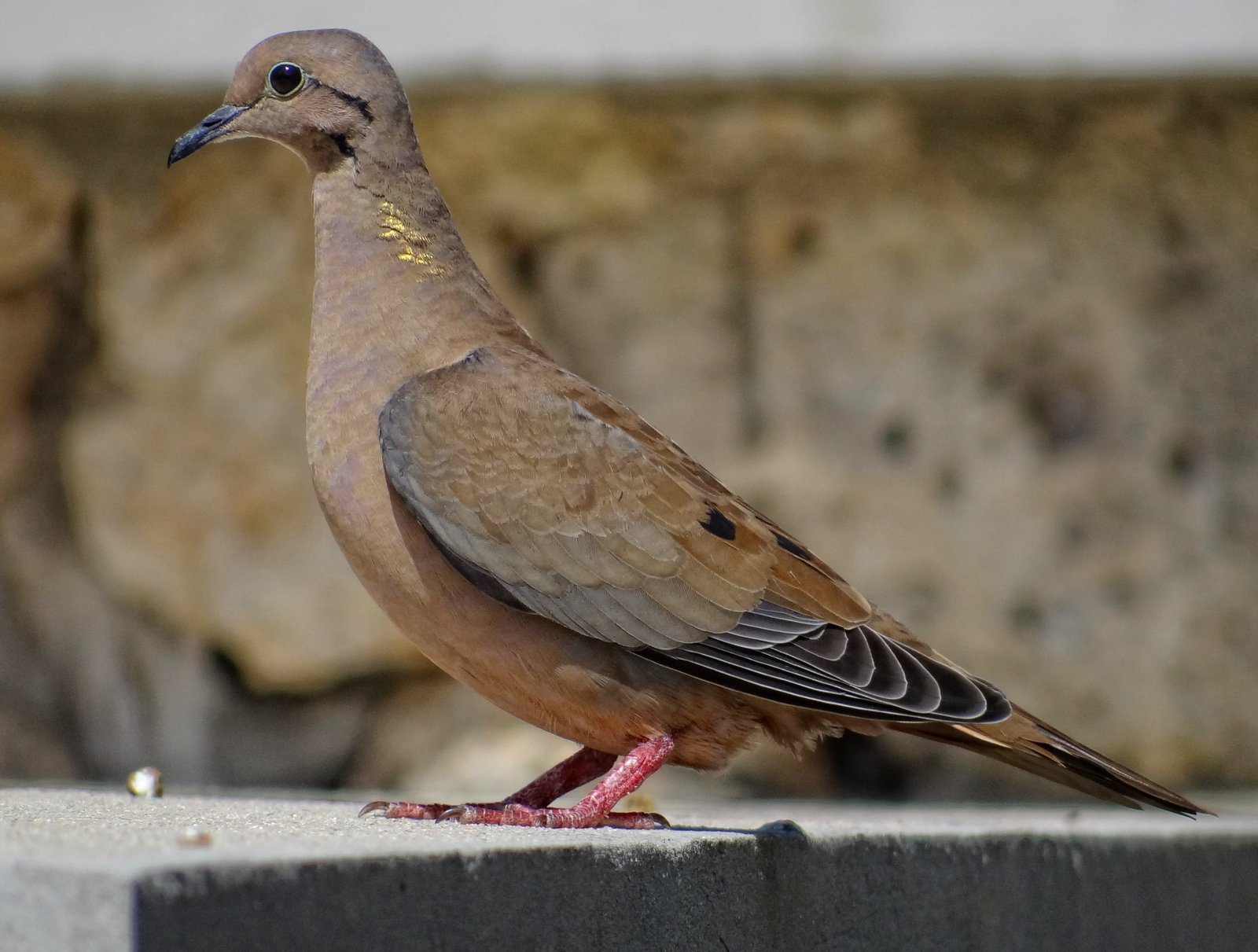
The Eared Dove is the South American counterpart of Mourning Dove: a small brown dove with black spots on the wing and a black streak on the ear coverts, which gives it its name. In the Caribbean it lives in the south, on the ABC Islands, Trinidad and Tobago and the southern Lesser Antilles. It is a fairly recent colonist of some of the islands and is still spreading north. On the ABC Islands it is called buladó.
Voice
A soft, deep, plaintive cooing, oo-ah-oo or ooo-OO... oo... oo, reminiscent of Mourning Dove and heard throughout the day. The wings clap and whistle on take-off.
Recording: JAYRSON ARAUJO DE OLIVEIRA — CC BY-NC-SA 4.0 · converted to mono · xeno-canto
Identification
22–25 cm, a small compact dove with a fairly short wedge-shaped tail. The upperparts are olive-brown, with a number of distinct black spots on the wing coverts and inner secondaries. The crown is grey. A narrow black streak runs behind the eye, and lower on the ear coverts is a second, blue-black spot. The underparts are pinkish to vinous brown, the sides of the neck with a golden or purple sheen. The outer tail feathers have a black band and rufous to pale tips. In flight there is no white in the wing. The legs are red. The female is duller and greyer.
Confusion species
Zenaida Dove Zenaida aurita, which occurs alongside it in the southern Lesser Antilles, is larger and stockier, with a white trailing edge to the secondaries. The small ground doves, Ruddy Ground Dove Columbina talpacoti and Common Ground Dove C. passerina, are much smaller and show rufous primaries in flight. Grey-fronted Dove Leptotila rufaxilla and White-tipped Dove L. verreauxi have unspotted wings and white tail corners and live in woodland and scrub.
Habitat
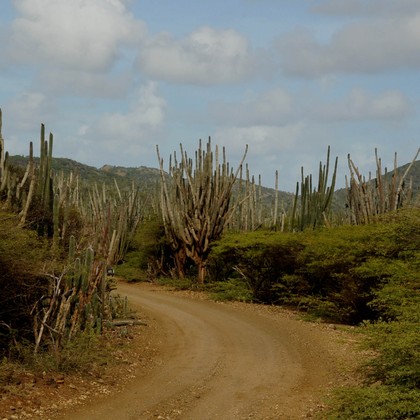
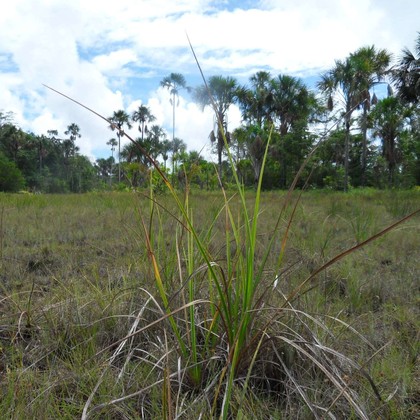
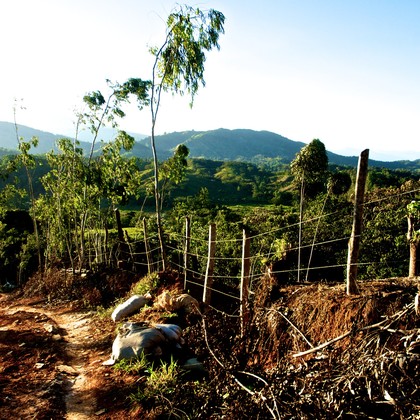
Dry and open country: cactus scrub and thorn scrub, savanna and grassland, fields, pasture and gardens, and in villages and towns on streets, yards and lawns. It picks seeds from the ground, often in flocks; elsewhere in its range it can gather in very large numbers on grain fields. The nest is a small platform of twigs in a tree or shrub, sometimes on the ground.
Where the bird is most at home, classified by the vegetation types of the Caribbean.


Range and movements
Common on Aruba, Curaçao and Bonaire, on Trinidad and Tobago, Grenada, the Grenadines and Saint Vincent, Barbados and Saint Lucia. In recent decades the species has become established further north on Martinique; there are a few records from Guadeloupe. On Trinidad and Tobago it is regarded as a fairly recent colonist. In the Greater Antilles and on San Andrés only a rare visitor. Beyond the region widespread over almost all of South America, from Colombia and Venezuela to Tierra del Fuego.
- Resident
- dark = core range, pale = thinly spread
How and when to look
On the ABC Islands one of the most frequently seen birds, in residential areas, yards and along roads through the cactus plains. On Trinidad mainly in open farmland and in town. The black wing spots and ear streak are visible even at a distance.
Conservation status
Not threatened globally and very numerous in large parts of South America, where it benefits from the spread of grain farming. In the Caribbean common and increasing. It adapts well to built-up areas and farmland.
Scientific name
Zenaida auriculata | (des Murs, 1847)
Des Murs described the species in 1847 as Peristera auriculata; because it was later moved to another genus, the author and year stand in brackets. The genus Zenaida was introduced in 1838 by Bonaparte. Zenaida honours Zénaïde Bonaparte (1801–1854), wife of the French ornithologist Charles Lucien Bonaparte, who named the genus in 1838. auriculata is Latin for 'eared', after the small dark marks on the ear-coverts. The specimen the first description was based on came from central Chile (Santiago).