All species › Birds of prey › Hawks, eagles and kites › Cuban Kite
Cuban Kite | Chondrohierax wilsonii
Cubaanse langsnavelwouw | Gavilán caguarero
The Cuban Kite is one of the rarest raptors in the world. Long treated as a subspecies of Hook-billed Kite, it is now recognised as a separate species with a large yellow bill. It once occurred over much of Cuba; today it is confined to remote forest in the far east, and the last documented sighting, with a photograph, dates from November 2009. In Cuba it is called gavilán caguarero.
No photograph of a living wild bird of this species with a suitable Creative Commons licence exists. Do you have one that meets the rules? Send it in.
Voice
Practically undocumented. The related Hook-billed Kite gives a rapid, chattering series of whistled notes at the nest.
No recording with a suitable Creative Commons licence is available for this species yet.
Identification
38–43 cm, with broad, rounded wings pinched in at the base, a long tail and a heavy, strongly hooked, bright yellow bill. The male is slate grey above and grey with whitish bars below; the long grey tail has dark bands. The female has a grey head, dark brown upperparts and chestnut-barred underparts; its tail bands are pale brown. Juvenile plumage is barely described.
Confusion species
Gundlach's Hawk Astur gundlachi has a smaller dark bill, a dark cap, a red to orange iris and barred rufous underparts, and hunts birds in fast flight. Broad-winged Hawk Buteo platypterus has a smaller dark bill, a short tail with broad white bands and rufous-barred underparts. Snail Kite Rostrhamus sociabilis also eats snails and has a slender hooked bill, but lives in open lowland marsh and has a white tail base. Cuban Black Hawk Buteogallus gundlachii is mostly blackish brown and lives along the coast.
Habitat
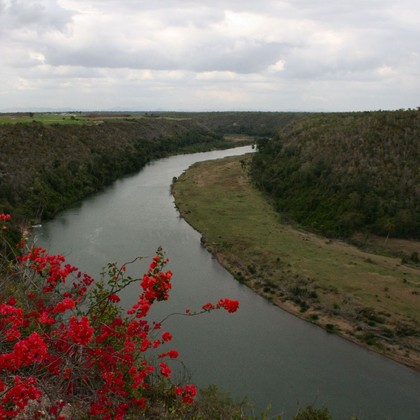
Tall, humid forest with large trees, especially along rivers and streams, below about 500 m. It forages in the understorey and mid-levels for tree snails and slugs, extracting them from their shells with its hooked bill; piles of empty shells can lie beneath regular feeding perches. Almost nothing is known of its breeding.
Where the bird is most at home, classified by the vegetation types of the Caribbean.


Range and movements
Endemic to Cuba. Formerly known from several parts of the island; by the twentieth century already confined to the provinces of Holguín, Santiago de Cuba and Guantánamo, and recent reports come from the Moa and Baracoa area, in and around Alejandro de Humboldt National Park. The species does not occur outside Cuba.
- Resident
- dark = core range, pale = thinly spread
How and when to look
There has been no documented sighting since 2009. Any record from the forests around Alejandro de Humboldt National Park is of great conservation value and deserves documentation with a photograph and precise location, reported to the Cuban conservation authorities.
Conservation status
Critically Endangered. The population is estimated at 50–249 mature birds, but the species may be functionally extinct. Threats are the clearance of riverine forest, the collection of the tree snails it feeds on and persecution by farmers who take it for a chicken thief; the birds are also tame, which makes them vulnerable to shooting.
Scientific name
Chondrohierax wilsonii | (Cassin, 1847)
Cassin described the species in 1847 as Cymindis Wilsonii; because it was later moved to another genus, the author and year stand in brackets. The genus Chondrohierax was introduced in 1843 by Lesson. Chondrohierax is Greek, from khondros 'coarse' or 'cartilage' and hierax 'hawk'; possibly because this kite lacks a bony shield above the eye. wilsonii probably honours the American physician and natural-history patron Thomas Bellerby Wilson (1807–1865) of the Academy of Natural Sciences of Philadelphia. The specimen the first description was based on came from near Gibara, Holguín, Cuba.