All species › Passerines › Starlings › Common Starling
Common Starling | Sturnus vulgaris
Spreeuw | Estornino pinto
The Common Starling is a European and West Asian species that was released in North America in the nineteenth century and is now common there. In the Caribbean it is an introduced species: in Jamaica, where it was brought in early in the twentieth century, a small, established population lives, and the northern islands occasionally receive birds from North America in winter.
Voice
A varied, chattering and clicking song with whistles, grating sounds and imitations of other birds and noises. Calls include a rasping shreeh and a short pyoo.
Recording: David Darrell-Lambert — CC BY-NC-SA 4.0 · shortened to the first 60 s, mono · xeno-canto
Identification
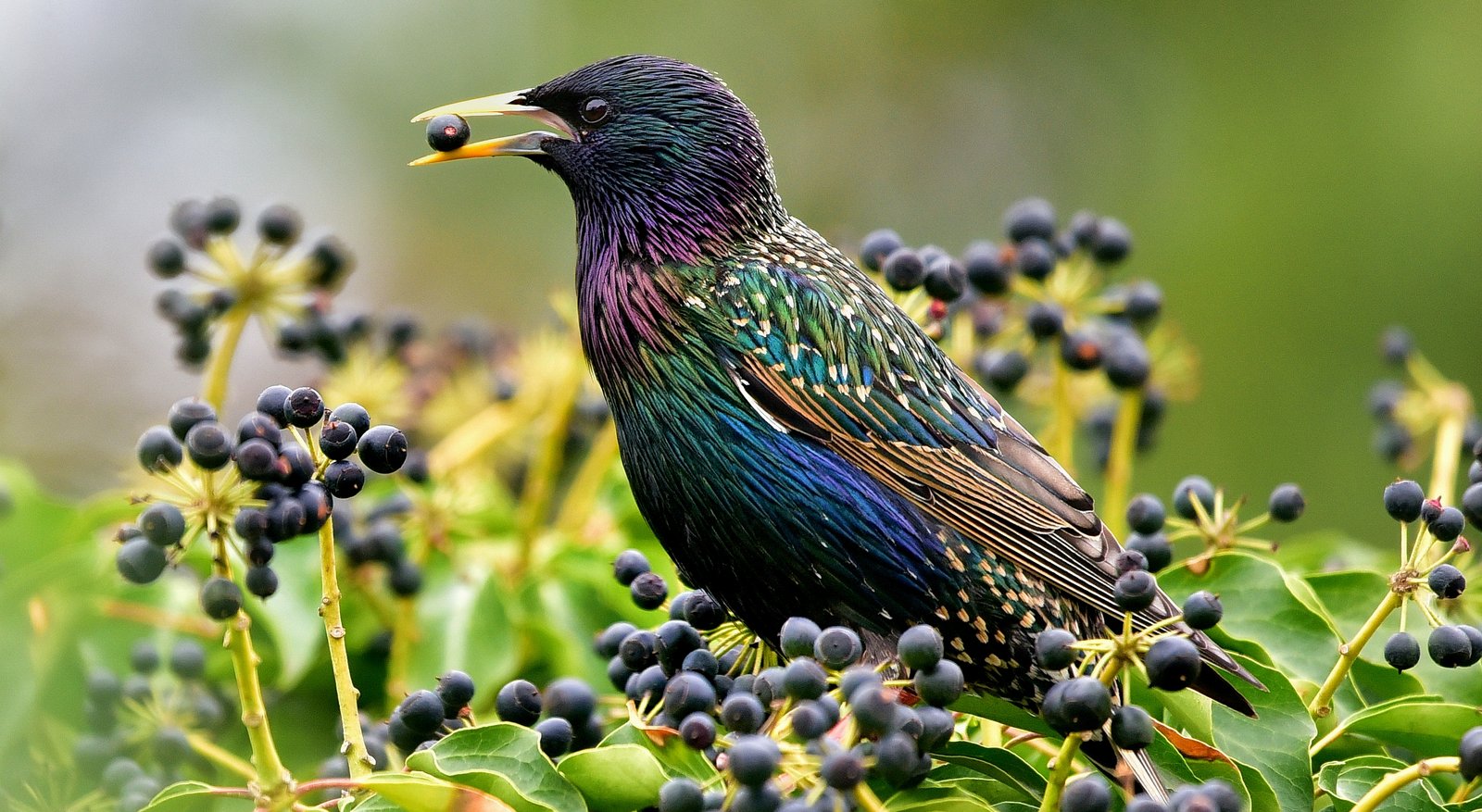
20–22 cm, compact, with a short, square tail, pointed triangular wings and a long, pointed bill. In breeding plumage black with a purple and green gloss, with few pale spots, and a yellow bill. In winter plumage densely covered in white and buff spots, with a dark bill. The legs are reddish. Juveniles are plain grey-brown with a paler throat and a dark bill. It walks with quick, waddling steps and flies straight and fast.
Confusion species
Greater Antillean Grackle Quiscalus niger is larger and slimmer, with a long, keel-shaped tail and a yellow iris. Shiny Cowbird Molothrus bonariensis has a shorter, conical bill, a longer tail and never shows white spots. Jamaican Blackbird Nesopsar nigerrimus is plain black and lives in cloud forest. Smooth-billed Ani Crotophaga ani has a high, laterally flattened bill and a long tail.
Habitat
Open country with short grass, especially pasture with cattle, also parks, playing fields, yards and built-up areas; it forages in small groups on the ground, probing the soil for insect larvae. It also eats fruit and scraps. It nests in holes in trees and buildings.
Where the bird is most at home, classified by the vegetation types of the Caribbean.




Range and movements
Introduced to Jamaica (usually given as 1903) and established, locally in small flocks, mainly near cattle pastures; a resident flock lives around Hope Gardens in Kingston. Introduced to Puerto Rico and breeding near Fajardo around 2000, but not reported since 2010 and possibly gone. In winter scarce to rare in the Bahamas (south to Grand Turk) and eastern Cuba; single birds in the Cayman Islands and on Saint Croix. Native to Europe and western Asia; introduced to North America, South Africa, Australia and New Zealand.
- Resident
- Winter visitor (c. Apr–Sep)
- Passage (Mar–Apr, Oct–Nov)
- dark = core range, pale = thinly spread
How and when to look
In Jamaica mostly at cattle pastures and grassland in the interior and in Hope Gardens in Kingston. In the Bahamas and Cuba it is a winter rarity, often among other black birds; the short tail and pointed bill are then the best features.
Conservation status
Not globally threatened, although declining in parts of Europe. In the Caribbean an introduced species with a small population in Jamaica; elsewhere it has not become permanently established. Elsewhere in the world it competes with native hole-nesters for nest cavities.
Scientific name
Sturnus vulgaris | Linnaeus, 1758
Linnaeus described the species in 1758 and placed it straight away in the genus where it still stands. He introduced the genus Sturnus in that same work. Sturnus is the Latin word for 'starling'. vulgaris is Latin for 'common, ordinary'. The specimen the first description was based on came from Sweden.