All species › Parrots › Cockatoos › Cockatiel
Cockatiel | Nymphicus hollandicus
Valkparkiet | Cacatúa australiana ninfa
The Cockatiel is a small, slender cockatoo from Australia with a pointed crest and a long, tapering tail, and one of the most widely kept cage birds in the world. In the Caribbean the birds are escapes or releases; no self-sustaining population has been described from any island. It is the only member of its own subfamily, Nymphicinae.
Voice
The flight call is a rolling, rising queel-queel or wee-ro, often repeated. Cage birds also copy whistled tunes, human speech and household sounds, and escaped birds sometimes give these in the open.
Recording: Thierry THOMAS — CC BY-NC-SA 4.0 · converted to mono · xeno-canto
Identification
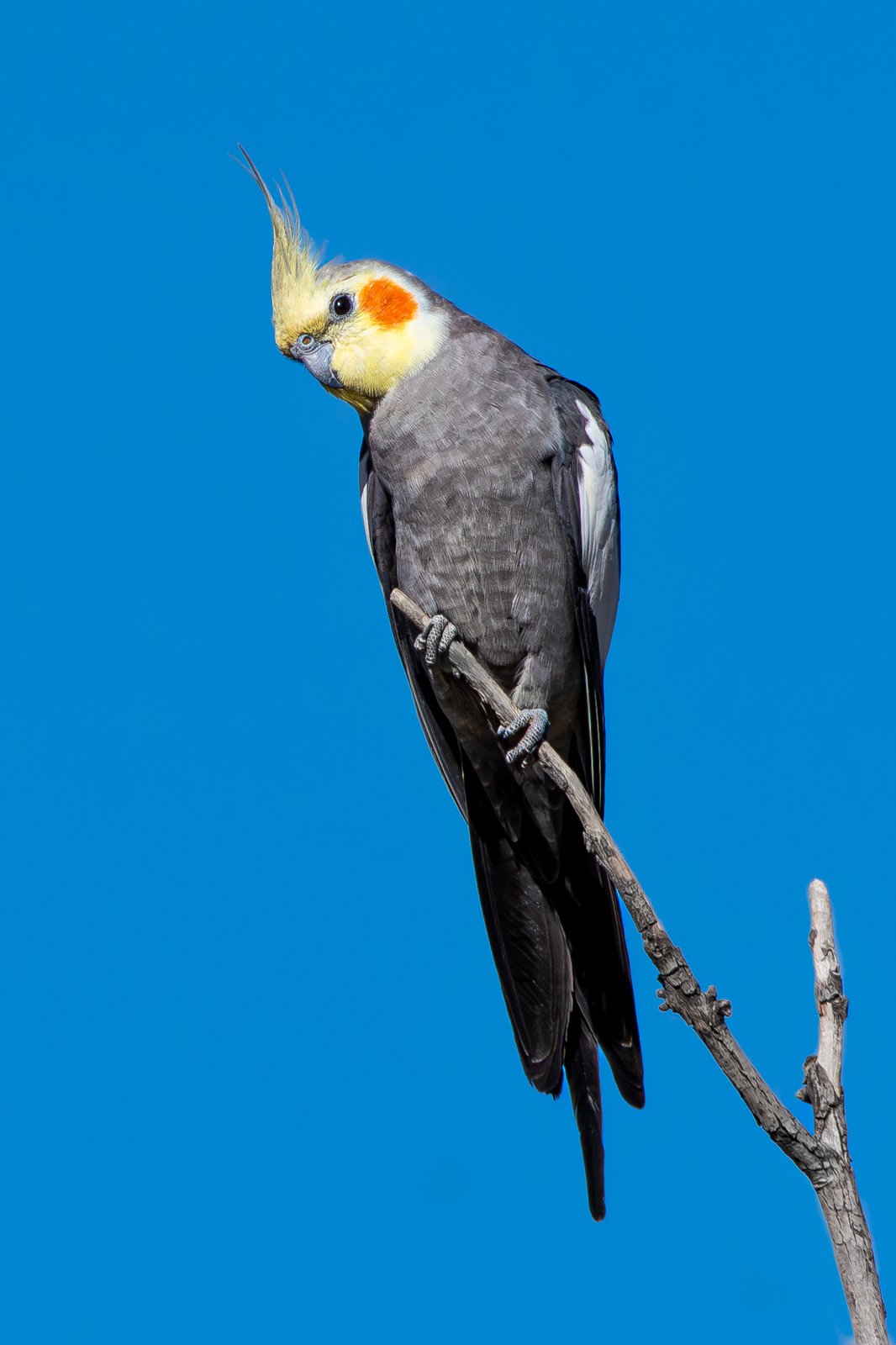
30–33 cm, almost half of it tail. Wild-type birds are grey, with a slim upright crest and a large white patch on the wing coverts that shows both perched and in flight. The male has a yellow head and crest and an orange ear patch; the female has a greyer face, a duller ear patch and fine yellow barring on the underside of the tail and flight feathers. Young birds resemble the female. Escaped birds are often aviary forms: all yellowish-white (lutino), pied, cinnamon and pearled birds are frequent. The flight is fast and direct on pointed wings, which gave the species its Dutch name of 'falcon parakeet'.
Confusion species
With its crest, grey plumage and white wing patch it cannot be confused with any other parrot in the region. Monk Parakeet Myiopsitta monachus has a grey forehead and breast, but is otherwise green and lacks a crest. Rose-ringed Parakeet Psittacula krameri also has a long pointed tail but is entirely green. In flight a lone bird may suggest a small falcon or a dove; the white wing patch and the call rule these out.
Habitat
Escaped birds keep to residential areas, gardens, parks and open grassy ground with scattered trees, often near houses. They feed on grass seed and other seeds on the ground and visit bird tables. In Australia the species lives in dry open country with trees, always near water, and moves around nomadically.
Where the bird is most at home, classified by the vegetation types of the Caribbean.


Range and movements
Scattered records of escaped birds come from Puerto Rico, which accounts for by far the most, and further from Cuba, the Dominican Republic, Guadeloupe, Martinique, the Bahamas and Barbados. No established populations have been shown there. Natural range covers almost the whole Australian interior.
- Summer visitor (c. Oct–Mar)
- Passage (Mar–Apr, Oct–Nov)
- dark = core range, pale = thinly spread
How and when to look
A stray Cockatiel usually turns up in residential areas and parks, often on a roof, an aerial or a lawn. With every bird the question remains whether it is a recent escape; aberrant aviary colours at least point that way.
Conservation status
Not threatened globally. In the Caribbean an alien without an established population; escaped birds sometimes survive for a while, but no self-sustaining breeding has been described.
Scientific name
Nymphicus hollandicus | (Kerr, 1792)
Kerr described the species in 1792 as Psittacus hollandicus; because it was later moved to another genus, the author and year stand in brackets. The genus Nymphicus was introduced in 1832 by Wagler. Nymphicus is Greek, from numphikos 'bridal, nymph-like', after the bird's elegance. hollandicus refers to New Holland, the old name for Australia. The specimen the first description was based on came from New Holland (Australia).