All species › Passerines › Tyrant flycatchers › Bran-colored Flycatcher
Bran-colored Flycatcher | Myiophobus fasciatus
Roesttiran | Mosquerito pechirrayado
The Bran-colored Flycatcher is a small brown tyrant of scrub and rank open country in South America. In the Caribbean it occurs only on Trinidad, home to the nominate subspecies. It keeps hidden in low scrub and is noticed mainly by its call.
Voice
A series of clear whistled notes, such as whee, whee, whee, usually from a low, open perch; also a soft, rising wheep.
Recording: Mateus Gonçalves Santos — CC BY-NC-SA 4.0 · converted to mono · xeno-canto
Identification
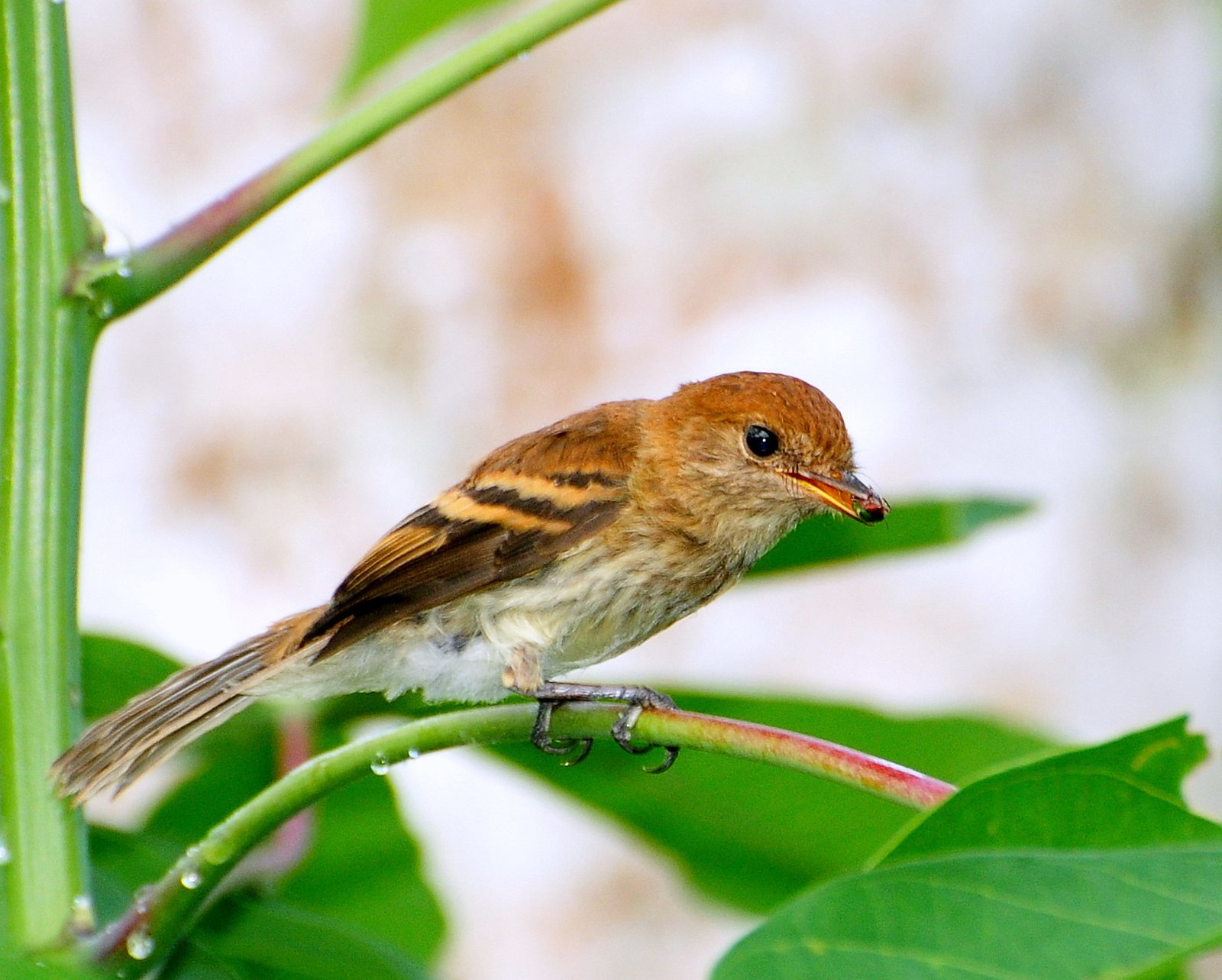
11–14 cm. Upperparts warm rufous-brown, the crown with a partly concealed yellow-orange patch, smaller in the female. Thin whitish eye-ring and faint pale lores. Wings dark brown with two distinct pale ochre to whitish wing bars. Underparts dingy white, breast and flanks streaked grey-brown to brown, the belly sometimes washed yellowish. Bill small, with a paler lower mandible. The female is slightly less streaked than the male.
Confusion species
Euler's Flycatcher Lathrotriccus euleri is more olive-brown, lacks breast streaks and lives inside forest. Fuscous Flycatcher Cnemotriccus fuscatus is larger and more uniformly brown, with a clear pale supercilium and an unstreaked breast. North American Empidonax flycatchers are olive-green to greyish and have neither rufous upperparts nor a streaked breast.
Habitat
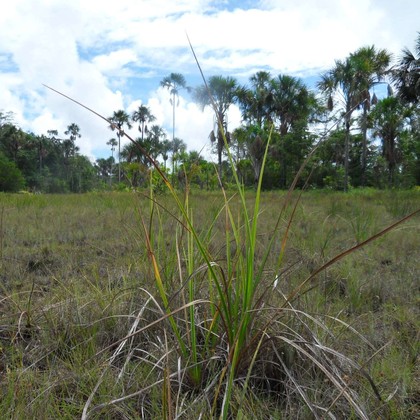
Scrub and overgrown open country: abandoned pasture, savanna edges, thickets along marshes and streams, forest edges and open secondary woodland in the lowlands. It forages low in the vegetation for insects, taken with short sallies from leaves. The nest is a deep cup of plant fibres and spider web in a branch fork, low down near the ground.
Where the bird is most at home, classified by the vegetation types of the Caribbean.


Range and movements
Resident on Trinidad; not recorded on Tobago. Outside the region from Costa Rica and Panama through much of South America to northern Argentina; the southernmost populations move north outside the breeding season.
- Resident
- Summer visitor (c. Oct–Mar)
- Winter visitor (c. Apr–Sep)
- Passage (Mar–Apr, Oct–Nov)
- dark = core range, pale = thinly spread
How and when to look
On Trinidad found locally in rank, open country with bushes, such as savanna edges and overgrown fields in the lowlands. The repeated whistled call in early morning is the best clue; the bird then often sings from a bare twig just above the scrub.
Conservation status
Not threatened. The species has a very large range and also occurs in rank, disturbed land.
Scientific name
Myiophobus fasciatus | (Müller, 1776)
Müller described the species in 1776 as Muscicapa fasciata; because it was later moved to another genus, the author and year stand in brackets. The genus Myiophobus was introduced in 1850 by Reichenbach. Myiophobus is Greek, from muia 'fly' and phobos 'terror, fear': 'terror of flies'. fasciatus is Late Latin for 'banded', from fascia 'band', after the pale wing bars. The specimen the first description was based on came from Cayenne, French Guiana.