All species › Passerines › Cardinals › Blue Grosbeak
Blue Grosbeak | Passerina caerulea
Blauwe bisschop | Picogrueso azul
The Blue Grosbeak is a medium-sized cardinal of scrub, forest edges and overgrown fields in the southern United States, Mexico and Central America. Northern birds winter in Mexico and Central America; the Caribbean is visited mainly in the north-west. In Cuba it is called azulejón.
Voice
The call is a loud, metallic chink; in flight a buzzy bzzt. The song is a rapid, chattering series of warbled notes, seldom heard in winter.
Recording: Manuel Grosselet — CC BY-NC-SA 4.0 · shortened to the first 60 s, mono · xeno-canto
Identification
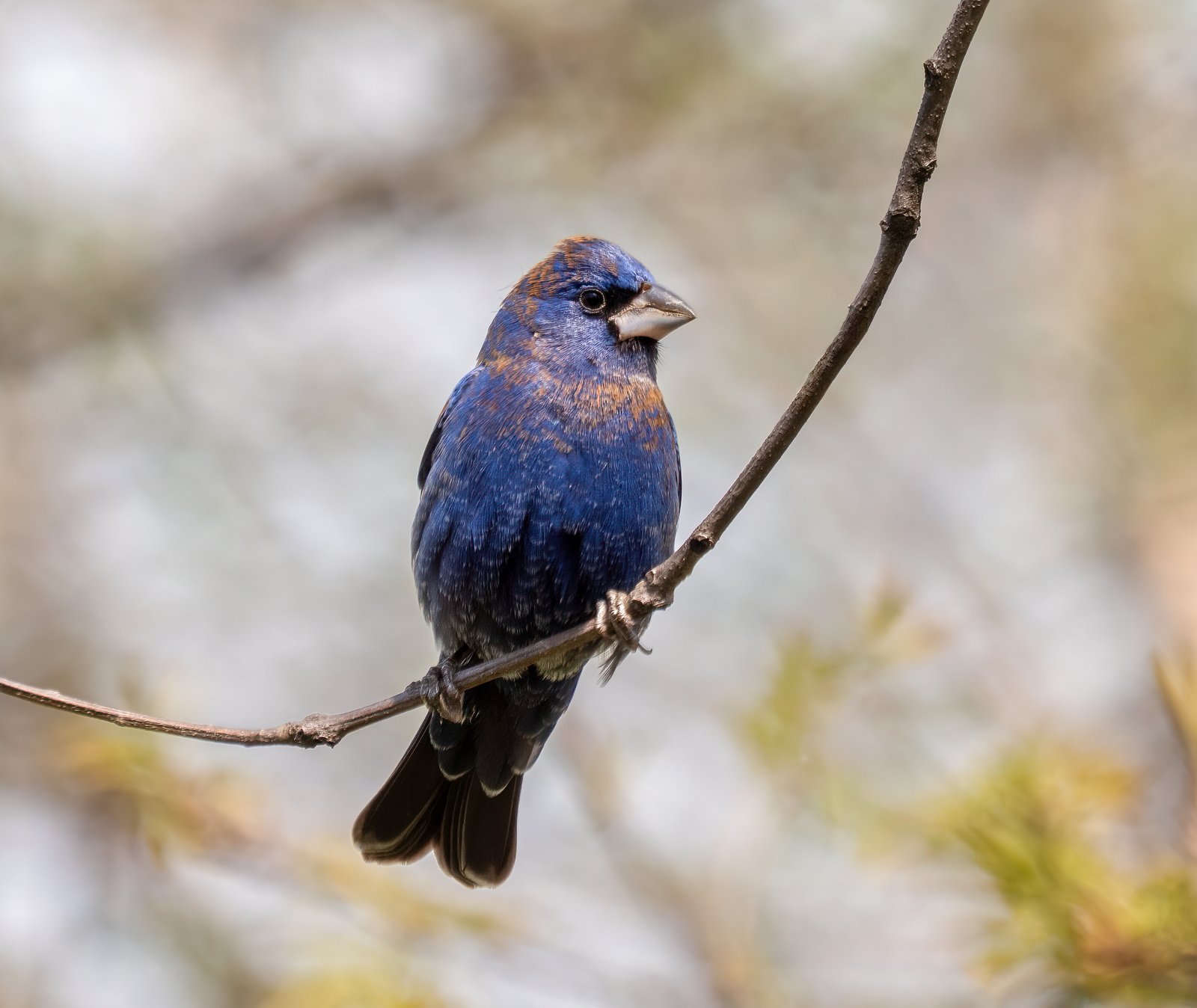
14–19 cm, with a heavy, triangular bill whose lower mandible is silvery grey. The male is deep blue with blackish lores and two broad chestnut wing bars; in autumn the blue feathers have brown edges. The female is warm brown, sometimes bluish on the rump, with two cinnamon-brown to buff wing bars. Young males are brown with blue patches. A characteristic habit is spreading the tail and swinging it from side to side.
Confusion species
Indigo Bunting Passerina cyanea is smaller, with a smaller bill and no broad chestnut wing bars; females are also plainer brown. Male Blue-black Grassquit Volatinia jacarina is smaller, glossy blue-black and lacks wing bars. Female Rose-breasted Grosbeaks Pheucticus ludovicianus are larger and streaked, with a white supercilium.
Habitat
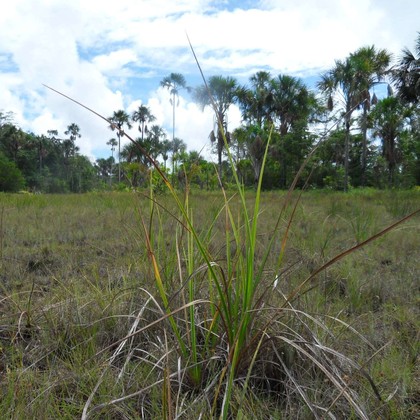
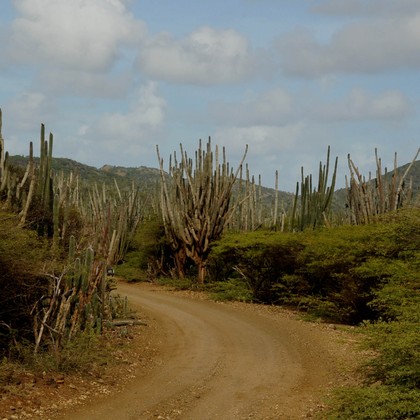
Rough grassland, field margins, pasture with scattered bushes, coastal scrub, thorn scrub and roadsides. It eats seeds of grasses and herbs and larger insects, foraging low in the vegetation or on the ground.
Where the bird is most at home, classified by the vegetation types of the Caribbean.



Range and movements
A scarce passage migrant in Cuba, the Bahamas, the Cayman Islands and San Andrés, with small numbers wintering, mainly in western Cuba. Rare on Jamaica; only a vagrant on Hispaniola, Puerto Rico, the Virgin Islands and in the Lesser Antilles. Breeds from the United States through Mexico to Costa Rica; northern birds winter from Mexico to Panama, a few reaching northern South America.
- Resident
- Summer visitor (c. Oct–Mar)
- Winter visitor (c. Apr–Sep)
- Passage (Mar–Apr, Oct–Nov)
- dark = core range, pale = thinly spread
How and when to look
The best chance is in September–October and April in western Cuba and the Bahamas, in rough grassland with bushes and along fields, often with Indigo Buntings. The loud chink separates it from the softer-calling Indigo Bunting.
Conservation status
Not threatened. The species is widespread and has expanded northwards in its breeding range over the past century.
Scientific name
Passerina caerulea | (Linnaeus, 1758)
Linnaeus described the species in 1758 as Loxia caerulea; because it was later moved to another genus, the author and year stand in brackets. The genus Passerina was introduced in 1816 by Vieillot. Passerina comes from the Latin passerinus 'sparrow-like', from passer 'sparrow'. caerulea is Latin for 'blue', after the male's blue plumage. The specimen the first description was based on came from South Carolina.