All species › Parrots › Parrots › Black-billed Amazon
Black-billed Amazon | Amazona agilis
Zwartsnavelamazone | Amazona jamaicana piquioscura
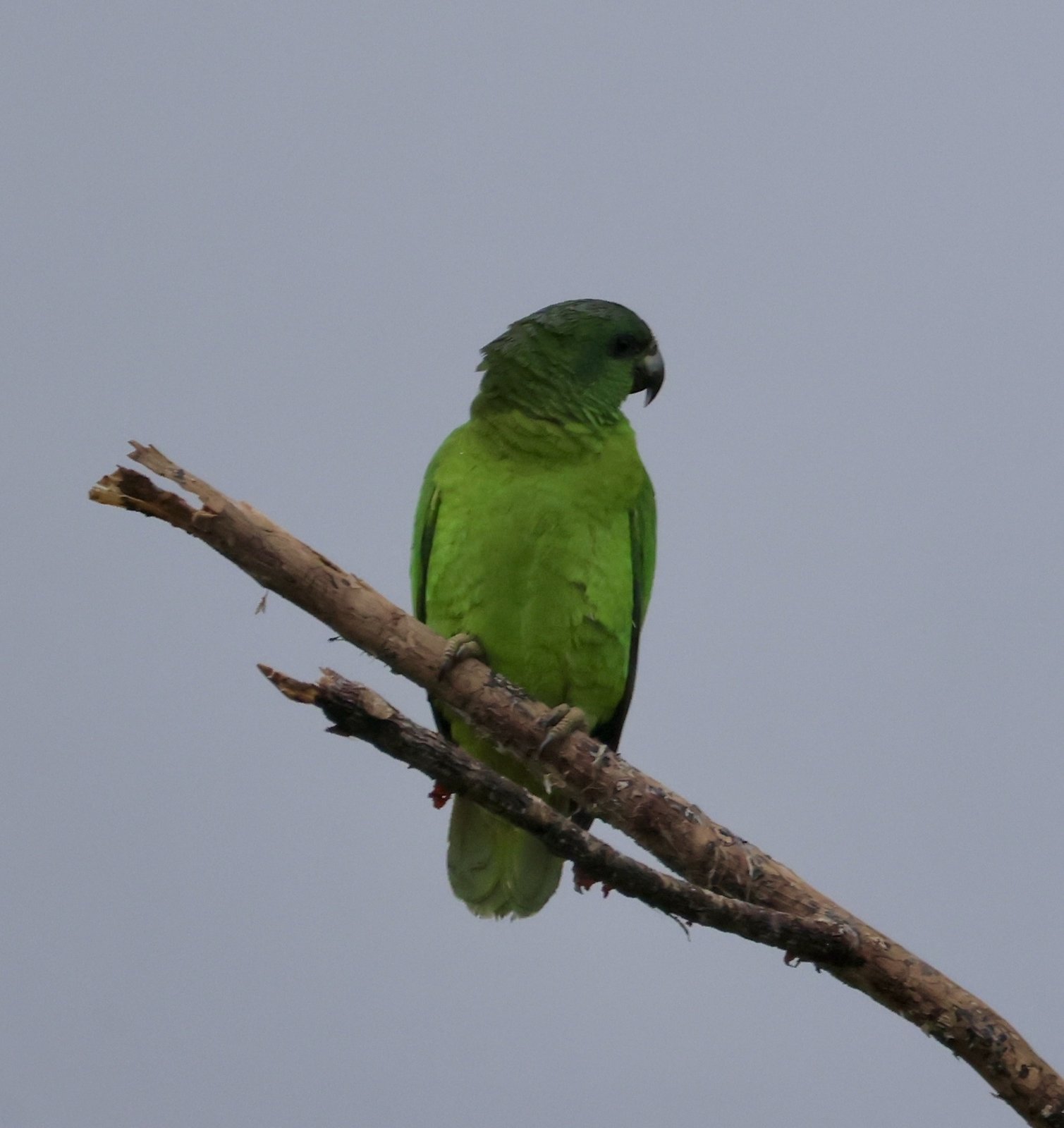
The Black-billed Amazon is the smallest amazon and one of two parrots found only on Jamaica. It is less colourful and scarcer than the Yellow-billed Amazon, with which it locally shares its range, and is closely tied to the intact limestone forest in the centre of the island.
Voice
In flight bugling, ringing calls; when perched growls and rumbling sounds. The calls sound sharper and more screeching than those of Yellow-billed Amazon.
Recording: Ross Gallardy — CC BY-NC-SA 4.0 · converted to mono · xeno-canto
Identification
26–29 cm, compact, with a short tail. Almost entirely green, with a dark ear patch and a white eye-ring. In males the primary coverts are red, showing in flight as a red patch on the forewing; in females they are wholly or partly green. The flight feathers are tipped blue and the outer tail feathers are red at the base. The bill is very dark grey, almost black.
Confusion species
Yellow-billed Amazon Amazona collaria is slightly larger, with a yellow bill, white forehead, blue forecrown and pink throat; in flight it shows blue primaries and no red on the forewing. Female Black-billed Amazons without red are identified by the dark bill and plain green head. Olive-throated Parakeet Eupsittula nana is smaller, with a long pointed tail and a brownish throat.
Habitat
Mainly wet limestone forest on karst, also moist mid-elevation forest and forest edge with plantations. It eats fruit, seeds and nuts, and also takes cultivated fruit such as mango and papaya. Nests in cavities in tall trees.
Where the bird is most at home, classified by the vegetation types of the Caribbean.



Range and movements
Endemic to Jamaica. Its stronghold is Cockpit Country and the Mount Diablo area in the centre of the island; elsewhere very local and scarce. It does not occur outside Jamaica.
- Resident
- dark = core range, pale = thinly spread
How and when to look
Best early in the morning from an open spot overlooking the forest in Cockpit Country, for example on the edges of the area near Windsor, when pairs and small groups fly over the forest. Flying birds are told from Yellow-billed Amazon by the male's red forewing and the dark bill; the two often fly together.
Conservation status
Endangered. Once as numerous as Yellow-billed Amazon, it has declined steeply through deforestation, fragmentation of the forest by hurricanes, and trapping for food and the cage-bird trade. Escaped non-native amazons, such as Yellow-naped Amazon A. auropalliata, pose an additional risk of hybridisation and disease.
Scientific name
Amazona agilis | (Linnaeus, 1758)
Linnaeus described the species in 1758 as Psittacus agilis; because it was later moved to another genus, the author and year stand in brackets. The genus Amazona was introduced in 1830 by Lesson. Amazona comes from 'Amazone', the French name Buffon gave to various tropical American parrots because they came from the Amazon region. agilis is Latin for 'nimble, agile'. The specimen the first description was based on came from Jamaica.