All species › Passerines › New World warblers › Yellow-Rumped Warbler
Yellow-Rumped Warbler | Setophaga coronata
Mirtezanger | Reinita coronada
A small, restless American warbler. It can digest the waxy berries of bayberry, which most insect-eaters cannot handle, and as a result it winters far further north than the rest of the family — and here it will sometimes hang about for weeks where another American warbler has vanished after three days. In every plumage, from the brightest spring male to the palest first-autumn bird in November, there is one place where yellow sits: the rump.
Voice
The song is a loose, rattling trill of even, rather flat notes that steps up or down at the end, softer than a bunting's trill and without its metallic edge; it does not sing here. What counts is the call, because it is loud and characteristic: a flat, dry chek, short and without inflection, that comes out of a bramble and carries fifty metres easily. In flight, a clear, slightly rising tseet. Unlike most American vagrants this one is regularly vocal, and more than one bird has been found on that chek.
Recording: Doug Hynes — CC BY-SA 4.0 · xeno-canto
Identification
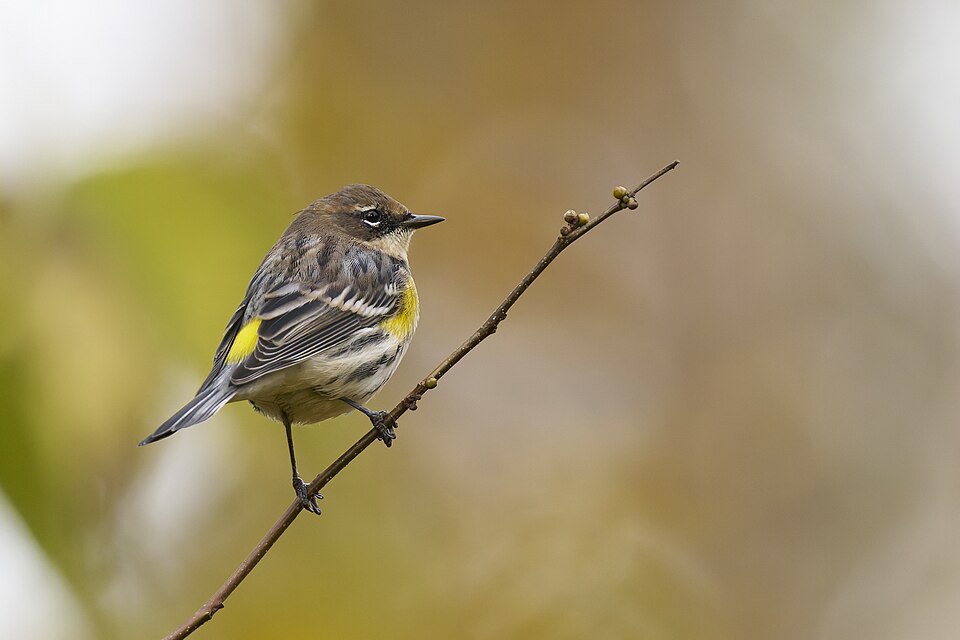
Start at the rump. A small, clean lemon-yellow patch between back and tail, which flares as the bird takes off and which this species carries all year; no other small passerine in the map area has it. The autumn bird is otherwise plain: grey-brown and dark-streaked above, off-white to cream below with fine dark streaking across breast and flanks, two narrow white wingbars and white tips to the outer tail feathers. The throat is white, and the white runs up in a narrow point behind the ear coverts. Above and below the eye stand short white crescents — a broken eye-ring, not a supercilium. There is usually a small yellow patch on each side of the breast, which on a dull bird can shrink to a few yellow feathers, and adults keep a small yellow crown patch that only shows when the bird raises the crown. The spring male is another bird altogether: blue-grey, black-streaked, with a black mask and a black breast band, and yellow on crown, breast sides and rump at once. The bill is short and fine, the legs dark. In western North America there is a form with a yellow rather than a white throat, now often treated as a separate species; it has not been recorded on this side, so a yellow throat is worth a second look.
Confusion species
Within the map area no small passerine combines a yellow rump with a white throat, a broken white eye-ring and two wingbars; see all that together and you are there. The trap is the other way round: a pale, streaked autumn bird that dives quickly into cover is easily written off as a young Whitethroat or a pipit, and then the yellow rump is the only thing left to recover — so always watch it fly away. Two American warblers also carry a yellow rump. Magnolia Warbler has bright yellow underparts with it, and a broad white band straight across the black tail. Cape May Warbler is finer and more densely streaked, has a shorter, slightly decurved bill and a yellow patch on the neck side, and lacks the white throat. Both are far rarer here than this species.
Habitat
Here it is a coastal bird: sea-buckthorn and elder in a dune slack, willow scrub in a wet hollow, nettle and bramble along a sea wall, and simply the gardens and hedges of an island village. It feeds restlessly, hopping from twig to twig, hanging beneath a leaf and making short sallies after an insect, low down and quite unafraid. In cold weather it switches to berries and ivy fruit, which is why it can stay on here. At home it breeds in the conifer and mixed forest of the boreal zone and the mountains, and winters far up the eastern seaboard of North America, living on bayberry in the coastal dunes.
Where the bird is most at home, classified with EUNIS — the European standard for habitats.




Range and movements
Breeds across boreal North America from Alaska to Newfoundland and south into the north-east of the continent, and winters from southern North America into Central America, with a striking share of the population staying far to the north. Within the map area it is a vagrant. Its stronghold is the British Isles, with the great majority of records in October and November and concentrated in the far south-west, including the Isles of Scilly and Cornwall; several birds stayed for weeks in one place. On Corvo and Flores, in the western Azores and just off the edge of this map, it is one of the commonest American warblers in autumn, and Iceland has records as well. In Iberia it is not a bird to expect.
How and when to look
Look for it in the second half of October in the dune scrub and village gardens of an island or a coastal headland, two to four days after a fast depression has crossed the ocean. Walk slowly and listen for the flat chek: that is half the work. If a pale streaked bird dives into cover, stand still and wait for the next flight, because the yellow rump settles the matter in half a second. Photograph rump, throat, eye-crescents and the side of the breast; those four together are enough for a rarities committee. And bear in mind that this species stays: report it the same day, and other people can still get there.
Conservation status
Not globally threatened (IUCN: Least Concern) and, with a population above a hundred million, one of the most abundant songbirds in North America; numbers are stable to slightly rising, which is unusual within this family. For the region of this guide the issue is not protection but origin, and here that question is easily answered: American warblers are not kept as cagebirds, and the records fall almost without exception in the narrow window behind a fast westerly gale. Birds that crossed part of the ocean aboard a ship have been described and are weighed up when a date looks odd, but the ordinary explanation is a bird that made the crossing itself.
Scientific name
Setophaga coronata | (Linnaeus, 1766)
Linnaeus described the species in 1766 as Motacilla coronata; because it was later moved to another genus, the author and year stand in brackets. The genus Setophaga was introduced in 1827 by Swainson. Setophaga is Greek, from sēs, sētos 'moth' and -phagos '-eating': 'moth-eater'. coronata is from Latin coronatus 'crowned', after the yellow crown patch. The specimen the first description was based on came from Philadelphia, Pennsylvania.