All species › Passerines › Wagtails and pipits › White Wagtail
White Wagtail | Motacilla alba
Witte kwikstaart | Lavandera blanca
No other bird walks like this. The White Wagtail trots across the tarmac of a car park, a freshly mown lawn or a barn's roof tiles, its head jerking forward and its long tail going up and down without a pause, then flies off in deep bounds with a sharp chiswick call. It never hops; it walks. And it belongs with people: farmyards, bridges, locks, campsites and industrial estates, from Lapland to the Maghreb. In the British Isles the resident race is the black-backed yarrellii, the Pied Wagtail; the White Wagtail of the Continent passes through every spring, and picking the one out from the other on a March seawall is one of the small satisfying jobs of the birding year. The species winters right across the Iberian Peninsula, and towards evening it gathers by the hundred in the plane trees of city squares and avenues.

Click a thumbnail to switch the photo above.
Subspecies


Voice
The call can be heard all over Europe: a sharp, disyllabic chis-ick or chizzik, hard and clear, given almost always in flight and usually at the exact moment the bird takes off. Agitated birds shorten it to a single hard note and repeat it quickly. The song is a hurried string of those same call notes with some twittering between, delivered from a ridge tile, a gutter or a fence post; it registers by its pace, not its tune. Song from March into July, the call all year.
Recording: Sonothèque ADVL — CC0 · xeno-canto
Identification
Slim and long, 16.5 to 19 cm, of which nearly half is tail. The tail is black with white outer feathers and is pumped continuously, even when the bird is standing still. Legs and bill are black. The summer male is a design in three colours: a black crown and nape running without a break into a black chin, throat and upper breast; a clean white forehead and white cheeks set into that black like a mask; and between them a clean pale grey mantle. The wing is blackish grey with broad white fringes forming two clear bars, and the flanks are white. The female is the same bird with a greyer, black-spotted crown and a little less black on the breast. In winter plumage the big black bib disappears, leaving a black crescent on the breast, and the throat turns white. Juveniles are dingy grey and buff with a yellowish wash on the face, but already have the black legs and the wagging tail. Flight is deeply undulating, with short bursts of wingbeats between the dips, and almost always accompanied by a call. Birds of the British Isles belong to the race yarrellii, the Pied Wagtail. On the male the back is not pale grey but deep black, so that crown, nape and mantle form one continuous black panel; the flanks are sooty grey rather than white and the black on the breast reaches further down. The female is dark slate-grey on the back. In winter plumage the difference narrows, but then the rump is the arbiter: dark grey to black on yarrellii and so barely paler than the tail, pale clean grey on the nominate alba and clearly set off against the black tail. Outside the British Isles Pied Wagtails rarely breed; on passage a few turn up every spring among the ordinary White Wagtails along the southern North Sea coast.
Confusion species
Look at the back, the rump and the leg colour and there is little difficulty. Grey Wagtail is longer-tailed still, blue-grey above with a yellow-green rump — back and rump are therefore different colours — bright yellow under the tail and, decisively, pink-flesh rather than black legs; it belongs at running water. On White Wagtail the rump is the same grey as the back and there is no yellow anywhere. Yellow Wagtail is shorter-tailed, olive-green above and yellow below, and walks in pasture and crops. Young Citrine Wagtails really are grey and white, but they show two very broad white wing bars, a pale surround that runs right round the ear coverts, and a shorter tail, and they stand on wet grassland rather than on a forecourt. Pipits share the undulating flight and the white tail sides, but they are brown and streaked, with no black-and-white contrast at all.
Habitat
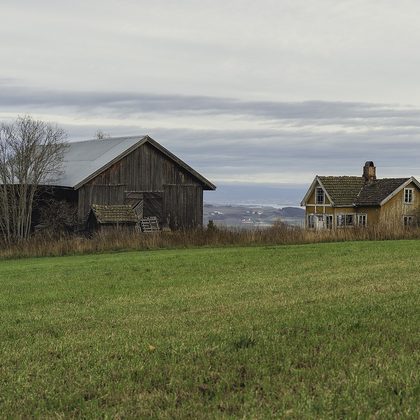
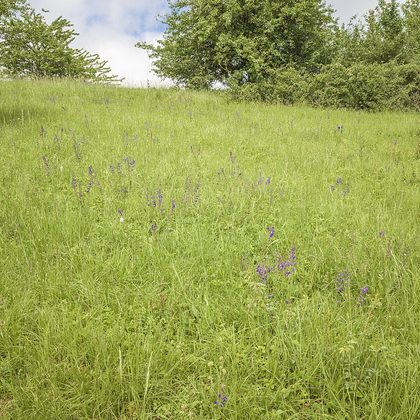
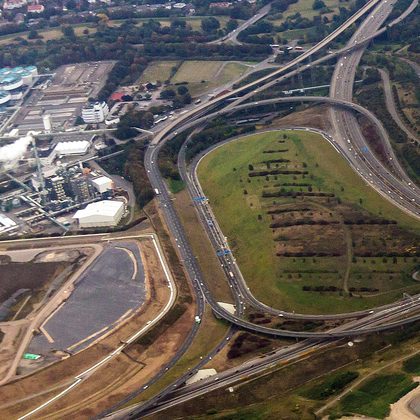
Short, open, hard ground it can run across, with water somewhere near and a cavity to nest in. In practice: farmyards and muck heaps, car parks and industrial estates, village streets and flat roofs, the margins of ditches, canals and rivers, shingle banks, saltmarsh, locks and bridges, mown lawns and playing fields. The nest goes in a hole — a wall crevice, a stack of pallets, a gap under the tiles, a piece of farm machinery standing idle, a bank revetment — and rarely far from water. In autumn and winter they roost communally in reedbeds, in town trees and in glasshouses, sometimes in hundreds.
Where the bird is most at home, classified with EUNIS — the European standard for habitats.


Range and movements
Breeds from Iceland and northern Scandinavia to North Africa and from the British Isles east deep into Siberia, and south to the Levant and the mountains of Anatolia. The British Isles hold the world population of yarrellii almost entirely: a few hundred thousand territories, widespread from city centres to upland farms, with many birds moving south and west in winter and some crossing to Iberia. Continental alba passes through there in March and April and again in autumn, chiefly along the coast and on inland gravel pits, and a handful stay to breed in most years. Along the southern North Sea coast the White Wagtail is one of the commonest farmyard and waterside birds, and in mild winters some stay to overwinter, mainly near open water and around farms. In Iberia the nominate form is a common breeder of the north, the centre and the mountains, scarce in the south and along the Mediterranean coast, and in winter it is everywhere — down to every village square, sewage works and river bed — swelled by central European and northern birds; the winter town roosts of Madrid, Seville, Zaragoza and many provincial capitals gather anywhere from a few hundred to several thousand birds in a handful of tree rows.
- Resident
- Breeding (summer)
- Winter
- Passage
- dark = core range, pale = thinly spread
How and when to look
Go to a farmyard, a marina or a lakeside car park in late March. The males are then at their sharpest and will let you come within a few metres, simply because they are used to people. In the same weeks walk the sea dykes and groynes for Pied Wagtails and look at nothing but the back and the rump: black against grey. And in October stand at sunset at the edge of a reedbed or in a lit shopping street; they then drop in by the dozen to roost, and only at that moment do you see how many there are.
Conservation status
Not globally threatened, and in Europe one of the few farmland birds that is doing well: the species needs bare, short, hard ground, and there is more of that than there used to be. What costs it locally is small and specific: sealing up barns and clearing untidy corners removes nest cavities, and insecticides around farmyards and along banks remove food for the young. Leave a pile of stones, an old machine or an open shed door and you will usually keep the pair.
Scientific name
Motacilla alba | Linnaeus, 1758
Linnaeus described the species in 1758 and placed it straight away in the genus where it still stands. He introduced the genus Motacilla in that same work. Motacilla was the Roman name for the wagtail; it is really a diminutive of motare 'to move about', but from medieval times -cilla was wrongly taken to mean 'tail'. alba is Latin for 'white', after the black-and-white plumage. The specimen the first description was based on came from Sweden.