All species › Passerines › Nuthatches › Western Rock Nuthatch
Western Rock Nuthatch | Sitta neumayer
Rotsklever | Trepador rupestre
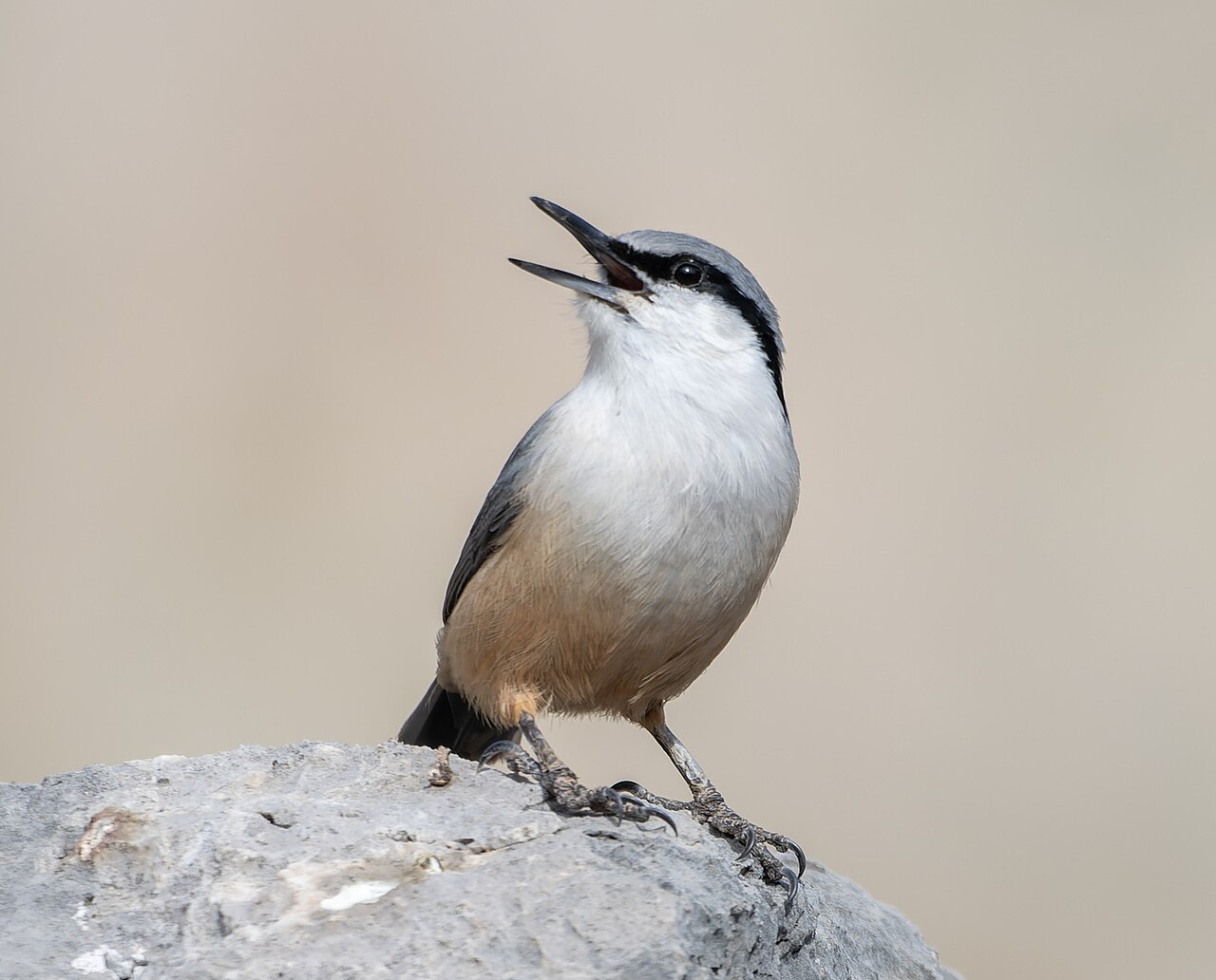
The nuthatch that has given up trees. Western Rock Nuthatch lives on bare limestone — gorge walls, cliffs, boulder fields, old walls and ruins from Dalmatia to the Zagros — and runs over vertical rock exactly as its woodland relatives run over bark. Its voice is one of the loudest sounds in a Balkan gorge, and the mud jug it builds to nest in can be mistaken for nothing else.
Voice
Extraordinarily loud for so small a bird, and in a gorge the sound bounces between the walls. The call is a sharp, hard tsik, fired off in rapid series when the bird is excited. The song is a clear, ringing, accelerating trill, tui-tui-tui-tui, which almost runs into a rattle at the end and carries for hundreds of metres. More often than not you hear the bird from the rim of a gorge long before you find it on the face.
Recording: Frantz Barrault — CC BY-NC-SA 4.0 · Wikimedia Commons
Identification
Bigger and heavier than Eurasian Nuthatch, with a longer, stouter bill and a strikingly large head, so that it looks front-heavy. Upperparts plain blue-grey, face and throat white, underparts pale buff warming slightly towards belly and vent but never reaching the rusty orange of the woodland bird. The black eyestripe is long and heavy, broadest behind the eye, fading out on the side of the neck. There is no white in the tail — a negative mark. The sexes are alike; juveniles are duller and shorter-billed. Legs and toes are heavy and grey. Everything about the bird is paler and coarser than in its forest relatives.
Confusion species
Eurasian Nuthatch is smaller, buff below, shows white spots in the tail and is a bird of trees; the two meet only where woodland touches rock, and there behaviour decides it. Eastern Rock Nuthatch, of eastern Anatolia, the Caucasus and the Iranian Plateau, is larger still, with an even broader eyestripe that runs back onto the mantle and a whiter face; in the zone of overlap a good view of bill length and stripe width is needed. Wallcreeper also works cliffs, but is grey with crimson wing panels, has a long curved bill and flits like a butterfly. Treecreepers do not occur in this landscape at all.
Habitat
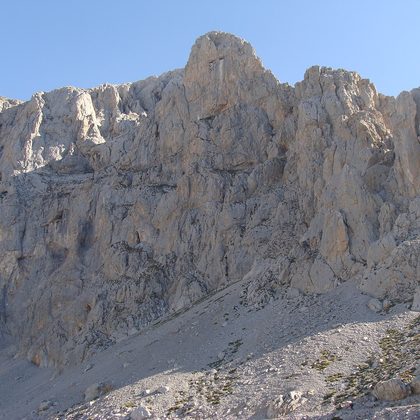
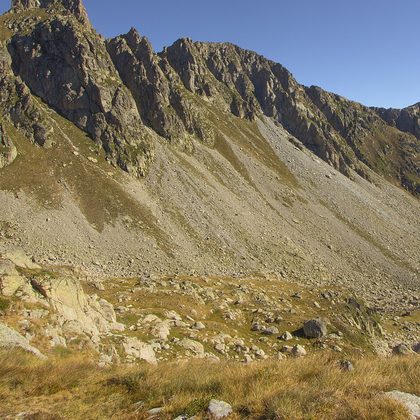
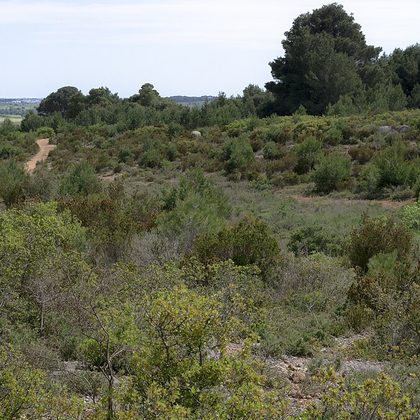
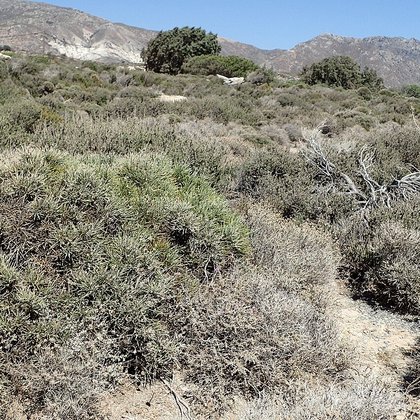
Bare rock in hot, open country: limestone gorges, cliffs, boulder fields, screes and weathered plateaus, and also old walls, ruins, bridge abutments and quarries. Garrigue and phrygana usually grow between the rocks, and the bird forages there as well, hopping over stones and among the low herbs. From sea level to well over two thousand metres, with mountain birds dropping lower in winter. The nest is characteristic: a flask- or jug-shaped structure of mud, dung and hair or feathers, plastered against a rock face or into a crevice or an overhung recess, with a short tunnel for an entrance. It takes weeks to build, and the cracks around it are stuffed with feathers, insect wings and snail shells. A nest may be used for years on end.
Where the bird is most at home, classified with EUNIS — the European standard for habitats.

Range and movements
From the eastern Adriatic coast through the southern Balkans, including many islands, and on through Anatolia, the northern Levant and the Kurdish uplands to the Caucasus and the Zagros. Only the easternmost fringe of that range falls outside the map area of this guide. It is resident everywhere; only the highest sites are vacated in winter. In suitable country it is numerous, and in the southern Balkans it is a regular inhabitant of the limestone gorges.
- Resident
- Breeding (summer)
- Passage
- dark = core range, pale = thinly spread
How and when to look
Be at a limestone gorge at sunrise — Meteora, the Vikos gorge, the crags above Delphi, the cliffs near Kalloni on Lesvos — and listen first for the accelerating trill. Then find the bird with binoculars on the face: it moves in jerky horizontal runs, often upside down beneath an overhang. Scan the shaded side of overhangs too, for a fist-sized lump of grey-brown mud with a round hole in it. That is the nest, and the bird will never be far away.
Conservation status
Not threatened, with a large range and high densities in suitable country. The species gains more from human structures than it loses to them: ruins, terrace walls and old bridges all provide extra nest sites. Local problems do exist, chiefly the cutting of quarries into gorge walls and the scrubbing over of open rocky slopes once grazing stops. Climbing plans and climbing routes on busy crags can disturb breeding sites.
Scientific name
Sitta neumayer | Michahelles, 1830
Michahelles described the species in 1830 and placed it straight away in the genus where it still stands. The genus Sitta was introduced in 1758 by Linnaeus. Sitta is the Ancient Greek name sittē for the nuthatch. neumayer honours Franz Neumayer (1791–1842), an Austrian naturalist and natural history dealer who lived at Ragusa, present-day Dubrovnik, and is called an active naturalist there in the original description. The specimen the first description was based on came from Dubrovnik, Croatia.