All species › Passerines › Leaf warblers › Western Bonelli's Warbler
Western Bonelli's Warbler | Phylloscopus bonelli
Bergfluiter | Mosquitero papialbo
Western Bonelli's Warbler is the leaf warbler of dry hill woodland around the western Mediterranean: pale, cold-toned and cleanly white beneath. Silent, it is among the hardest birds in this book; the moment it delivers its dry rattle it is settled from fifty metres away. In Iberia it is one of the commonest woodland birds of all, with more than a million pairs spread across half the peninsula, and yet it goes almost unnoticed by anyone who does not know its voice. In north-western Europe it is a vagrant of a handful of records a year.
Voice
The song lasts barely a second and is entirely colourless: a dry, flat rattle on one pitch, srrrrrrrrr, resolving at close range into a run of separate ticks, tsi-tsi-tsi-tsi-tsi-tsi-tsi. Every note sits at the same height, the tempo never changes, and the phrase stops as abruptly as it starts; the next follows after five to ten seconds. Anyone who knows Wood Warbler hears the difference at once: Wood Warbler accelerates from loose ticks into a shivering trill and dies away, while Bonelli's rattles at one speed from the first note and simply ends. The sound carries far through open pine and oak wood and is densest from sunrise until about ten, from late April to late June. The call is the second character and every bit as important: a soft, disyllabic, rising hoo-eet, warm and weak — exactly what a Willow Warbler says. In southern Europe that causes no confusion, because Willow Warbler is only a passage bird there; in north-west Europe it is the classic way a vagrant goes unnoticed.
Recording: Benoît Van Hecke — CC BY-SA 4.0 · xeno-canto
Identification
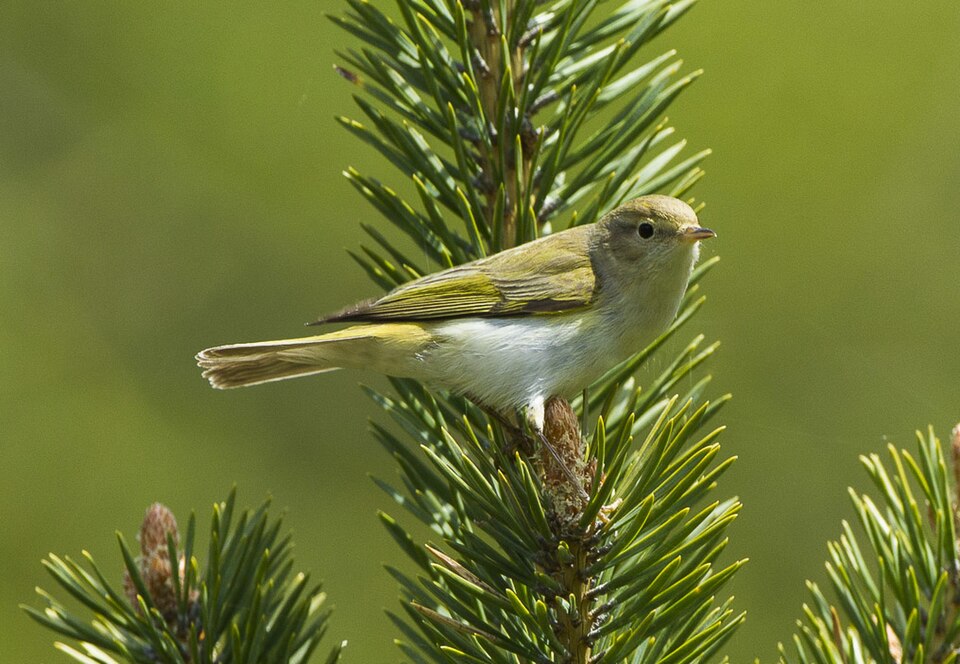
A pale, low-contrast leaf warbler that looks greyer and whiter than any other. The upperparts are grey-green to grey-brown, the underparts silky white with no trace of yellow on throat, breast or flanks. Three things do carry colour, and those three make the bird: a bright yellow rump, a yellow-green panel on the closed wing formed by the yellow fringes of primaries and secondaries, and yellow-green edges to the tail feathers. The head looks strikingly open and expressionless — a short, diffuse whitish supercilium, a large dark eye in a blank face, no real eye-stripe. The lower mandible is orange to flesh, the legs grey-brown. The primary projection is long, about three-quarters of the tertial length. Sexes alike; juveniles are warmer brown with a duller rump.
Confusion species
Wood Warbler is bigger and far more strongly marked: vivid yellow throat and breast against a snow-white belly, where Bonelli's is white right up to the chin. Chiffchaff is browner and darker-legged, lacks the yellow rump and wing panel, and constantly dips its tail; Willow Warbler is more suffused with yellow and has pale legs. The real problem is Eastern Bonelli's Warbler — see its own species page, where the same difference is set out from the other side. That bird is a shade greyer and whiter still, with less green in wing and rump and a slightly longer, heavier bill, but in the field those differences overlap completely and settle nothing. The voice does settle it: Western gives a soft, disyllabic hoo-eet, Eastern a hard monosyllabic chip. Mind the trap: that hoo-eet sounds very like a Willow Warbler.
Habitat
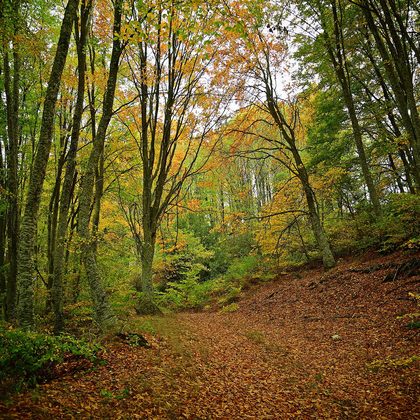
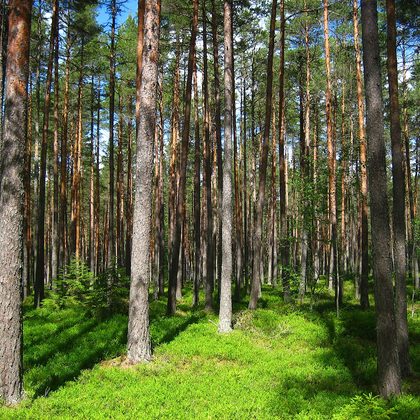
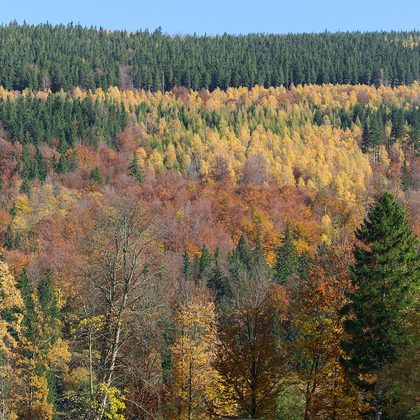
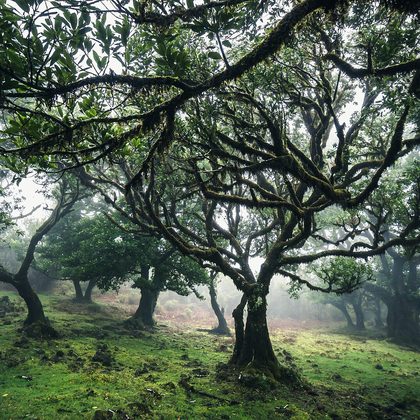
Open, dry, elevated woodland on sunny slopes: Pyrenean and downy oak woods that hold their dead brown leaves through winter, mixed oak and pine, old pinewood with a thin low understorey, sweet chestnut, and warm holm-oak hillsides. The signature is tall, well-spaced trees over a sparse shrub layer; dense, damp, closed woodland is avoided. In Iberia the bulk of the population sits between 500 and 2,000 metres, in the Alps and Pyrenees up to the highest woodland, and in the Maghreb in the cedar and oak forests of the Atlas. The nest is a domed ball on the ground, tucked against a bank or under a tussock.
Where the bird is most at home, classified with EUNIS — the European standard for habitats.
Range and movements
A breeding bird of the western Mediterranean: Iberia, the land south of roughly a line from the Seine estuary to the Adriatic, the Italian peninsula and the Maghreb. It winters in the western and central Sahel. Iberia is the core, with roughly two-thirds of the European breeding population, mainly in the northern mountains — the Sierra de Guadarrama, the Iberian System, the Cantabrian range, the Pyrenees — with southern strongholds in the mountains of eastern and western Andalusia, from Cazorla to Grazalema. It is absent from the Balearics and the Canaries. It arrives in April and has mostly left by the end of August, earlier than almost any other woodland migrant. In north-western Europe it is a scarce but near-annual vagrant, most records singing males in May and early autumn birds already in the second half of August and in September.
- Breeding (summer)
- Passage
- dark = core range, pale = thinly spread
How and when to look
The second and third weeks of May, in an old pine or oak wood on a sunny slope in the Iberian sierras or the Cévennes, from sunrise onward. Do not search — stand and listen. The dry rattle carries, while the bird itself stays high and restless in the canopy. Follow the song until you get it in sunlight, then watch for two things at once: the clean white throat and the yellow rump, which only flares as the bird turns or flies. Good addresses: the oak woods of the Sierra de Guadarrama, the woods of the Iberian System, and the pine woods of Cazorla and Segura. In north-western Europe, May is also the month to listen in coastal pine and dune woodland for the call — a Willow-warbler-like hoo-eet repeated for hours from the same treetop.
Conservation status
Not threatened, and stable over most of its range. On the northern edge, however, numbers have fallen, most likely because open slope woodland closes over once grazing stops. Drought in the Sahel remains, as for every trans-Saharan migrant, the great unknown.
Scientific name
Phylloscopus bonelli | (Vieillot, 1819)
Vieillot described the species in 1819 as Sylvia bonelli; because it was later moved to another genus, the author and year stand in brackets. The genus Phylloscopus was introduced in 1826 by Boie. Phylloscopus is Greek, from phullon 'leaf' and skopos 'seeker', from skopeō 'to watch': the bird that searches the foliage. bonelli honours the Italian zoologist Franco Andrea Bonelli (1784–1830), who curated the natural history collections at the University of Turin. The specimen the first description was based on came from Piedmont.