All species › Waders, gulls and terns › Sandpipers and snipes › Spotted Redshank
Spotted Redshank | Tringa erythropus
Zwarte ruiter | Archibebe oscuro
The Spotted Redshank is a slim, long-legged shank: sooty black flecked with white in summer, pale grey above and gleaming white below in winter. A bird found on the mud in August is usually caught halfway through the moult, with black patches showing through a grey plumage.

Click a thumbnail to switch the photo above.
Voice
Vocal, including on migration, and often heard before it is seen. The flight call is a sharp, disyllabic chu-it, higher and more piercing than anything Redshank or Greenshank produces. When uneasy on the flats it gives a short, hard chip, often repeated. In late summer and autumn the call carries at night over inland country as birds shift from pool to pool.
Recording: Jens Loose — CC BY-SA 4.0 · Wikimedia Commons
Identification
Slimmer and longer-legged than a Redshank, with a strikingly long, needle-fine bill that droops slightly at the tip and shows red only at the base of the lower mandible. Summer adults are wholly sooty black with fine white scaling above, the legs then dark red to almost black. In winter plumage pale grey above and white below, with a clear white supercilium in front of the eye and bright red legs. In flight the broad white trailing edge of a Redshank is entirely absent; instead a narrow white oval runs as a wedge up the back, and the feet project well beyond the tail. First-years are finely dark-barred on belly and flanks and so look far dirtier than the clean-plumaged winter adults.
Confusion species
Redshank is shorter in leg and bill, warmer brown, and shows broad white trailing edges to both wings in flight — that alone settles it. Greenshank is paler and heavier, with olive-green legs and a thicker, slightly upturned bill, and its call has three syllables where the Spotted Redshank's has two. Marsh Sandpiper is considerably smaller and finer, with a needle-straight bill lacking any red and greenish-grey legs. A shank swimming in deeper water or up-ending is, in north-west Europe, almost always this species.
Habitat
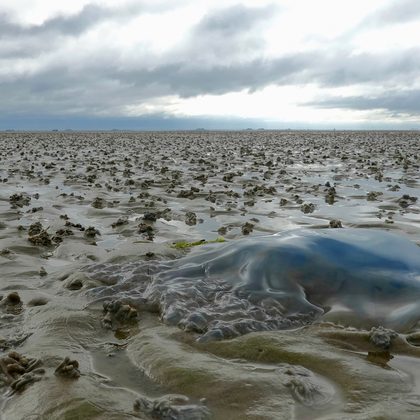
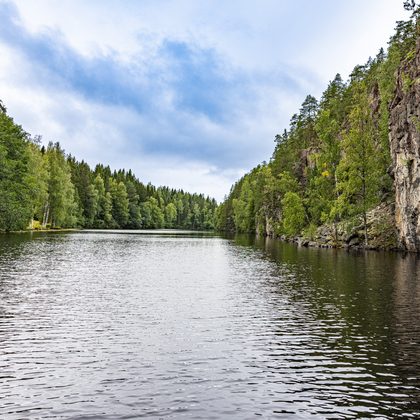
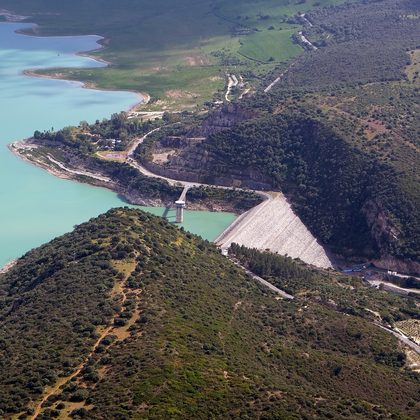
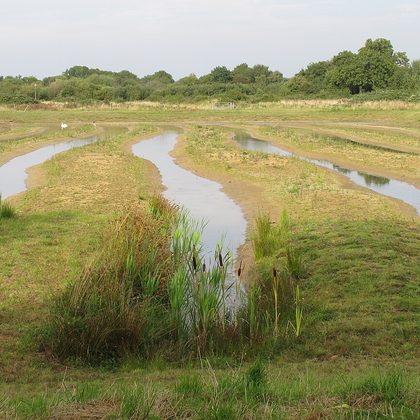
On passage it uses shallow fresh to brackish pools, clay pits, sheltered lagoons behind the sea wall, wet grassland and the muddy edges of creeks; on tidal flats it will wade in to its belly. It feeds more actively than most waders — running, swimming, sometimes sweeping the water in a loose group — taking shrimps, small fish, worms and aquatic insects. It breeds far north on open marshy tundra and in the tree-limit zone among sphagnum and dwarf birch.
Where the bird is most at home, classified with EUNIS — the European standard for habitats.
Range and movements
Breeds in northern Scandinavia and across the tundra of the far north-east of Europe and Siberia, from Lapland east beyond the Yenisey. The southern North Sea coast sits on the flyway: adults in full summer plumage appear in late April and early May, the largest numbers in July and August, spread over the Delta, the Wadden coast and the clay pits of the river district. It winters chiefly around the Mediterranean and in the Sahel; in Iberia it stages in Doñana, the Ebro delta and the saltpans of Cádiz, where birds linger into March.
- Resident
- Breeding (summer)
- Winter
- Passage
- dark = core range, pale = thinly spread
How and when to look
From late April to mid-May look on shallow freshwater pools for adults in full summer dress — four or five sooty birds stand out at several hundred metres. In July and August moulting adults and later the first-years work the muddy edges; at high tide try the lagoons and wet fields behind the sea dyke. Avoid working into the light: the contrast between a black bird and glittering water erases every detail.
Conservation status
Least Concern globally. The European breeding population in Fennoscandia and the far north-east of Europe appears reasonably stable, though the trend is poorly known because the breeding grounds are barely surveyed. Numbers on passage here swing widely from year to year with breeding success in the north, which in turn tracks rodent and insect years. Along the flyway the loss of shallow brackish pools and disturbance at moulting sites are the main concerns.
Scientific name
Tringa erythropus | (Pallas, 1764)
Pallas described the species in 1764 as Scolopax erythropus; because it was later moved to another genus, the author and year stand in brackets. The genus Tringa was introduced in 1758 by Linnaeus. Tringa is the Neo-Latin name Aldrovandi gave to the green sandpiper, after Ancient Greek trungas, a thrush-sized, white-rumped, tail-bobbing wading bird mentioned by Aristotle. erythropus is Greek, from eruthros 'red' and pous 'foot', after the red legs. The specimen the first description was based on came from Holland.