All species › Waterfowl › Ducks, geese and swans › Smew
Smew | Mergellus albellus
Nonnetje | Serreta chica
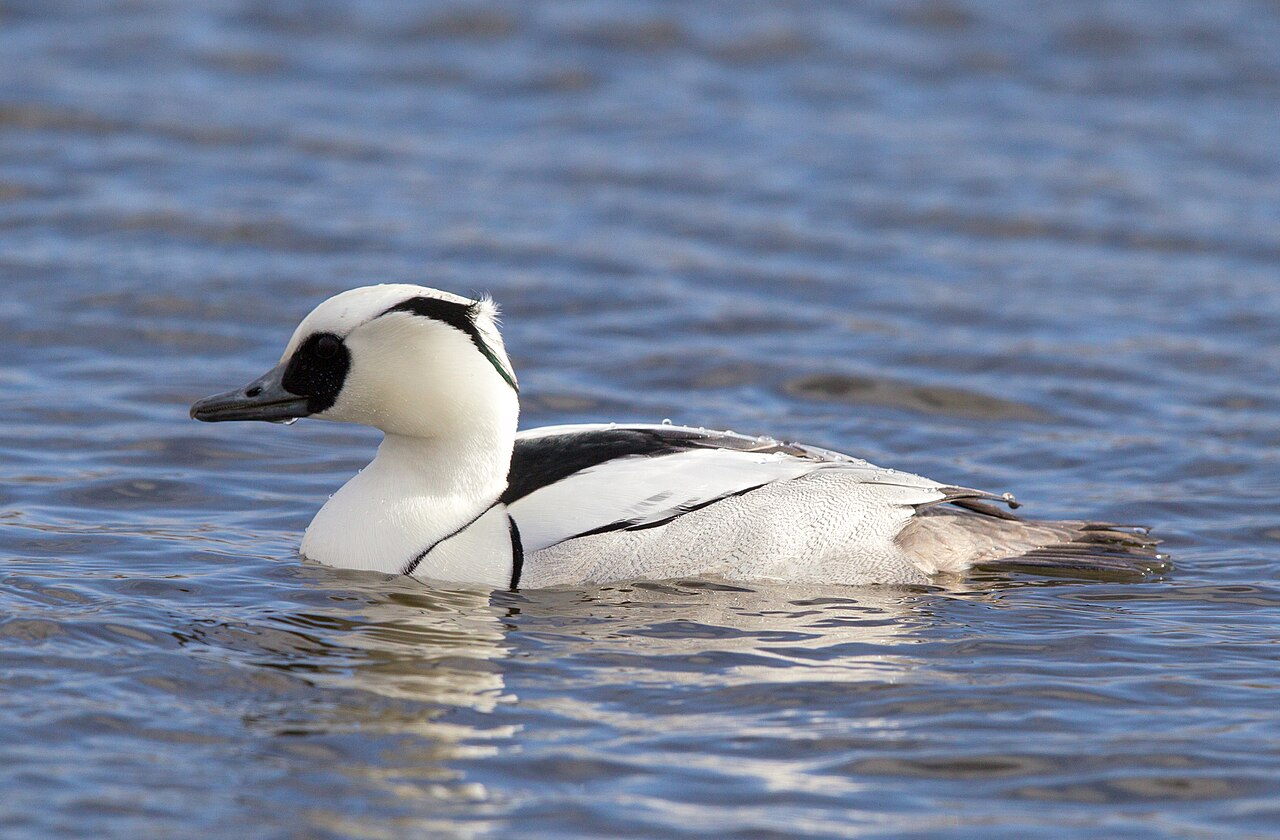
Europe's smallest sawbill and a genuine bird of hard winters. The drake is snow-white traced with fine black lines, like crackle glaze over porcelain, while females and young birds are grey with a chestnut cap.
Click a thumbnail to switch the photo above.
Voice
Usually silent. Displaying drakes give a soft, creaking krruh-krruh and a mechanical rattle that barely carries over water; females a low kerr. Only worth listening for in February and March, and then only from parties displaying at close range.
Recording: Stanislas Wroza — CC BY-NC-SA 4.0 · Wikimedia Commons
Identification
The drake is mainly white with a black eye patch, black lines across the neck and flanks and a black back. Females and immatures, the so-called redheads, have a red-brown cap reaching below the eye, cut cleanly against a white cheek and throat. The bill is short, grey and hooked; in flight the drake shows a large white wing panel.
Confusion species
Redheads are confused with female Goldeneye and with Horned Grebe. Goldeneye is larger, with a darker brown head lacking the sharp white cheek and a peaked, triangular head shape. On Smew the border between chestnut cap and white cheek is knife-sharp, and the bird looks compact with a stubby bill.
Habitat
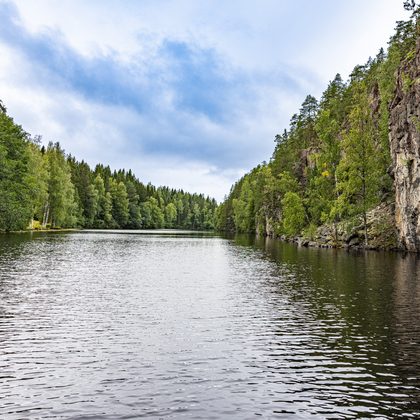
Deep, clear fresh waters, large lakes, sand pits and quiet rivers; in hard frost birds move to whatever open water remains around the IJsselmeer and occasionally into brackish harbours. Breeds in tree holes in the northern taiga, often in old Black Woodpecker nests beside forest lakes.
Where the bird is most at home, classified with EUNIS — the European standard for habitats.


Range and movements
Breeds in Fennoscandia and the north of eastern Europe and Siberia and winters in north-west and central Europe. The southern North Sea coast, with the IJsselmeer, the Randmeren and the large rivers, is one of the key wintering areas. In Iberia it is a rare vagrant, appearing only during extreme cold spells.
- Resident
- Breeding (summer)
- Winter
- Passage
- dark = core range, pale = thinly spread
How and when to look
Go out in January or February, ideally after an easterly cold spell. Scan early in the morning from a dyke: Smew dive as a group and their whiteness picks them out at a kilometre or more.
Conservation status
The world population is stable. Threats are drowning in set gill nets, disturbance of moulting and wintering flocks by watersports, and loss of old hole-bearing trees on the breeding grounds.
Scientific name
Mergellus albellus | (Linnaeus, 1758)
Linnaeus described the species in 1758 as Mergus albellus; because it was later moved to another genus, the author and year stand in brackets. The genus Mergellus was introduced in 1840 by Selby. Mergellus is a diminutive of Latin mergus, from mergere 'to dive', used by Pliny for an unspecified diving bird. albellus is a Latin diminutive of albus 'white', after the largely white plumage of the male. The specimen the first description was based on came from the Mediterranean near Izmir.